
Clinical picture. M., a woman in her early forties, presented with chronic exhaustion and recurrent anxiety ahead of professional deadlines. She described reviewing her work repeatedly past midnight, yet feeling no reassurance. During a session using the psychoeducational sheet on rules and assumptions, the clinician invited her to trace the shared thread across work, friendships, and family: she consistently over-prepared and apologised preemptively. Together they articulated the underlying rule: "If I am not perfectly prepared, I will be exposed as incompetent and lose everything." M. noted, with some surprise, that writing it down made it look like a sentence rather than a fact. A modest first step was agreed: she would submit one low-stakes piece of work without a final review pass, and observe what actually followed.
Modifying Rules and Assumptions: PDF Worksheet, Tools and Exercises
A printable PDF fiche and concrete exercises to help clinicians explain conditional beliefs, surface their costs, and guide patients toward more flexible rules in session.
Clinical vignettes
Spotting the Rule Behind Overwork
Rewriting a Childhood Shield
Clinical picture. T., a man in his late thirties, sought help after a close friendship ended when he declined a request for financial support. His presenting concern was guilt, but early sessions revealed a broader pattern: he rarely expressed a need of his own and became distressed when others were displeased with him. Using the worksheet, the clinician asked what would be so bad about not fixing someone else's distress, and they worked down that ladder until T. identified the rule: "If I'm not useful, I'm not worth keeping." The clinician acknowledged explicitly that this rule had once made sense, orienting T. toward its protective origins rather than inviting contempt for it. Over the following weeks, T. experimented with stating one small preference per day, tracking whether the feared outcome materialised; the disconfirming evidence became material for revising the rule's wording toward something more conditional and less absolute.
Intermediate beliefs, the conditional rules and assumptions that sit between core beliefs and surface-level automatic thoughts, are one of the most clinically productive levels of the cognitive model, and one of the hardest to make tangible for patients. Explaining them verbally tends to produce polite agreement rather than genuine recognition. This fiche PDF gives you a structured visual scaffold to change that, right inside the session.
Use this resource with your patients
Handout, exercises and materials ready to use, right inside SessionFuel.
Why Rules and Assumptions Are Difficult to Explain Verbally
The problem is phenomenological. Rules and assumptions don't feel like rules to the patient, they feel like accurate descriptions of reality. A patient governed by "If I'm not perfect, I'll be rejected" doesn't experience that sentence as a belief she chose; she experiences it as something she simply knows. Naming this in the abstract rarely creates the shift you need.
The second difficulty is the dual function of the rule: it costs the patient something, but it also delivers something (structure, safety, approval, the absence of feared outcomes). Any psychoeducation that treats rules purely as distortions to discard will meet resistance, because the patient is right that the rule does something useful. That ambivalence needs to be visible, not just spoken.
A third difficulty specific to this level of the cognitive model: patients often confuse intermediate beliefs with either core beliefs (too deep, too diffuse) or automatic thoughts (too surface, too reactive). Without a clear diagram showing how these three levels relate to each other, the distinction collapses in the patient's mind. This is precisely what a visual support resolves where the spoken word cannot.
What the Fiche Contains: Mapping the Rule from Self-Image to Behaviour
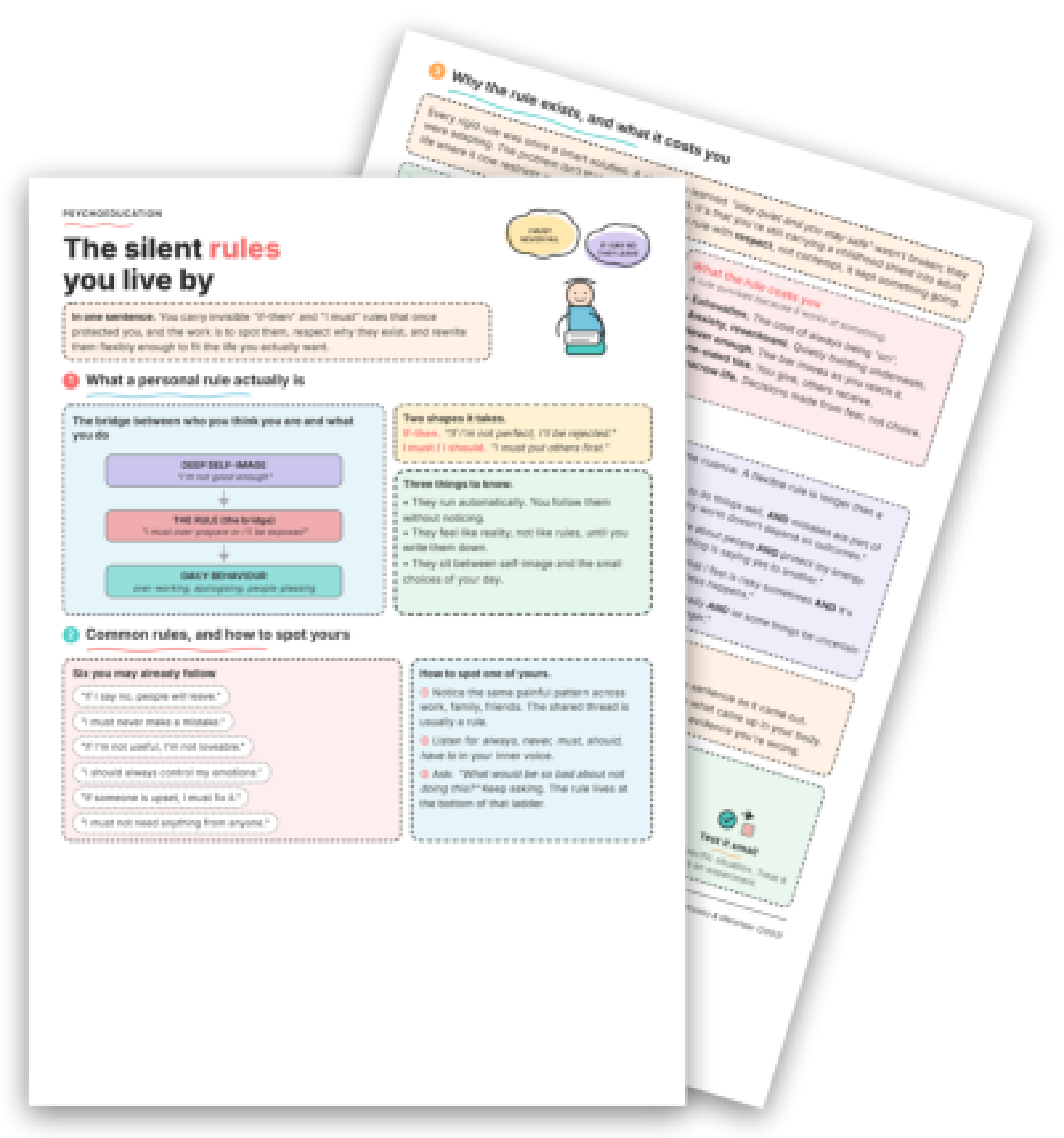
The fiche PDF unfolds across four named panels, grounded in Beck's cognitive model and in schema therapy (Padesky, 1994; Young, Klosko & Weishaar, 2003).
The first panel, "What a personal rule actually is," provides a three-level diagram: a deep self-image (e.g., "I'm not good enough"), the rule as bridge (e.g., "I must over-prepare or I'll be exposed"), and the resulting daily behaviours (overworking, apologising, people-pleasing). This visual alone resolves the patient's confusion between levels in seconds. The two surface forms, if-then and I must / I should, are named and illustrated. Three bullet points make the automaticity explicit: rules run without notice, feel like reality until written down, and live between self-image and daily micro-decisions.
The second panel offers six common rules drawn from across the domains of relationships, performance, and self-worth, alongside three concrete methods for spotting the patient's own: noticing the same painful pattern across contexts, listening for always, never, must, should, have to in inner speech, and using a downward-arrow logic ("What would be so bad about not doing this?").
The third panel is clinically distinctive: a two-column layout opposing what the rule gives the patient and what it costs them. Both columns are explicitly required. This structure operationalises the cost/benefit analysis that standard psychoeducation often skips, and it directly addresses the ambivalence that makes rule-modification so slow.
The fourth panel presents four worked rewrites, each using AND rather than OR as the logical connector. The rewriting logic is stated plainly: "A flexible rule is longer than a rigid one, that's normal." The examples cover perfectionism, boundary-setting, vulnerability, and control, which map cleanly onto the presentations you see most often in weekly practice.
A final section, "To discuss in session," provides three debriefing prompts for use after the patient takes the sheet away.
> Key point: This fiche is a visual support that facilitates the explanation of rules and assumptions during the session itself. It is not a questionnaire patients complete independently; it is a working document the clinician uses alongside the patient to make a complex cognitive level immediately legible.
750+ clinical tools
A library built with and for clinicians, ready to use in session and extend between appointments.
Access all the toolsWhen and How to Introduce the Fiche
Timing matters. The fiche fits best after the initial formulation phase, once you and the patient share a working understanding of their core beliefs, typically from session four onward when using a standard CBT case formulation. If you are working within schema therapy, it slots in naturally as a bridge between identifying early maladaptive schemas and beginning mode work.
Introduce it with a single concrete sentence, for example: "I want to show you something about the unspoken rules that seem to be driving what we've been describing. Let's look at this together." Avoid labelling the patient's rules as distortions at this stage, the fiche's own framing ("treat the rule with respect, not contempt, it kept something going") models the tone you want to establish from the start.
Profiles who benefit most include patients presenting with perfectionism, people-pleasing, approval-seeking, or all-or-nothing thinking, as well as those who find cognitive distortions work insufficient because the distortions keep regenerating from an unaddressed rule. The fiche also opens a natural entry point for the downward-arrow technique when a patient has difficulty identifying the rule spontaneously.
Debrief the third panel first, the costs and benefits, before moving to the rewriting section. Patients who feel heard about why the rule exists are reliably more willing to test a modified version in a specific real-world situation. You can then assign the demandingness exercise or a new core belief consolidation exercise as between-session work.
One practical contraindication: with patients in acute crisis or with severe dissociation, the three-level diagram can amplify cognitive overwhelm. In those contexts, hold the fiche until stabilisation is established.
The fiche leaves patients with a written, personalised version of their own rule alongside a rewritten alternative, a concrete trace to bring back and refine across subsequent sessions.
Use it with your patients
Share this tool in the mobile app and follow the work between sessions.
Sources
- Beck, J. S. (2021). Cognitive Behavior Therapy: Basics and Beyond (3rd ed.). Guilford Press.
- Greenberger, D., & Padesky, C. A. (2016). Mind Over Mood: Change How You Feel by Changing the Way You Think (2nd ed.). Guilford Press.
- Beck, A. T., Freeman, A., & Davis, D. D. (1990). Cognitive Therapy of Personality Disorders. Guilford Press.
Your session continues in your patients' pocket
Use with a patientYour resources, available everywhere
The handouts, exercises, programs and audios above: you choose which ones to make available to your patients, in the mobile app dedicated to them.
And far more than a library
The app goes well beyond resources, to support your patients every day:
Related categories
Explore other clinical resources by category.

Identity
Clinical resources for self-identity work in therapy: CBT, ACT, schema tools for clinicians addressing self-concept, core beliefs, and identity disruption.

Relationships
Clinical worksheets and tools on relational functioning: attachment, schemas, assertiveness, and communication skills for therapists. Printable PDF resources.

Cognition
Printable cognitive therapy worksheets and clinical tools for therapists: CBT, ACT, schema work, defusion, distortions, and belief restructuring.

Build awareness
Clinical worksheets and tools to build awareness in therapy: cognitive distortions, schemas, emotions, ACT and CBT resources for practitioners.

Restructure
Clinical hub for cognitive restructuring worksheets: distortion identification, belief disputation, ABC model, and schema work for evidence-based practice.

CBT
CBT worksheets, cognitive restructuring exercises & behavioral tools for clinicians. Evidence-based resources for every phase of cognitive behavioral therapy.