
Clinical picture. T., a woman in her late thirties, presented with recurrent depressive episodes and a longstanding pattern of intense distress following perceived social slights. In session, she described a near-paralyzing sadness after a colleague failed to acknowledge her contribution during a team meeting. The clinician introduced the four-step worksheet and invited T. to name the emotion, locate it in her body, and then identify the precise moment the feeling spiked. Working through step two, T. recognized a familiar internal line: "I am invisible to people who matter," a belief she traced back to chronic emotional unavailability in her family of origin. By session end she had drafted a balanced alternative sentence she rated as roughly 65% believable, and agreed to one small act of self-acknowledgment before the next appointment.
Schema-Focused Cognitive Restructuring: PDF Worksheet, Tools and Exercises
A visual PDF worksheet helping clinicians guide patients from a disproportionate emotional reaction back to the early maladaptive schema driving it, step by step in session.
Clinical vignettes
Abandonment Schema Behind a Workplace Slight
Defectiveness Belief Activated by a Correction
Clinical picture. M., a man in his mid-forties referred for generalized anxiety, described a disproportionate shame response after his supervisor corrected a minor error in a report. He arrived convinced the incident confirmed he was fundamentally incompetent, despite a consistently strong performance record. The clinician used the worksheet to help him slow the sequence: the body sensation (heat rising to the face, sudden fatigue), the automatic thought ("One mistake and they will see through me"), and the underlying schema of incompetence he had carried since a highly critical home environment in adolescence. Examining the evidence he had been skipping, M. identified several recent successes the belief had filtered out and formulated a more contingent self-appraisal. He left with a concrete action: to note, once daily, a task completed adequately, without qualification.
When a patient's reaction to a minor slight is wildly out of proportion to the trigger, explaining schema activation verbally rarely lands on the first attempt. The patient hears the theory; they do not feel the mechanism. This PDF worksheet gives you a concrete, visual scaffold to slow the moment down, and work through it together.
Use this resource with your patients
Handout, exercises and materials ready to use, right inside SessionFuel.
Why schema activation resists verbal explanation
The core clinical difficulty is that early maladaptive schemas operate as pre-attentive lenses. The patient is not choosing to overreact; the schema has already colored the perception before conscious appraisal can intervene. Telling someone "this reaction belongs to an old story, not the present event" is accurate, but it stays abstract. Without a structured sequence to follow, patients default to either defending their reaction or intellectualizing it, two routes that bypass the somatic and affective processing you actually need.
The other common sticking point is the "balanced thought" instruction. Patients trained in standard cognitive restructuring often produce a hollow positive reframe, exactly what the fiche calls a "glossy 100% positive one that feels hollow inside." The schema, especially in the defectiveness, abandonment, or failure schema territory, simply waits it out. Without grounding the new thought in evidence and calibrating it to a believable 60%, the exercise collapses.
What the fiche contains, and what the visual layout makes possible
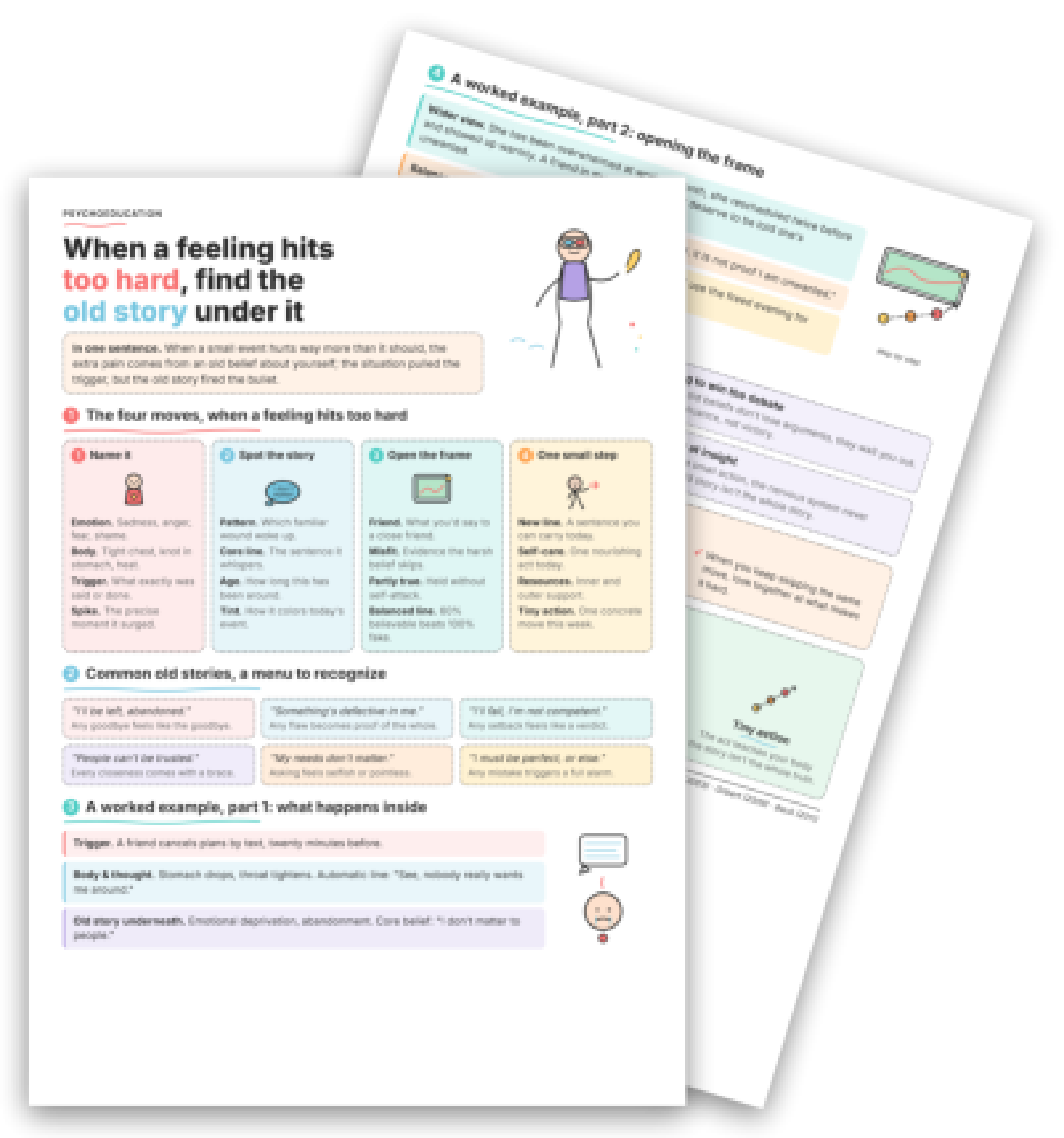
The fiche is organized into five numbered panels that function as a shared visual map during the session, not a questionnaire the patient fills in alone at home.
- Panel 1: The four moves leads patient and clinician through naming the emotion and body sensation, identifying the trigger and the precise spike moment, then surfacing the "old story underneath", its core line, its age, and how it "tints today's event."
- Panel 2: A schema recognition menu lists six common early maladaptive schemas (abandonment, defectiveness, failure, mistrust, emotional deprivation, and unrelenting standards) with one-line behavioral signatures. Pointing to this list mid-session often does what ten minutes of verbal description cannot.
- Panels 3 and 4 walk through a fully worked example (a friend cancels plans by text; automatic thought: "See, nobody really wants me around") showing both the internal schema activation and the reframing sequence, right down to a balanced sentence and a concrete tiny action.
- Panel 5: Pitfalls names four common failure modes: skipping somatic grounding, trying to win the cognitive debate, writing a fake new thought, and stopping at insight without behavioral follow-through.
The visual layout makes one thing legible that oral explanation rarely achieves: the four-step sequence is non-linear in experience but must be followed in order. Patients can see at a glance where they are and where they have stalled. That spatial orientation alone often breaks the therapeutic impasse.
> Key point: this fiche is a visual support that facilitates in-session explanation; it externalizes the schema-activation sequence so patient and clinician can look at it together, name what is happening, and move forward without the patient having to hold the entire model in working memory.
750+ clinical tools
A library built with and for clinicians, ready to use in session and extend between appointments.
Access all the toolsWhen and how to introduce the fiche
The worksheet fits naturally from the middle phase onward, once the therapeutic alliance is established and at least one core belief has been identified. It is particularly useful when schema bias is visibly maintaining symptoms, or when standard cognitive restructuring keeps producing unconvincing alternatives.
Introduce it around a live example rather than as a teaching document. A formulation such as "There's a pattern in what you've just described, would you be willing to map it together on this sheet?" keeps the tone collaborative and grounds the work in something the patient already experienced this week. For abandonment-schema presentations in particular, doing the mapping in-session before sending the sheet home builds the somatic familiarity the exercise requires.
Debrief the "tiny action" box explicitly: the fiche emphasizes that "without one small action, the nervous system never learns the old story isn't the whole story." Linking it to a clarifying core belief exercise or a new belief reinforcement exercise as between-session work consolidates what the in-session mapping opened. For patients who keep stalling at the reframing step, pairing the fiche with the downward arrow technique or tracing a thought back to its core belief can help locate exactly which schema is driving the resistance.
The fiche does not replace schema mode work or the longitudinal formulation; it operationalizes one of its central micro-interventions and makes it portable.
Use it with your patients
Share this tool in the mobile app and follow the work between sessions.
Sources
- Young, J. E., Klosko, J. S., & Weishaar, M. E. (2003). Schema Therapy: A Practitioner's Guide. Guilford Press.
- Young, J. E., & Klosko, J. S. (1993). Reinventing Your Life: The Breakthrough Program to End Negative Behavior and Feel Great Again. Plume/Penguin.
- Rafaeli, E., Bernstein, D. P., & Young, J. E. (2011). Schema Therapy: Distinctive Features. Routledge.
- Thimm, J. C., & Chang, M. (2022). Early Maladaptive Schemas and Mental Disorders in Adulthood: A Systematic Review and Meta-analysis. International Journal of Cognitive Behavioral Therapy.
Your session continues in your patients' pocket
Use with a patientYour resources, available everywhere
The handouts, exercises, programs and audios above: you choose which ones to make available to your patients, in the mobile app dedicated to them.
And far more than a library
The app goes well beyond resources, to support your patients every day:
Related categories
Explore other clinical resources by category.

Identity
Clinical resources for self-identity work in therapy: CBT, ACT, schema tools for clinicians addressing self-concept, core beliefs, and identity disruption.

Emotions
Clinical resources on emotion regulation: worksheets, coping tools, CBT, REBT, and ACT exercises for therapists working across diagnoses and age groups.

Cognition
Printable cognitive therapy worksheets and clinical tools for therapists: CBT, ACT, schema work, defusion, distortions, and belief restructuring.

Build awareness
Clinical worksheets and tools to build awareness in therapy: cognitive distortions, schemas, emotions, ACT and CBT resources for practitioners.

Restructure
Clinical hub for cognitive restructuring worksheets: distortion identification, belief disputation, ABC model, and schema work for evidence-based practice.

Repair & soothe
Clinical resources for the repair and soothe therapeutic aim: worksheets, exercises and tools to build self-compassion, reduce shame and restore emotional safety.