
Clinical picture. M., a 34-year-old teacher, presented with longstanding social anxiety centred on staff meetings, reporting that her distress began well before each event and persisted for days afterward. Her clinician introduced the three-stage framework as a psychoeducational worksheet, walking through the anticipation, in-the-moment self-focus, and post-event replay phases in sequence. M. recognised her own pattern immediately, noting that she had always experienced the anxiety as one undifferentiated mass rather than three distinct, linked processes. In the following session she reported that labelling her Sunday-evening worry as "the BEFORE phase" had reduced its felt urgency, though it had not eliminated it. She described this as a modest but meaningful shift in her relationship to the cycle.
Stages of Social Anxiety: PDF Worksheet, Tools and Exercises for Clinical Practice
A visual psychoeducation fiche PDF mapping the three-phase loop of social anxiety, tools and exercises to use in session and build a shared clinical vocabulary.
Clinical vignettes
Naming the Phase, Breaking the Loop
Post-Event Rumination as a Therapeutic Entry Point
Clinical picture. T., a 28-year-old graduate student, sought help after withdrawing from seminars; he described the problem as replaying conversations for up to two days after each class, searching for proof that he had embarrassed himself. His clinician used the three-stage model to locate his dominant difficulty in the post-event phase, which reframed the rumination not as a character flaw but as one node in a closed loop. T. was visibly relieved to learn that intervening at the replay stage, without first resolving his anticipatory anxiety, could still weaken the overall cycle. He agreed to a targeted behavioural experiment focused on limiting post-event analysis to a fixed ten-minute window. At review two weeks later he reported attending two seminars, with noticeably less preparatory dread than he had anticipated.
Patients with social anxiety often arrive having lived through hundreds of cycles without ever naming the three phases that drive them. Explaining the anticipation-self-focus-replay loop verbally tends to produce a vague "yes, that sounds like me", without the structural clarity needed to actually interrupt anything. This fiche PDF gives that structure a visual form, making the three-stage model workable in session within minutes.
Use this resource with your patients
Handout, exercises and materials ready to use, right inside SessionFuel.
Why the three phases resist verbal explanation
The Clark & Wells (1995) model is well-known to clinicians, but breaking it down in real time with a patient is harder than it looks. The BEFORE phase (anticipatory worry, rehearsing disaster, scripting every sentence) bleeds into the DURING phase (inward attention shift, safety behaviours, constructing a felt image of how you look and treating it as fact) and into the AFTER phase (post-event rumination, selective zoom on the one awkward second, reassurance-seeking). Patients rarely perceive these as three distinct mechanisms. They experience them as one undifferentiated dread.
Without a visual anchor, the concept floats. You explain self-focused attention; the patient hears "I overthink." You explain post-event processing; they hear "I replay things." The clinical precision is lost before you can use it. The fiche separates the three phases exactly enough to make each one actionable, and visible alongside the others.
For patients who also meet recognizable social anxiety disorder criteria, the model maps cleanly onto their lived experience; for those presenting with subclinical but functionally impairing patterns, it offers a framework that does not require a diagnostic label to be useful.
What the fiche contains: a visual map of the self-feeding loop
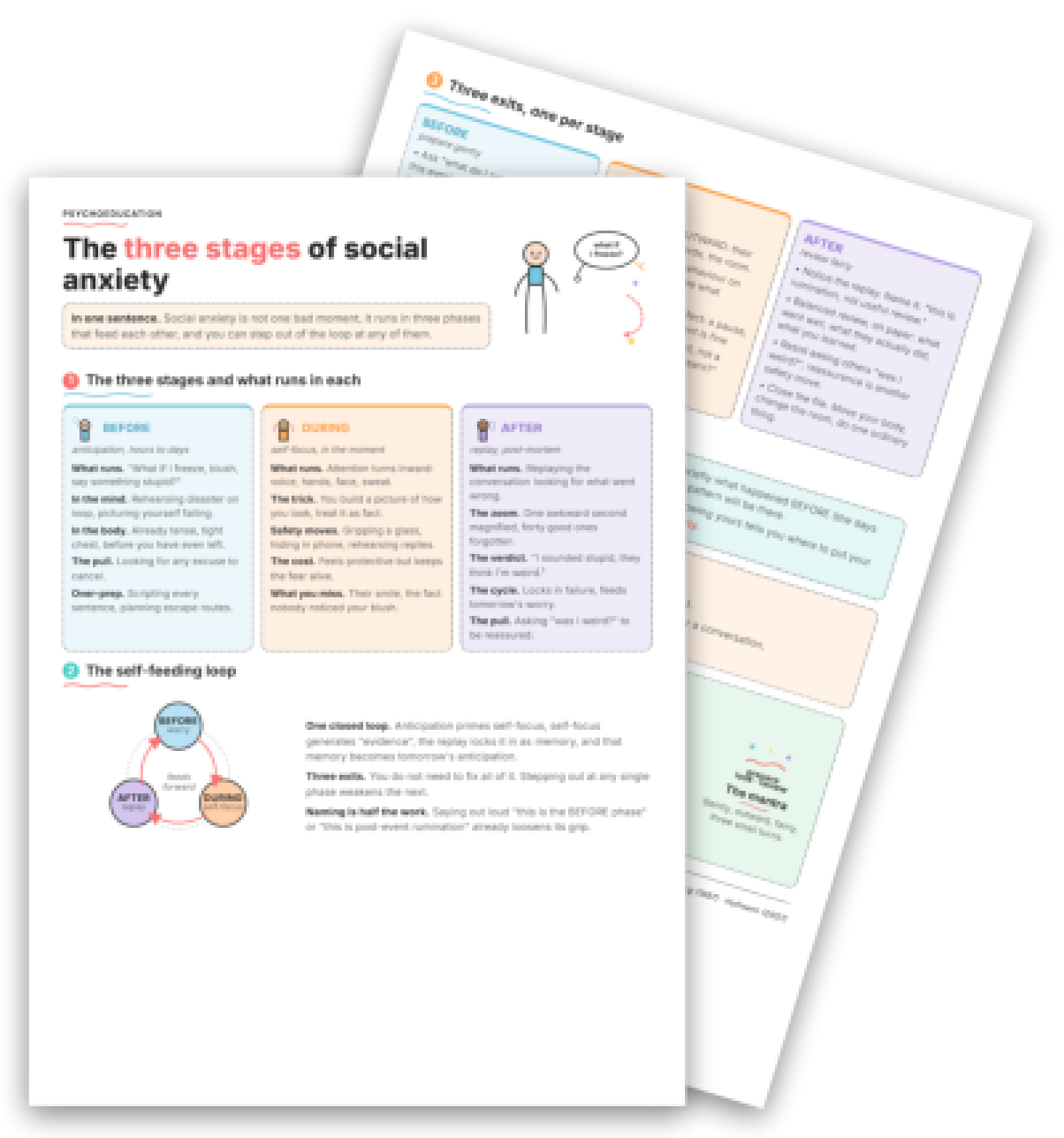
The fiche is organised into four sections, none invented, all grounded in the Clark & Wells (1995) and Rapee & Heimberg (1997) tradition.
The first section details what runs in each phase. For BEFORE: "Rehearsing disaster on loop, picturing yourself failing", tight chest already present before the patient has left the house, and the pull toward cancellation. For DURING: "Attention turns inward: voice, hands, face, sweat", with safety moves (gripping a glass, hiding in a phone, rehearsing replies) described precisely, the social anxiety safety behaviours your patient is likely already using without naming them. For AFTER: "Replaying the conversation looking for what went wrong", one awkward second magnified, forty good ones forgotten.
The second section diagrams the self-feeding loop: anticipation primes self-focus, self-focus generates "evidence," the replay locks it in as memory, and that memory becomes tomorrow's anticipation. Seeing this cycle of avoidance and internal maintenance drawn as a closed circuit is often the moment patients stop interpreting their distress as a character flaw.
The third section maps three exits, one per stage, prepare gently (BEFORE), look outward (DURING), review fairly (AFTER), with concrete moves listed under each. The mantra "prepare gently, look outward, review fairly" gives the patient a memorable phrase to carry out of session. The fourth section invites them to map one recent situation across all three phases and locate their heavy phase, the stage where their pattern bears down hardest. This feeds directly into prioritising intervention.
> Key takeaway: The fiche is a visual support you use in session to explain the three-phase loop; it is not a self-administered questionnaire, but a shared map that gives patient and clinician a common vocabulary from the first time the model is introduced.
750+ clinical tools
A library built with and for clinicians, ready to use in session and extend between appointments.
Access all the toolsWhen and how to propose the fiche in session
The fiche fits naturally at the psychoeducation stage of a CBT protocol for social anxiety, typically sessions 2 to 4, after initial functional analysis has identified core feared situations. It pairs well with the Clark & Wells model of social anxiety, and with a review of what the fiche calls the cost of safety behaviours: "Feels protective but keeps the fear alive."
A low-inference introduction: "I'd like to show you a map of what tends to happen for most people with social anxiety, before, during, and after a situation. Tell me whether it matches what you know of yourself." This framing invites self-recognition without diagnostic labelling.
Once you've worked through the fiche together, ask the patient to identify their heavy phase. A patient whose distress concentrates in AFTER will benefit from the structured exercises on post-event rumination before moving to exposure; understanding what distinguishes constructive from harmful rumination can then become explicit homework. A patient concentrated in BEFORE will need decatastrophising first, the anticipatory fear decatastrophizing exercise is a direct complement. When the time comes to build situational exposure, the fiche's groundwork makes a graded exposure hierarchy easier for the patient to accept.
For patients presenting with high perfectionism alongside social anxiety, frame the three exits explicitly as experiments, not standards: the fiche's own phrasing is "what will I learn?", which sidesteps the trap of turning psychoeducation into a new performance rule.
The social anxiety in relationships program and the Safety Behaviors worksheet are natural next steps once the three-stage map is in place. The fiche does not replace a full formulation or an exposure hierarchy; it lays the conceptual groundwork that makes both those steps easier to introduce.
Use it with your patients
Share this tool in the mobile app and follow the work between sessions.
Sources
- Clark, D. M., & Wells, A. (1995). A cognitive model of social phobia. In R. G. Heimberg, M. R. Liebowitz, D. A. Hope, & F. R. Schneier (Eds.), Social Phobia: Diagnosis, Assessment and Treatment (pp. 69-93). Guilford Press.
Your session continues in your patients' pocket
Use with a patientYour resources, available everywhere
The handouts, exercises, programs and audios above: you choose which ones to make available to your patients, in the mobile app dedicated to them.
And far more than a library
The app goes well beyond resources, to support your patients every day:
Related categories
Explore other clinical resources by category.

Anxiety
Clinical hub for anxiety disorders: CBT and ACT worksheets, psychoeducation sheets, and exercises for assessment and treatment across the anxiety spectrum.

Identity
Clinical resources for self-identity work in therapy: CBT, ACT, schema tools for clinicians addressing self-concept, core beliefs, and identity disruption.

Cognition
Printable cognitive therapy worksheets and clinical tools for therapists: CBT, ACT, schema work, defusion, distortions, and belief restructuring.

Build awareness
Clinical worksheets and tools to build awareness in therapy: cognitive distortions, schemas, emotions, ACT and CBT resources for practitioners.

Restructure
Clinical hub for cognitive restructuring worksheets: distortion identification, belief disputation, ABC model, and schema work for evidence-based practice.

CBT
CBT worksheets, cognitive restructuring exercises & behavioral tools for clinicians. Evidence-based resources for every phase of cognitive behavioral therapy.