
Clinical picture. J., a man in his late thirties presenting with recurrent low mood and occupational stress, described spending most Sunday evenings replaying a difficult conversation with his manager, asking himself repeatedly why he always said the wrong thing. During session, the clinician used the constructive-vs-harmful-rumination sheet to help J. notice that his loop was abstract, self-focused, and producing no new information after the first few minutes. Together they reformulated his central question from 'Why am I so bad at this?' to 'What is one thing I could clarify with my manager before Thursday?' J. identified a brief email he could send; his reported Sunday-evening distress dropped noticeably over the following fortnight, though the underlying pattern required continued work.
Constructive vs Harmful Rumination: PDF Worksheet, Tools and Exercises
A visual PDF worksheet with worked examples and clinical exercises to help patients distinguish productive self-reflection from the loops that erode them.
Clinical vignettes
Redirecting a 'Why' Loop in CBT
Psychoeducation Normalising a Repetitive Loop
Clinical picture. A., a woman in her mid-twenties with a recent diagnosis of generalised anxiety disorder, arrived at session distressed by what she described as 'thinking that goes in circles for hours' about why she never finished personal projects. The clinician introduced the informational sheet as a shared reference point, drawing her attention to the distinction between loops that end in one concrete step and those that tighten around self-appraisal. A. identified that her loop routinely crossed the 30-minute threshold with no new idea and left her feeling worse than when it began, matching several of the sheet's 'tipped into harmful mode' indicators. She left with a single reformulated question to test before the next appointment: what was the smallest next step on the one project she cared about most that week. The exercise did not resolve her avoidance pattern, but it gave her a concrete language to bring back the following session.
Many patients who ruminate defend the process as "thinking things through." That framing makes the clinical conversation harder: they are not simply avoiding the problem, they are convinced they are working on it. Nolen-Hoeksema's foundational work on response styles shows that what matters is not whether a person thinks about a difficulty, but how they think about it. Communicating that distinction verbally in session tends to produce polite nodding, not genuine recognition. This PDF worksheet is built to close that gap.
Use this resource with your patients
Handout, exercises and materials ready to use, right inside SessionFuel.
Why the Constructive / Harmful Distinction Resists Verbal Explanation
The central problem is phenomenological. Both types of loops feel like thinking, and patients with a strong intellectualizing defense are often the most prolific ruminators. When you describe the difference at the conceptual level, the patient assesses the description through the same loop you are trying to interrupt.
What is missing in a purely verbal explanation is contrast. Patients cannot reliably self-observe which pathway they are on while they are inside the loop. The distinction between asking "Why is this happening to me?" and asking "What is one thing I can do about this?" is simple to state, but without a visual anchor it stays abstract. This is exactly where structured self-monitoring exercises for rumination and a psychoeducation support like this worksheet earn their place in the session.
What the Worksheet Shows: A Visual Tool for In-Session Psychoeducation
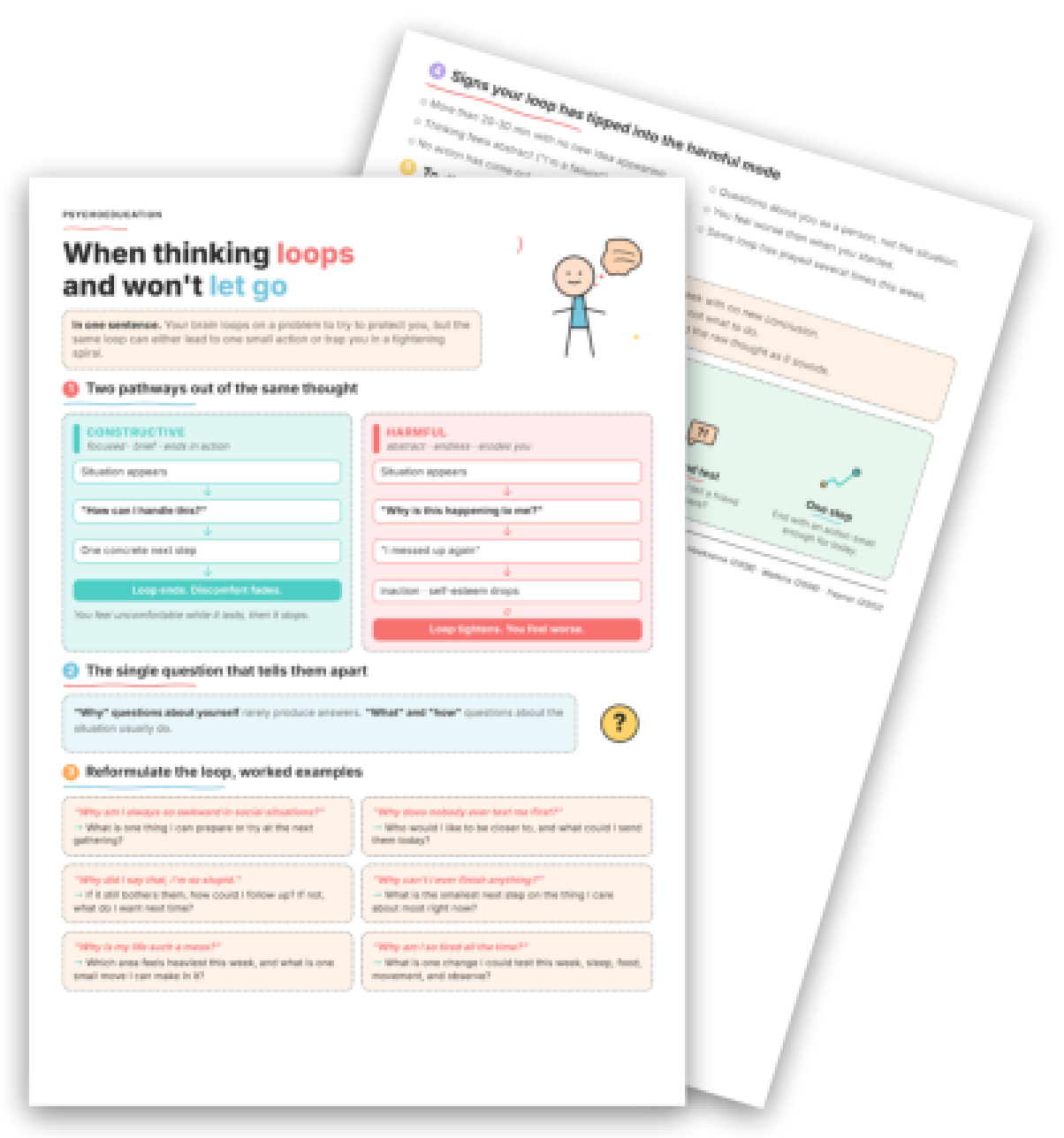
The fiche maps the same triggering situation across two diverging flowcharts, side by side on the page. The left column traces the constructive pathway: focused, brief, ending in one concrete next step and followed by the loop closing. The right column traces the harmful pathway: abstract, self-referential, generating inaction and a drop in self-esteem, then looping back on itself tightening. The visual opposition does in seconds what a verbal explanation takes several minutes to approximate.
Panel 2 then gives patients the single diagnostic question: whether their loop generates "why" questions about themselves versus "what" and "how" questions about the situation. The worksheet quotes verbatim: "'Why' questions about yourself rarely produce answers. 'What' and 'how' questions about the situation usually do."
Panel 3 provides six worked reformulations, moving from a harmful prompt ("Why am I always so awkward in social situations?") to a constructive one ("What is one thing I can prepare or try at the next gathering?"). These cover self-esteem, social withdrawal, self-criticism, procrastination, and fatigue, which means they map cleanly onto the presentations you encounter across generalized anxiety, depression, and perfectionism.
Panel 4 lists six observable signs that a loop has tipped into the harmful mode: more than 20-30 minutes with no new idea, questions about the person rather than the situation, abstract framing such as "I'm a failure", worsening mood, no action output, and the same loop recurring across the week. This is the part patients tend to annotate. It gives automatic thought monitoring work a concrete entry point.
The worksheet closes with four take-home anchors: swap why for what/how, time-box the loop to ten minutes then act or set it down, apply the friend test, and end with one action small enough for today. These translate directly into between-session assignments, and they connect naturally to a rumination psychoeducation program or to a standalone guided rumination audio for patients who need a somatic interrupt.
> Key point: the worksheet is a visual support for the clinician's in-session explanation, not a self-administered questionnaire. Its value comes from going through it together, panel by panel, so the patient builds the vocabulary during the encounter, not alone afterward.
750+ clinical tools
A library built with and for clinicians, ready to use in session and extend between appointments.
Access all the toolsWhen and How to Introduce It in Session
This worksheet fits naturally at mid-psychoeducation phase, once you have established the cognitive model and the patient has begun tracking their thoughts. It is particularly well-suited to patients who:
- Present with brooding as a depression maintenance factor
- Over-intellectualize and frame rumination as productive problem-solving
- Are working through worry and attention capture or thought utility evaluation
- Struggle to differentiate adaptive from maladaptive coping (see the adaptive vs maladaptive coping worksheet)
A neutral introduction might be: "I want to show you a diagram that maps two ways the mind can stay with a problem. Tell me which column feels more familiar." That framing positions the patient as the expert on their own loop, which protects the alliance and avoids a diagnostic label.
After the session, panel 5's "to discuss in session" prompts serve as a concrete debriefing grid: the patient is asked to bring back any loop that ran three times with no new conclusion, any why-am-I question about identity rather than action, or any moment when reformulating into what/how felt impossible. That structure makes the next session's agenda nearly automatic, and it extends naturally into ACT defusion work or catching automatic thoughts for patients ready to go further.
The worksheet does not replace the clinical formulation. What it does is give the patient a durable reference point, and give you a shared language that makes the rest of the cognitive work faster.
Use it with your patients
Share this tool in the mobile app and follow the work between sessions.
Sources
- Watkins, E. R. (2016). Rumination-Focused Cognitive-Behavioral Therapy for Depression. The Guilford Press.
Your session continues in your patients' pocket
Use with a patientYour resources, available everywhere
The handouts, exercises, programs and audios above: you choose which ones to make available to your patients, in the mobile app dedicated to them.
And far more than a library
The app goes well beyond resources, to support your patients every day:
Related categories
Explore other clinical resources by category.
Anxiety
Clinical hub for anxiety disorders: CBT and ACT worksheets, psychoeducation sheets, and exercises for assessment and treatment across the anxiety spectrum.

Mood
Evidence-based worksheets and clinical tools for mood disorders: CBT, ACT, and positive psychology resources for psychologists and therapists.

Identity
Clinical resources for self-identity work in therapy: CBT, ACT, schema tools for clinicians addressing self-concept, core beliefs, and identity disruption.

Cognition
Printable cognitive therapy worksheets and clinical tools for therapists: CBT, ACT, schema work, defusion, distortions, and belief restructuring.

Understand
Clinical hub for the therapeutic aim 'Understand': worksheets and tools to build patient insight across CBT, ACT, schema therapy and more.

Build awareness
Clinical worksheets and tools to build awareness in therapy: cognitive distortions, schemas, emotions, ACT and CBT resources for practitioners.