
Clinical picture. M., a woman in her mid-forties, presents with generalised worry centred on a benign but ambiguous finding from a recent scan; she reports difficulty concentrating at work and describes her mind as "constantly occupied." The clinician introduces the structured exercise, asking her to rate attentional capture: M. scores the worry at 8 out of 10 and, on reflection, acknowledges she has already received medical clearance and has no concrete action available today. When invited to consider whether she consents to giving this fear that much mental space, she pauses noticeably and says she had never framed it as a choice. By the following session she had begun using a brief redirecting practice (a short walk, then return to a task) and reported a self-rated drop to 5, with no change in the underlying uncertainty.
Managing Worry: A Structured Attentional Awareness Exercise
Help patients examine what drives their worry, assess controllability, and build genuine attentional flexibility through guided self-reflection.
Clinical vignettes
Chronic Health Anxiety, Attentional Capture
Work-Related Worry, Redirecting Attention
Clinical picture. P., a man in his early thirties with a history of burnout, brings a persistent worry about a performance review scheduled three weeks away; the concern intrudes during evenings and disrupts sleep onset. Working through the exercise questions in session, he identifies that one concrete step is within reach today: drafting a short list of completed projects to review with his manager. Scoring his attentional capture at 7, he acknowledges that the remaining portion of the worry pertains to outcomes he cannot influence before the meeting. The clinician notes that distinguishing the actionable from the non-actionable component reduced his self-reported tension within the session, and P. agreed to trial a designated "worry window" as an attentional redirection strategy.
The clinical challenge: when worry becomes its own problem
Worry is rarely just a content problem. What makes it clinically stubborn is that it operates at the level of attention itself: the patient knows, rationally, that dwelling is not helping, yet the mind keeps returning. This recursive quality is exactly what resists a purely verbal intervention in the consultation room. You can explain the concept of attentional capture clearly, draw the diagram, use the right words, and still leave the patient without a lived sense of what it means to notice, evaluate, and deliberately disengage from a worry spiral.
The difficulty is compounded when patients conflate two separate questions: whether a situation is genuinely threatening, and whether anything can actually be done about it right now. Without a structured prompt to separate these, the Control, Influence, Accept distinction stays abstract. Similarly, the metacognitive step of asking "am I willing to give this worry that much space?" touches on processes central to intolerance of uncertainty and cognitive fusion, yet it is hard to transmit as a live question during a consultation.
This is the gap this exercise is designed to fill.
Use this resource with your patients
Handout, exercises and materials ready to use, right inside SessionFuel.
What the tool contains
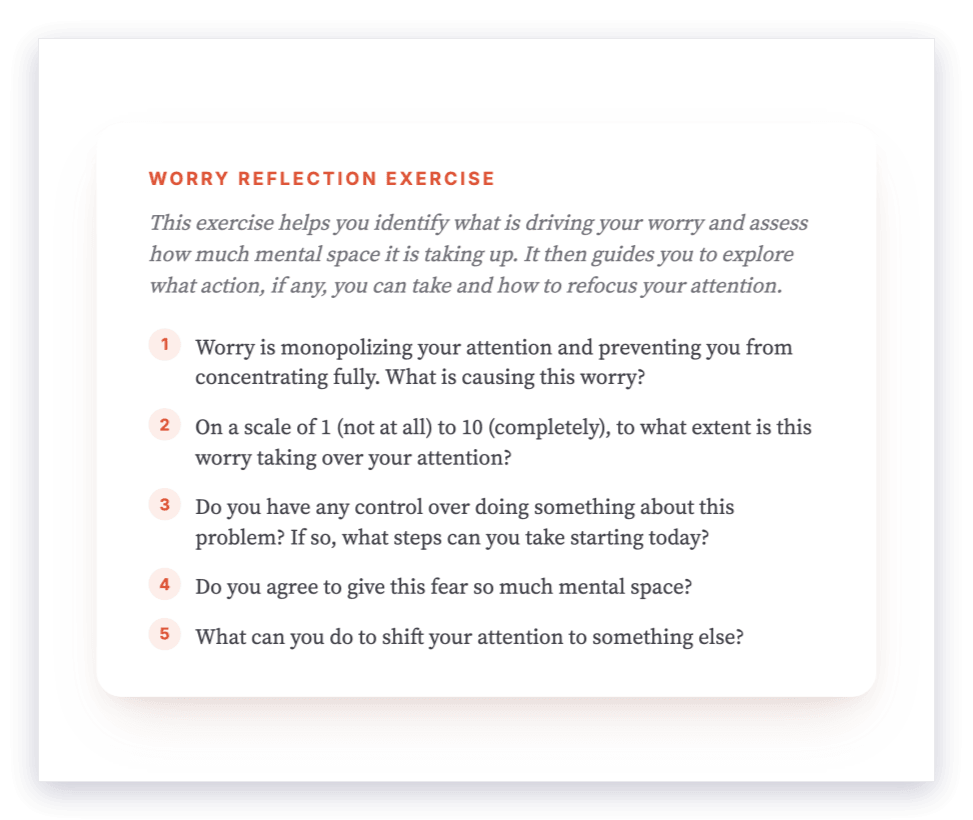
The exercise is built around five sequential questions that mirror a structured clinical reasoning about worry. The patient begins by naming the source of the worry in concrete terms, then rates, on a scale of 1 to 10, how strongly it is capturing their attention. The third question introduces the pivotal controllability distinction: does the patient actually have agency over the problem, and if so, what steps are available today? Question four asks an explicitly metacognitive question, whether the patient genuinely consents to giving that worry so much mental space, which functions as a values-based pause similar to the moment of choice explored in ACT-informed work. The fifth and final question asks the patient to identify concrete ways of redirecting attention elsewhere.
This image is a static preview of the exercise questions only. The full guided experience, with patient-facing instructions, space to write, and the complete interactive flow, is what the patient actually works through on their own in the app, not what is shown here.
This exercise is available to patients through the mobile application that is the dedicated patient-side interface of SessionFuel: once you assign it in your SessionFuel account, your patient receives it directly on their phone and completes it autonomously, on their own time.
Taken together, the five questions move the patient through description, quantification, action-sorting, consensual awareness, and redirection: a sequence that externalises what is normally an internal and automatic loop. This makes the exercise a concrete clinical support, not a self-help checklist. It creates material you can read, annotate, and use as a point of entry in the next consultation.
750+ clinical tools
A library built with and for clinicians, ready to use in session and extend between appointments.
Access all the toolsUse it with your patients
Share this tool in the mobile app and follow the work between sessions.
Integrating the exercise as between-session homework
Assign this exercise between two consultations when a patient reports recurrent or intrusive worry that is eating into daily concentration without translating into action. It suits patients working on generalised anxiety, those prone to overthinking loops, and patients for whom the constructive versus ruminative distinction is still new. It also works well alongside the Anticipatory Fear exercise when the worry has a specific future event as its object.
Introduce it simply: tell the patient that the next time they notice a worry capturing their attention, before doing anything else, they should open the exercise and answer the five questions honestly. Frame it as a real-time experiment in noticing, not a test.
When the patient brings their responses back, the most clinically productive entry points are usually the gap between the intensity rating and the actual controllability answer, and what the patient wrote in response to the consent question. A high intensity score paired with zero available action is a clean opening for attentional defusion work or a discussion of selective attention. A patient who says "no, I don't agree" to giving the worry space has already taken the metacognitive step; your next session can build from that.
For patients who need more structural support around anxiety and thought evaluation, pair this exercise with Is This Thought Useful? or the Anxiety Self-Reflection exercise for a richer between-session sequence.
Key takeaway: This exercise turns the attentional capture of worry into an observable, rateable, and actionable event. It gives the patient a structured pause between the onset of worry and their response to it, and it gives you concrete written material to work with when they return.
Your session continues in your patients' pocket
Use with a patientYour resources, available everywhere
The handouts, exercises, programs and audios above: you choose which ones to make available to your patients, in the mobile app dedicated to them.
And far more than a library
The app goes well beyond resources, to support your patients every day:
Related categories
Explore other clinical resources by category.

Anxiety
Clinical hub for anxiety disorders: CBT and ACT worksheets, psychoeducation sheets, and exercises for assessment and treatment across the anxiety spectrum.

Identity
Clinical resources for self-identity work in therapy: CBT, ACT, schema tools for clinicians addressing self-concept, core beliefs, and identity disruption.

Emotions
Clinical resources on emotion regulation: worksheets, coping tools, CBT, REBT, and ACT exercises for therapists working across diagnoses and age groups.

Behaviours
Clinical hub for behaviors in therapy: worksheets and tools for coping, eating disorders, CBT formulation, and maladaptive behavioral patterns.

Cognition
Printable cognitive therapy worksheets and clinical tools for therapists: CBT, ACT, schema work, defusion, distortions, and belief restructuring.

Build awareness
Clinical worksheets and tools to build awareness in therapy: cognitive distortions, schemas, emotions, ACT and CBT resources for practitioners.