
Clinical picture. A is a 34-year-old doctoral candidate referred for low-grade depression and chronic work avoidance; she describes submitting nothing unless she considers it flawless, which in practice means submitting very little. In session, the clinician introduces the informational sheet on perfectionism and invites A to locate herself on the perfectionism-versus-healthy-ambition comparison. A identifies immediately with the "all or nothing: flawless or worthless" self-view row, and notes, with some surprise, that she had always framed her paralysis as a motivation problem rather than a fear-driven one. Over the following two sessions she begins to distinguish between the driver column, fear of rejection versus desire to grow, and uses that distinction as a small but workable lever for restarting a stalled chapter draft.
Understanding Perfectionism: PDF Worksheet, Tools and Exercises
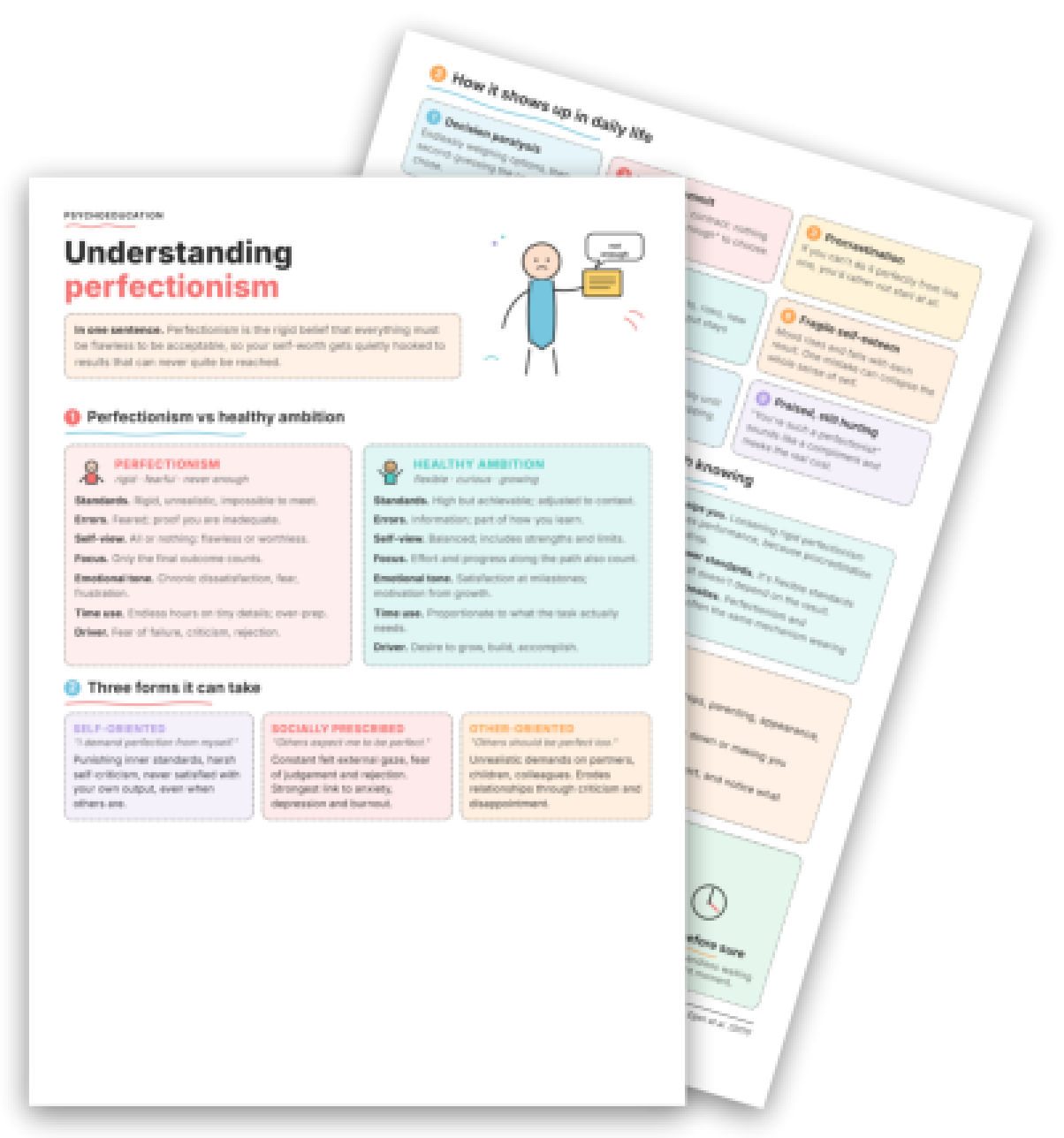
A visual psychoeducation tool to help clinicians explain perfectionism in session, distinguish it from healthy ambition, and open the door to clinical work.
Clinical vignettes
Psychoeducation Reframes a Stalled Writer
Naming Socially Prescribed Perfectionism in Burnout
Clinical picture. M is a 41-year-old nurse manager presenting with occupational burnout; he reports spending two to three hours each evening reworking shift schedules that colleagues consider adequate, and describes a persistent sense that any visible error will confirm others' low opinion of him. The clinician shares the three-forms section of the psychoeducation sheet and reads the socially prescribed description aloud: "constant felt external gaze, fear of judgement and rejection." M pauses, then says this is the first time a framework has captured why exhaustion alone does not explain his behaviour. Naming the form did not resolve the pattern, but it gave M a more precise target for subsequent cognitive work and reduced some of the shame attached to his over-checking.
Perfectionism is one of those constructs patients readily identify with yet stubbornly misread: "I just have high standards" is not resistance, it's a genuine conceptual confusion that oral explanation alone rarely untangles. This fiche PDF on understanding perfectionism gives you a structured visual reference to make the distinction clinically precise during the session itself, rather than asking the patient to trust an abstract account of something they still experience as a virtue.
Use this resource with your patients
Handout, exercises and materials ready to use, right inside SessionFuel.
What makes perfectionism so resistant to oral psychoeducation?
The main obstacle is ego-syntonic framing. Perfectionism arrives in your office wearing a compliment, and the fiche names this explicitly: "You're such a perfectionist" sounds like a compliment and masks the real cost. That single line, seen in writing rather than heard from the therapist, tends to land differently.
Two specific confusions compound the difficulty. First, patients cannot reliably distinguish rigid perfectionism from healthy ambition without a side-by-side comparison; one sounds like the other when described verbally. Second, the link between perfectionism and procrastination is genuinely counterintuitive: patients who identify as "not getting things done" are often the last to connect that pattern to excessively high standards. The fiche makes both confusions visible in a format that holds still while you work through it together.
The third subtype, socially prescribed perfectionism ("Others expect me to be perfect"), is typically the hardest to name without a structure to point at. Research in the Hewitt and Flett tradition, which the fiche cites, consistently shows this dimension carries the strongest links to anxiety, depression, and burnout. Patients experiencing it often present with low self-esteem, chronic burnout symptoms, or all-or-nothing thinking, without connecting these to an interpersonal perfectionist schema.
750+ clinical tools
A library built with and for clinicians, ready to use in session and extend between appointments.
Access all the toolsWhat the fiche contains, and why the visual format matters
The fiche PDF is organised into five numbered panels plus a closing discussion prompt, all on a single printable page.
Panel 1 presents a parallel comparison between perfectionism and healthy ambition across seven dimensions: standards, relationship to errors, self-view, focus, emotional tone, time use, and driver. The visual alignment is what does the clinical work here: a patient can scan left and right and locate themselves, rather than inferring a contrast from two separate paragraphs of speech. You can connect this directly to work on demanding standards or the CBT model of perfectionism later in the care plan.
Panel 2 names the three subtypes (self-oriented, socially prescribed, other-oriented) with brief, recognisable descriptions. Clinicians working with impostor syndrome presentations or schema-level work will find the socially prescribed subtype particularly useful as a bridge concept.
Panel 3 maps nine concrete daily-life manifestations, from decision paralysis and hard-to-commit patterns to sleep disruption and slow burnout. Nine items in a visual list do something that the same nine items spoken aloud cannot: the patient sees the breadth of the construct simultaneously. "If you can't do it perfectly from line one, you'd rather not start at all" often prompts an immediate recognition response in patients who have never connected their avoidance to perfectionism.
Panel 4 gathers five characteristic inner-voice statements (including "If it's not perfect, it's worthless"), and Panel 5 offers three psychoeducational points worth revisiting: that loosening rigid perfectionism typically improves performance, that the goal is flexible standards rather than lower ones, and that perfectionism and procrastination are often the same mechanism in different clothes. The perfectionism ratchet effect is a natural follow-up resource once this last point takes hold.
A structured discussion prompt closes the sheet with three clinician-ready questions covering life domains, functional cost, and a between-session behavioural experiment.
> Key point: the fiche is a visual support that facilitates the explanation of perfectionism during the session itself; it is not a questionnaire patients complete alone, but a shared reference that lets you build a common vocabulary in real time and leave the patient with a concrete anchor between appointments.
Use it with your patients
Share this tool in the mobile app and follow the work between sessions.
When and how to introduce it
The fiche fits naturally in an early-middle phase of treatment, once the formulation is outlined and the patient has acknowledged some cost to their patterns. Introducing it before any alliance is established risks being read as a lecture; leaving it too late means several sessions of oral psychoeducation that could have been more efficient.
For patients whose main complaint is burnout, chronic dissatisfaction, or all-or-nothing thinking, you can frame the introduction simply: "I'd like to show you a sheet that maps a pattern I think is relevant to what you're describing, and we can look at it together." This sidesteps the label before the patient is ready to accept it.
After going through the fiche together, a productive debrief question is: which of the nine daily-life manifestations they recognised most immediately, and which surprised them. That response often tells you more about the active maintaining processes than a direct questionnaire would. From there, the perfectionism self-reflection exercise and work on the clinical model of perfectionism provide the natural next steps, alongside growth mindset work or self-compassion practice for patients whose self-criticism is prominent.
One contraindication worth noting: patients with strong intellectualisation defences may use the typology to classify themselves with apparent insight while avoiding affective contact. In that case, the CBT model of perfectionism and Socratic questioning around the inner-voice panel tend to be more useful entry points than the comparison table.
The fiche does not replace formulation; it makes one aspect of it concrete enough to work with.
Your session continues in your patients' pocket
Use with a patientYour resources, available everywhere
The handouts, exercises, programs and audios above: you choose which ones to make available to your patients, in the mobile app dedicated to them.
And far more than a library
The app goes well beyond resources, to support your patients every day:
Related categories
Explore other clinical resources by category.

Identity
Clinical resources for self-identity work in therapy: CBT, ACT, schema tools for clinicians addressing self-concept, core beliefs, and identity disruption.

Emotions
Clinical resources on emotion regulation: worksheets, coping tools, CBT, REBT, and ACT exercises for therapists working across diagnoses and age groups.

Behaviours
Clinical hub for behaviors in therapy: worksheets and tools for coping, eating disorders, CBT formulation, and maladaptive behavioral patterns.

Transitions
Clinical hub for life transitions: tools, worksheets and exercises to support psychosocial adjustment, role change and identity work in practice.

Understand
Clinical hub for the therapeutic aim 'Understand': worksheets and tools to build patient insight across CBT, ACT, schema therapy and more.

Build awareness
Clinical worksheets and tools to build awareness in therapy: cognitive distortions, schemas, emotions, ACT and CBT resources for practitioners.