
Clinical picture. A., a 34-year-old professional, presented with persistent low mood and sleep disruption centered on whether to accept a job offer. He had spent six weeks collecting opinions from colleagues, running spreadsheets of pros and cons, and repeatedly reading the contract, yet reported feeling less certain with each pass. The clinician introduced the psychoeducational sheet on overthinking and worked through the "signs you are in the loop" checklist with him; A. identified four of the five markers without prompting, which shifted his stance from self-blame to recognition of a cognitive pattern. They then applied principle 3 (likely over unlikely): A. crossed out the catastrophic scenarios he had been fixating on and narrowed deliberation to two plausible outcomes. By the following session he had accepted the offer, noting reduced rumination rather than any certainty about the outcome.
Stop Overthinking: PDF Worksheet, Tools and Exercises for Clinical Practice
A printable PDF worksheet, practical tools, and clinical exercises to help patients break the decision loop, move from analysis paralysis to action, and trust their own judgment.
Clinical vignettes
Rumination Loop in Career Decision
Values Clarification After Chronic Indecision
Clinical picture. M., a 29-year-old presenting with generalised anxiety, described a long-standing pattern of asking friends and family for advice before any significant decision, then discounting whatever they said and starting the cycle again. The clinician framed this using the sheet's concept that outsourcing decisions erodes one's own value compass, which M. found more validating than a behavioural explanation alone. Together they completed the values exercise from principle 5, producing a ranked list of five personal values; M. used this list to evaluate a pending housing decision rather than canvassing opinions again. She returned reporting that the process had not removed discomfort but had shortened her deliberation time and reduced the sense of helplessness that usually accompanied her choices.
Patients caught in decision paralysis can articulate the problem with striking precision and still loop for weeks without moving. Explaining the mechanism verbally rarely breaks anything: they nod, they agree, they return in the same fog. This fiche PDF gives you a visual support to use directly in session, making the overthinking loop concrete, nameable, and interruptible.
Use this resource with your patients
Handout, exercises and materials ready to use, right inside SessionFuel.
Why Overthinking Is So Hard to Dismantle in Session
The clinical difficulty is not conceptual, it is structural. Overthinking masquerades as thoroughness. Patients who engage in it are not passive; they are intensely active, gathering information, consulting their social circle, simulating outcomes. From their perspective, they are doing the responsible thing. Challenging that frame orally, without a visual anchor, often produces defensiveness or surface agreement that evaporates between sessions.
A second difficulty is heterogeneity of maintaining processes. For one patient the engine is intolerance of uncertainty; for another it is perfectionism; for a third it looks almost identical to reassurance-seeking behavior. Without a shared map on the table, it is easy to spend time on the wrong lever. The fiche structures that diagnostic conversation.
What the Fiche Contains: A Visual Map of the Loop
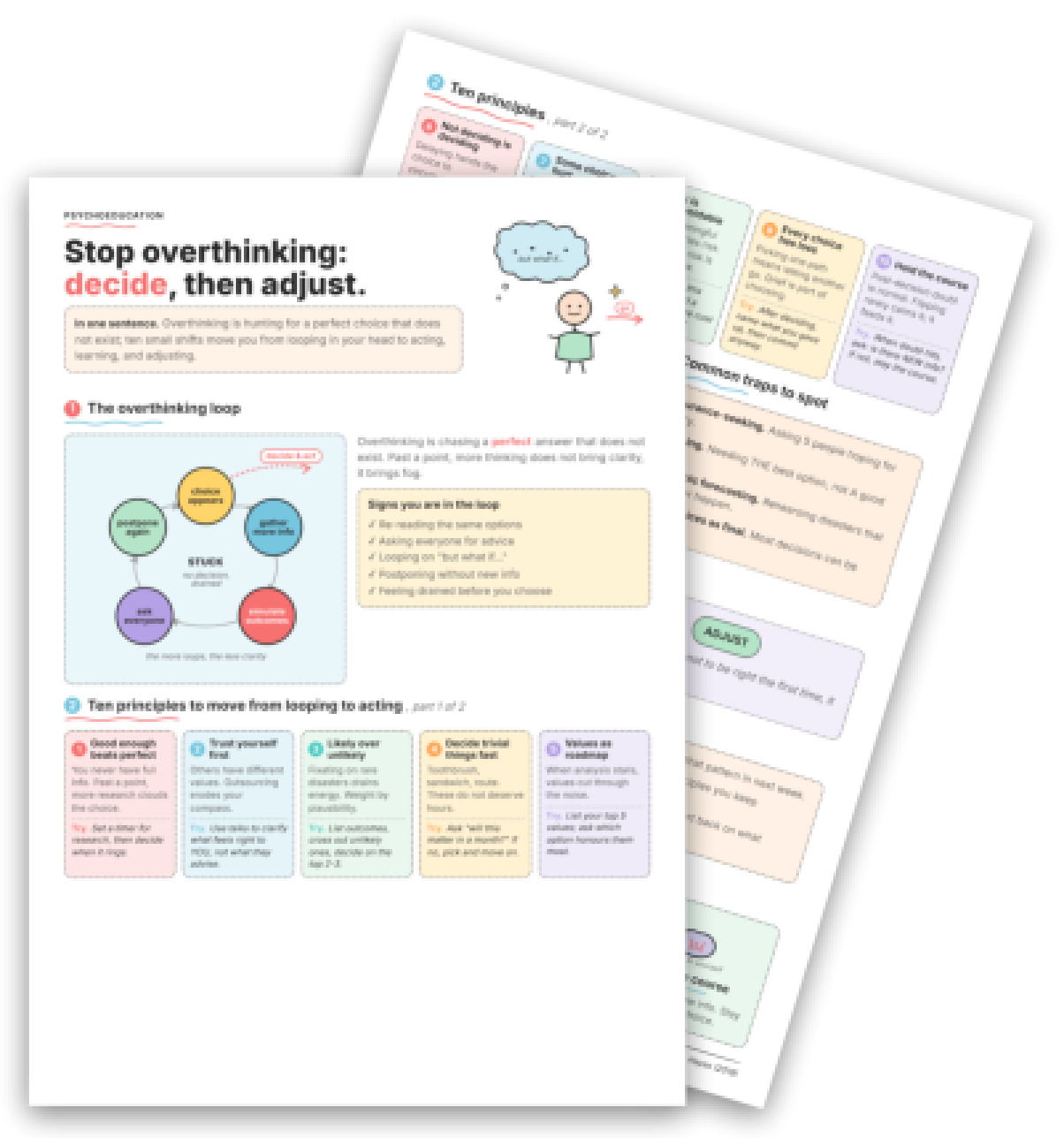
The fiche PDF opens with a flowchart labeled The overthinking loop: choice appears, gather more info, simulate outcomes, ask everyone, postpone again, back to the start, labelled simply STUCK. Seeing the cycle drawn out, patients frequently recognise themselves before you say a word. A checklist of five loop-signs follows (re-reading the same options, asking everyone for advice, looping on "but what if...", postponing without new info, feeling drained before you choose), giving you an immediate psychoeducation hook.
The two central panels present ten principles to move from looping to acting, each paired with a concrete Try exercise: setting a research timer before deciding, crossing out unlikely scenarios, writing out what is missed by waiting another month. The fiche names four common traps explicitly: reassurance-seeking, maximising, catastrophic forecasting, and treating choices as final. These map cleanly onto existing CBT and ACT constructs, so you can thread them into your formulation without having to re-explain. A values clarification exercise pairs well with Principle 5, which asks patients to list their top five values and ask which option honours them most.
The closing reframe presents decision-making as DECIDE → ACT → OBSERVE → ADJUST, a cycle the fiche labels explicitly: "A choice is not a verdict. It is a hypothesis you test, then refine." This framing supports ACT-informed work on the Choice Point and sits comfortably inside an exposure-oriented approach where tolerating outcome uncertainty is the therapeutic target.
A final panel, To discuss in session, gives you three ready-made debrief prompts the patient can bring back the following week.
> Key takeaway: the fiche is a visual support that facilitates the explanation of overthinking in session, not a questionnaire to fill out alone. The loop diagram, the ten principles with their Try exercises, and the session-discussion prompts are all designed for clinician-guided use, with the patient leaving a concrete, named reference.
750+ clinical tools
A library built with and for clinicians, ready to use in session and extend between appointments.
Access all the toolsWhen and How to Propose the Fiche
This fiche fits mid-early treatment, once the presenting pattern is established and the alliance allows some gentle challenge of avoidance. It is particularly indicated for patients presenting with procrastination, worry and attention capture, catastrophizing, or high intolerance of uncertainty around life decisions. It also complements a risk-weighted decision-making exercise later in the work, or a cost/benefit analysis when the patient is weighing two comparably loaded options.
A low-threshold introduction: "I'd like to show you something that describes what you've been telling me. Let's look at it together and you can tell me which parts fit." Walk through the loop diagram first, then invite the patient to identify their dominant trap from the four listed. Assign one Try exercise between sessions, drawn from whichever principle resonates most. Debrief using the To discuss in session prompts at the next appointment.
One limit worth noting: for patients whose decision avoidance is driven primarily by a failure schema or strong self-doubt tied to early maladaptive schemas, the ten principles alone will not be sufficient. Use the fiche as a psychoeducation layer, not a standalone intervention, and keep the rumination self-monitoring work running in parallel.
The fiche does not replace the formulation or the relational work of the session. It makes the explanation sharper, faster, and leaves the patient with something to hold onto between appointments.
Use it with your patients
Share this tool in the mobile app and follow the work between sessions.
Sources
- Schwartz, B. (2004). The Paradox of Choice: Why More Is Less. Harper Perennial.
- Trenton, N. (2021). Stop Overthinking: 23 Techniques to Relieve Stress, Stop Negative Spirals, Declutter Your Mind, and Focus on the Present. Independently published.
Your session continues in your patients' pocket
Use with a patientYour resources, available everywhere
The handouts, exercises, programs and audios above: you choose which ones to make available to your patients, in the mobile app dedicated to them.
And far more than a library
The app goes well beyond resources, to support your patients every day:
Related categories
Explore other clinical resources by category.

Identity
Clinical resources for self-identity work in therapy: CBT, ACT, schema tools for clinicians addressing self-concept, core beliefs, and identity disruption.

Emotions
Clinical resources on emotion regulation: worksheets, coping tools, CBT, REBT, and ACT exercises for therapists working across diagnoses and age groups.

Behaviours
Clinical hub for behaviors in therapy: worksheets and tools for coping, eating disorders, CBT formulation, and maladaptive behavioral patterns.

Cognition
Printable cognitive therapy worksheets and clinical tools for therapists: CBT, ACT, schema work, defusion, distortions, and belief restructuring.

Build awareness
Clinical worksheets and tools to build awareness in therapy: cognitive distortions, schemas, emotions, ACT and CBT resources for practitioners.

Build skills
Skill-building resources for clinicians: printable worksheets and exercises for coping, assertiveness, and communication skills training in therapy.