
Clinical picture. M., a woman in her early forties, presents with recurrent depressive disorder, currently in partial remission; she reports near-nightly loops of self-critical thought that she describes as impossible to interrupt once they begin. Her therapist introduces the four-question exercise after a session in which M. struggled to articulate what the thoughts actually contained, noting only that they felt overwhelming. Over the following fortnight M. completed the worksheet on three separate evenings, recording the specific content of her ruminations, the bedroom context and its role in triggering them, and her ambivalent sense that reviewing past decisions felt both necessary and exhausting. By the fourth session she had identified redirecting her attention to slow diaphragmatic breathing as a workable anchor, and reported one night on which she interrupted the loop within roughly ten minutes. The exercise did not eliminate rumination but gave M. a structured language for discussing it, which facilitated more targeted cognitive work in subsequent sessions.
Rumination: A Guided Self-Monitoring Exercise for Clinicians
A structured four-question exercise helping patients observe, contextualize, and redirect their ruminative thinking patterns autonomously.
Clinical vignettes
Nocturnal Rumination in Recurrent Depression
Work-Related Rumination After Burnout
Clinical picture. T., a man in his mid-thirties, was referred following a burnout-related sick leave; he described spending most weekend afternoons replaying professional conflicts and anticipating negative evaluations from his manager. His psychologist offered the guided exercise as a between-session self-observation task, framing it as descriptive rather than prescriptive. When T. answered the second question, he realised that rumination peaked specifically when he was alone at home with no scheduled activity, a contextual detail he had not previously articulated. His response to the third question was particularly generative: he acknowledged that the loops gave him a feeling of control through anticipation, while conceding they consistently worsened his mood and disrupted sleep. This recognition shifted subsequent sessions toward scheduling structured activities on weekends, a concrete change that T. connected directly to what the exercise had surfaced.
Why Rumination Resists Verbal Explanation Alone
Rumination sits at the heart of depression, anxiety, and a wide range of presentations clinicians see daily. Yet explaining it verbally often lands flat. Patients nod, agree that "going in circles" is unhelpful, and promptly go home and do exactly that. The difficulty is threefold: the concept is abstract until the patient catches it live; the contexts that trigger ruminative episodes are rarely reconstructable inside a consultation; and the step from awareness to redirection is far harder than it sounds when described out loud.
A clinician using Rumination in Depression: A Structured Psychoeducation Program or the Constructive vs Harmful Rumination fiche will already have built a shared framework. What is often still missing is a concrete self-observation anchor the patient can use the moment a ruminative loop starts, on their own, in real time or shortly after.
Use this resource with your patients
Handout, exercises and materials ready to use, right inside SessionFuel.
What the Exercise Contains
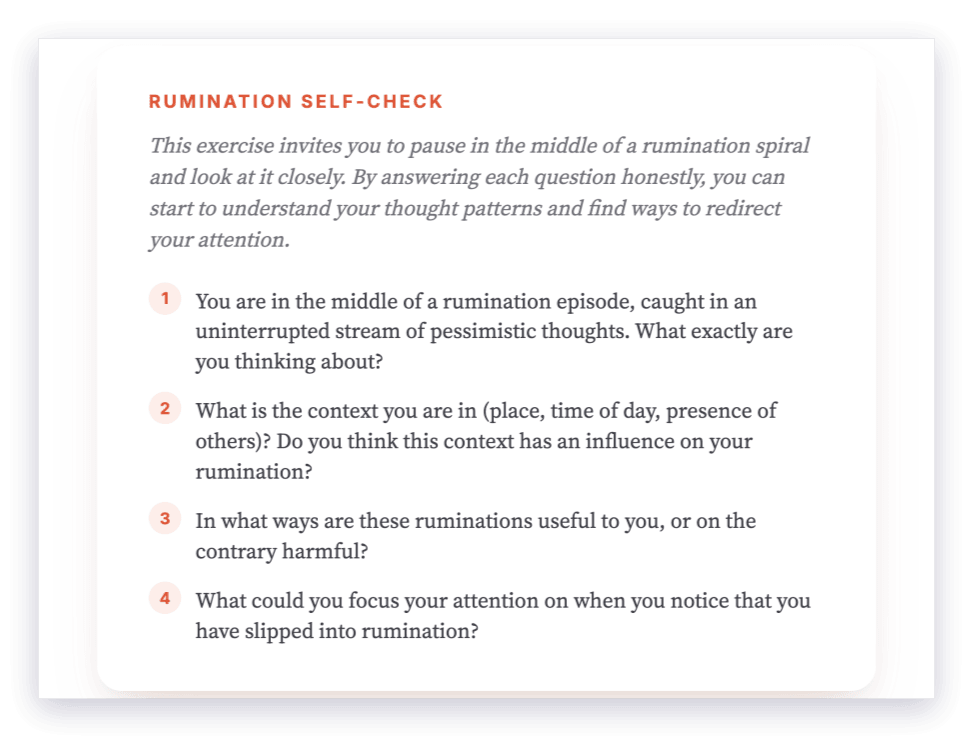
The exercise called I'm ruminating... is built around four sequenced questions that move the patient from raw content to contextual awareness to cost-benefit appraisal to attentional redirection.
The first question asks the patient to describe exactly what thoughts are present during a ruminative episode. This is the content layer, essential for the clinician to identify recurring themes and link them to automatic thoughts or core beliefs. The second question asks for the specific context: place, time of day, whether others are present. Context data is rarely accessible during a session and is clinically rich for pattern recognition. The third question asks the patient to weigh the utility and the cost of the rumination, echoing the metacognitive approach found in the Evaluating Thought Utility exercise and the broader logic of cost-benefit analysis. The fourth question asks what the patient could redirect their attention toward once they notice the loop beginning, seeding the skill addressed in tools like Focusing on Solutions and the Rumination Eraser: A Guided Meditation Audio.
The image above lists the four exercise questions with a brief introductory framing.
This image is a static preview of the question list only. The full guided exercise, including patient-facing instructions and answer spaces, is experienced by the patient autonomously inside the app, not in this image.
Key insight: The exercise's real clinical value is in combining four distinct angles, content, context, cost-benefit, and redirection, in a single autonomous sequence the patient completes close to the actual episode.
This exercise is available to patients directly through the mobile application that is the dedicated patient-side interface of SessionFuel: the clinician assigns it as between-session homework, and the patient completes it independently on their phone, on their own time.
750+ clinical tools
A library built with and for clinicians, ready to use in session and extend between appointments.
Access all the toolsUse it with your patients
Share this tool in the mobile app and follow the work between sessions.
Integrating This as Between-Session Homework
This exercise suits a broad range of patients: those with depressive rumination, those with anxious worry loops (see Worry and Attention Capture), and patients already working with cognitive distortions who are ready to monitor their thinking in naturalistic conditions.
A natural introduction might be: "This week I'd like you to complete this exercise the next time you notice you've been caught in repetitive thoughts. Do it as close to the episode as possible, even a few minutes after." The key clinical instruction is timing: completing it close to the episode, not from memory two days later.
When the patient returns the following week, the four questions generate directly usable material. The content from question one can feed into cognitive restructuring or defusion work. The context data from question two can anchor a trigger-mapping conversation. The utility appraisal from question three is an entry point for metacognitive work, and the redirection strategy from question four becomes a between-session behavioral contract to revisit at the next appointment.
For patients who find the exercise challenging, pairing it with the Distancing and Decentering fiche beforehand gives them the conceptual vocabulary to answer question three with precision. For those already comfortable with self-monitoring, it connects naturally to the Sensory Grounding for Cognitive Overwhelm exercise as a practical follow-up on redirection.
Your session continues in your patients' pocket
Use with a patientYour resources, available everywhere
The handouts, exercises, programs and audios above: you choose which ones to make available to your patients, in the mobile app dedicated to them.
And far more than a library
The app goes well beyond resources, to support your patients every day:
Related categories
Explore other clinical resources by category.

Anxiety
Clinical hub for anxiety disorders: CBT and ACT worksheets, psychoeducation sheets, and exercises for assessment and treatment across the anxiety spectrum.

Mood
Evidence-based worksheets and clinical tools for mood disorders: CBT, ACT, and positive psychology resources for psychologists and therapists.

Cognition
Printable cognitive therapy worksheets and clinical tools for therapists: CBT, ACT, schema work, defusion, distortions, and belief restructuring.

Build awareness
Clinical worksheets and tools to build awareness in therapy: cognitive distortions, schemas, emotions, ACT and CBT resources for practitioners.

CBT
CBT worksheets, cognitive restructuring exercises & behavioral tools for clinicians. Evidence-based resources for every phase of cognitive behavioral therapy.

Metacognitive
Metacognitive Therapy (MCT): clinical resources, worksheets, and exercises for practitioners targeting CAS, rumination, and metacognitive beliefs.