
Clinical picture. M., a 34-year-old teacher, presented with longstanding scrupulosity and mounting distress around intrusive blasphemous images that arose during prayer. He reported spending up to two hours each evening in silent mental repetition of corrective phrases, convinced that failing to neutralise each image placed him in the same moral category as someone who had acted blasphemously. The clinician introduced the thought-action fusion informational sheet as a structured psychoeducation step, reviewing the morality flavour together and asking M. to locate his own pattern on the page. M. recognised his behaviour in the neutralising column without prompting, which opened a productive discussion about the difference between a mental event and a moral act. By the following session he had reduced his nightly ritual by roughly half, though ambivalence about full exposure work remained.
Thought-Action Fusion: PDF Worksheet, Tools and Exercises
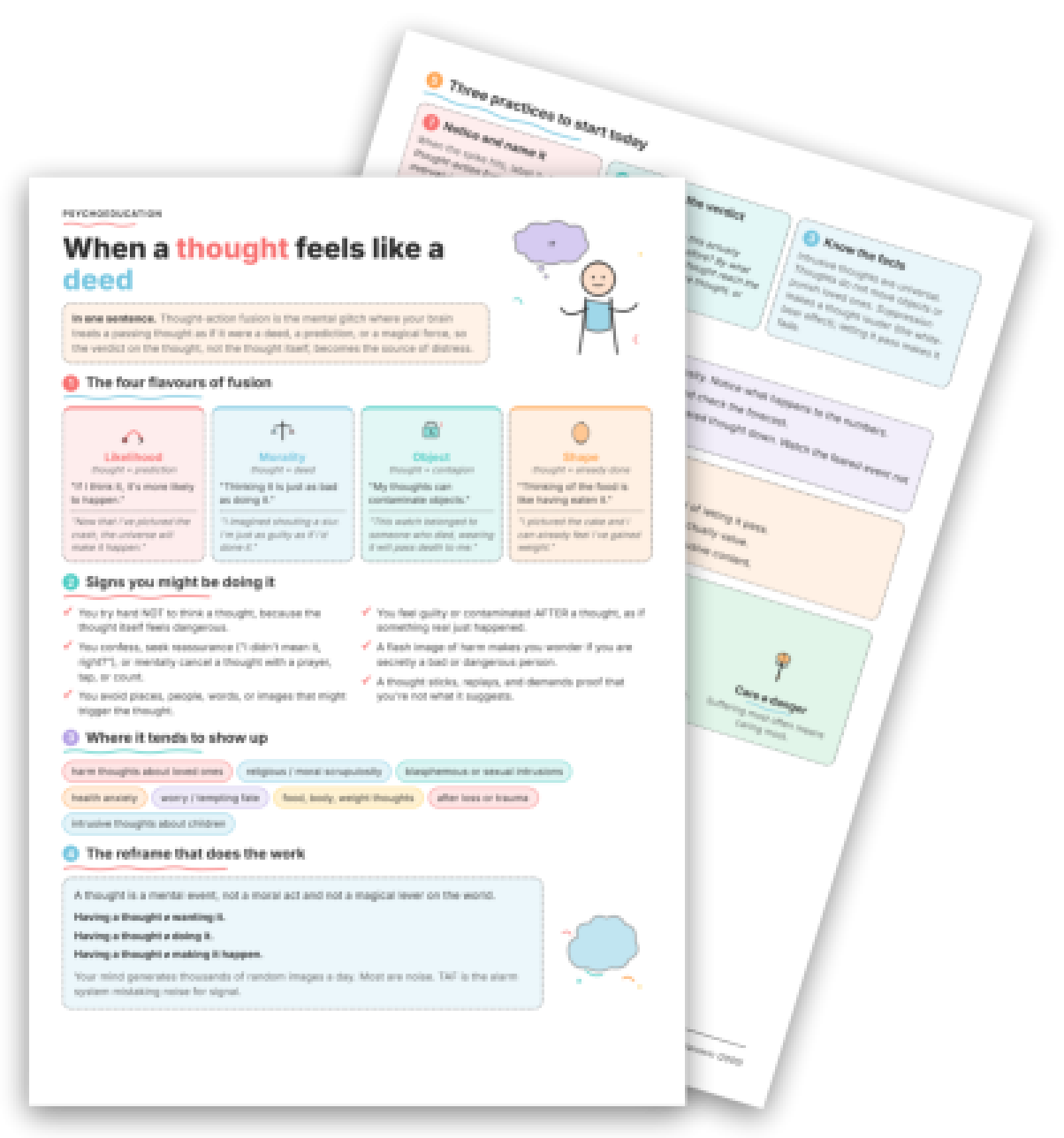
A printable PDF worksheet with tools and exercises to explain thought-action fusion in session, ground intrusive-thought work, and give patients a concrete visual reference they can keep.
Clinical vignettes
Moral Fusion in Scrupulosity
Likelihood Fusion and Tempting Fate
Clinical picture. R., a 28-year-old in treatment for generalised anxiety, described an entrenched habit of silently knocking on wood and avoiding any positive statement about her family's health, fearing that voicing good news would cause harm. She framed this not as superstition but as a reasonable precaution, insisting that past coincidences confirmed the link. The clinician used the informational sheet to name likelihood fusion specifically, pointing to the line distinguishing a thought from a prediction or a magical lever on the world. R. pushed back initially, yet agreed to map her avoidance behaviours against the signs listed in the sheet, noting she met five of the six. This concrete exercise shifted the conversation from debate about probability to curiosity about what function the rituals were serving, which the pair then explored directly.
Explaining thought-action fusion verbally is deceptively hard: most patients nod along, then leave the session still treating their intrusive image as evidence of character or cause of catastrophe. This fiche PDF gives you a visual scaffold to deliver the psychoeducation with precision, not approximation.
Use this resource with your patients
Handout, exercises and materials ready to use, right inside SessionFuel.
Why TAF Resists a Pure Verbal Explanation
Thought-action fusion (TAF) sits at the intersection of magical thinking, moral self-evaluation, and évitement expérientiel. What makes it particularly resistant to oral explanation is the metacognitive layer: the patient is not distressed by the intrusive content per se, but by the verdict they pass on it. That distinction rarely lands without a visual anchor.
Patients with intrusive thoughts, images, and impulses commonly arrive having already tried thought suppression, the Wegner white-bear effect they have never heard named. When you explain TAF only verbally, they hear another variation of "thoughts are just thoughts," which they have also heard from everyone else. What they have not seen is why a particular subset of thoughts sticks while others don't, and which specific mechanisms are keeping the alarm firing.
The same difficulty surfaces in OCD presentations, in scrupulosity, in postpartum intrusive thoughts, and in health anxiety where a thought about illness feels like a symptom. Each of these profiles uses a slightly different flavour of fusion, and distinguishing them out loud is cumbersome.
750+ clinical tools
A library built with and for clinicians, ready to use in session and extend between appointments.
Access all the toolsWhat the Fiche Contains: A Visual Framework for Six Moving Parts
The fiche maps four distinct subtypes of TAF on one page: Likelihood (thought equals prediction), Morality (thought equals deed), Object (thought equals contagion), and Shape (thought equals already having acted). Each subtype carries a paired patient-level statement, so you can point to the exact variant your patient endorses rather than describing it in the abstract.
A second panel offers six behavioural signatures to help both of you spot fusion in real time: suppression efforts, reassurance-seeking and mental cancellations, avoidance of triggering stimuli, post-thought guilt, character doubt from a flash image, and thought-looping with demands for proof. These map precisely onto what you already track when reviewing checking, certainty, and doubt cycles or safety behaviours.
The reframe section states the clinical premise plainly: "A thought is a mental event, not a moral act and not a magical lever on the world." Below it, three short practices (notice and name it, question the verdict, know the facts) translate the psychoeducation into something the patient leaves with, not just hears.
The fiche closes with gentle behavioural experiments grounded in the disconfirmatory logic of Theory A / Theory B work: wishing for the lottery jackpot, attempting to move the weather by thought, then, when ready and with your support, sitting with a feared thought on paper and watching the anticipated consequence not arrive.
> To keep in mind: this fiche PDF is a support visuel that facilitates the explanation of TAF in session; it is not a self-report questionnaire to hand out between appointments. You use it as a shared reference while you talk, pointing to specific panels, and the patient takes it home as a concrete anchor, not a homework task.
Use it with your patients
Share this tool in the mobile app and follow the work between sessions.
When and How to Introduce the Fiche
The natural entry point is immediately after you have named TAF in a formulation, typically in the second or third session once the anamnèse has surfaced either reassurance loops, mental rituals, or intrusive content the patient is actively suppressing. For patients already engaged in OCD-focused work, the fiche consolidates the psychoeducation before moving into the exposure hierarchy.
You can introduce it with a straightforward frame: "I want to show you something that explains what I think is happening when that thought gets stuck. It will take five minutes and I think it will make the rest of what we do together much clearer."
Point to the subtype panel first, let the patient self-identify, then move to the signatures panel. The most clinically productive moment is usually when they read the Morality variant aloud and say "that's exactly it," confirming that the distress is about self-judgment, not intent. From there, cognitive defusion techniques from ACT and the distancing and decentering work have a shared vocabulary to build on.
One limit worth noting: the fiche is not designed for florid psychotic presentations where the literal reality of thought-transmission beliefs requires a different clinical stance. For psychoeducation on reassurance-seeking patterns that follow TAF, a separate structured exercise will take the work further. The fiche opens the door; the clinical work you do with it keeps it open.
Your session continues in your patients' pocket
Use with a patientYour resources, available everywhere
The handouts, exercises, programs and audios above: you choose which ones to make available to your patients, in the mobile app dedicated to them.
And far more than a library
The app goes well beyond resources, to support your patients every day:
Related categories
Explore other clinical resources by category.
Anxiety
Clinical hub for anxiety disorders: CBT and ACT worksheets, psychoeducation sheets, and exercises for assessment and treatment across the anxiety spectrum.

Mood
Evidence-based worksheets and clinical tools for mood disorders: CBT, ACT, and positive psychology resources for psychologists and therapists.

Behaviours
Clinical hub for behaviors in therapy: worksheets and tools for coping, eating disorders, CBT formulation, and maladaptive behavioral patterns.

Cognition
Printable cognitive therapy worksheets and clinical tools for therapists: CBT, ACT, schema work, defusion, distortions, and belief restructuring.

Understand
Clinical hub for the therapeutic aim 'Understand': worksheets and tools to build patient insight across CBT, ACT, schema therapy and more.

Build awareness
Clinical worksheets and tools to build awareness in therapy: cognitive distortions, schemas, emotions, ACT and CBT resources for practitioners.