
Clinical picture. T., a man in his early forties, was three weeks into abstinence from alcohol when he presented reporting a near-slip following a difficult performance review at work. In session, the clinician introduced the permissive-thinking framework and walked T. through the three-step urge chain, asking him to reconstruct what had gone through his mind that evening. T. quickly identified the phrase "I've worked hard all week, one beer won't undo anything" as the hinge point, noting he had not previously registered it as a thought at all, only as a feeling of certainty. The clinician invited him to apply the zoom-out question: "How did you feel about yourself the following morning when you had, in fact, not drunk?" T. reflected that naming the permission as a cognitive event, rather than a signal to trust, had created enough distance for him to call a contact instead of opening the fridge.
Permissive Thinking: PDF Worksheet, Tools and Exercises for Clinical Practice
A printable PDF worksheet, clinical tools and exercises to help patients catch the cognitive step that turns an urge into a behaviour, and intervene at the right moment.
Clinical vignettes
Catching the Permission in Alcohol Relapse
Permissive Thought Chain in Binge Eating
Clinical picture. M., a woman in her late twenties presenting with recurrent binge episodes, reported that her urges felt "instantaneous," with no discernible gap between a stressful moment and finding herself in the kitchen. Using the informational sheet in session, the clinician guided her through the typical permissive phrases and asked her to mark any that felt personally familiar. M. circled "I feel awful, so it's OK" and "already messed up, might as well finish," then noted with some surprise that the second thought routinely prolonged episodes she might otherwise have interrupted. The clinician focused attention on the notice-and-name strategy: practicing the label "permissive thought" aloud, without argument, as a first and modest goal between sessions. At the following appointment M. reported two instances where naming the thought had introduced a brief pause, during one of which she had texted a friend rather than continued eating.
Patients who struggle with repetitive self-defeating behaviours, from binge eating and alcohol use to self-harm and compulsive scrolling, can usually identify their triggers. What they routinely miss is the half-second cognitive step that actually releases the behaviour: the internal yes that follows the urge. This fiche PDF on permissive thinking is a visual support built specifically to name and intervene at that step, in session, before the patient leaves without a workable handle on it.
Use this resource with your patients
Handout, exercises and materials ready to use, right inside SessionFuel.
Why Permissive Thinking Resists Explanation Without a Visual Support
The concept sits awkwardly in verbal explanation. Clinicians working from a TCC or DBT framework know that permissive thoughts (sometimes called permission-giving thoughts in Marlatt and Gordon's relapse prevention model) function as a cognitive bridge between craving and action. But patients tend to hear them as common sense in the moment: "I've had a hard day, I deserve this" does not feel like a distortion; it feels like a fair assessment.
Explaining this orally often lands as moralising. The patient agrees in principle, then goes home and misses the thought entirely because, as the fiche makes explicit, it "wears the costume of self-care" and arrives in under a second when vigilance is lowest. Without a shared visual map of the chain, the concept stays abstract.
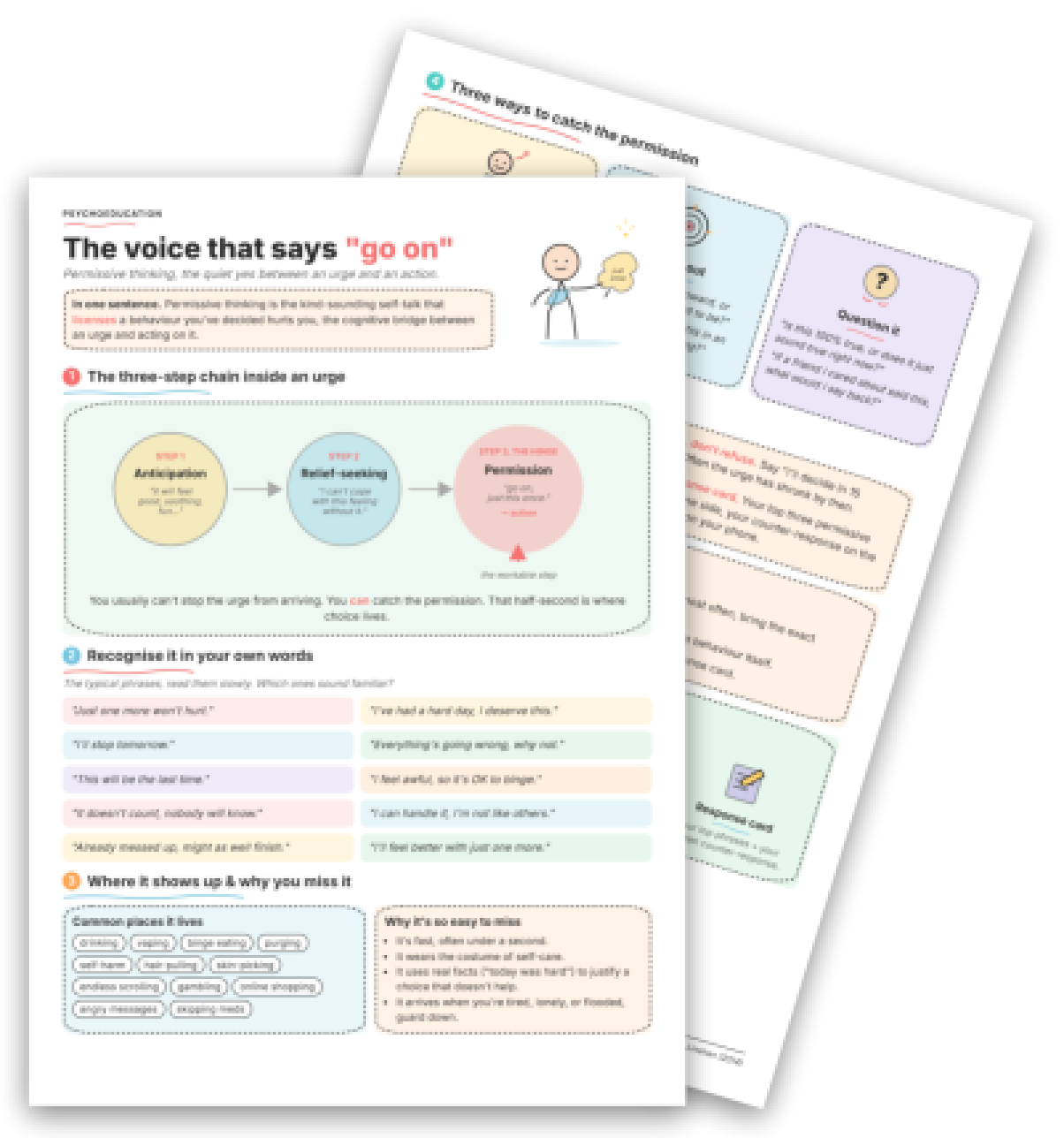
This is precisely where the worksheet earns its place. Seeing the three steps laid out spatially, Anticipation, Relief-seeking, Permission, makes one thing immediately visible that an oral explanation rarely achieves: the permission step is not the urge itself, and it is the only step where choice is still available.
> Key takeaway: The fiche is a visual support that facilitates the explanation of permissive thinking in session; it gives the patient a concrete, named reference point to take home, not a solo questionnaire to complete.
What the Worksheet Contains
The fiche is structured across five numbered sections, each addressing a distinct clinical sub-task.
- Section 1 renders the three-step chain inside an urge as a visual sequence: Anticipation ("it will feel good, soothing, fun...") → Relief-seeking ("I can't cope with this feeling without it") → Permission ("go on, just this once"). An explicit call-out highlights that "the permission step is the workable one", useful framing for patients who feel defeated by the urge itself.
- Section 2 lists ten verbatim permissive phrases ("I'll stop tomorrow," "Already messed up, might as well finish," "It doesn't count, nobody will know"). Reading these aloud in session and asking the patient which ones sound familiar is a fast, low-resistance way to personalise the concept with no stigma attached.
- Section 3 maps the behaviours where permissive thinking appears (drinking, vaping, binge eating, purging, self-harm, hair-pulling, skin-picking, gambling, online shopping, angry messages, skipping medication) alongside a four-item list of why it is so easy to miss: speed, disguise as self-care, use of real contextual facts, and arrival at moments of emotional depletion.
- Section 4 offers three catching strategies (Notice and name, Zoom out, Question it) with specific prompts the patient can internalise: "Does this take me toward, or away from, who I want to be?"
- Section 5 presents four response options (urge surfing, 15-minute postponement, a short alternative list, and a personal response card), and closes with a "To discuss in session" block that structures the next conversation.
The visual architecture does the work that bullet points in a session notebook cannot: the patient sees the chain, locates themselves in it, and can trace the intervention point before they leave the room. Combined with a resource like the Lapse and Relapse Management worksheet or Marlatt and Gordon's relapse model fiche, it slots naturally into a psychoeducation arc on adaptive versus maladaptive coping.
750+ clinical tools
A library built with and for clinicians, ready to use in session and extend between appointments.
Access all the toolsWhen and How to Introduce the Worksheet
The fiche is best introduced once the patient has some behavioural map of their cycle, after one or two sessions exploring triggers, not on intake. It works across a wide range of presentations: substance use, eating disorders, self-harm, impulse-control difficulties, and any pattern where the patient reports "I don't know how it happens, I just find myself doing it."
A low-resistance introduction might be: "There's a very short cognitive step that most people miss between the craving and the moment they act, I'd like to show you what it looks like, because that step is actually the most useful one to work with." Then open the fiche and walk through Section 1 together before moving to the phrase recognition in Section 2.
For patients working on coping skills in the context of addictions, pair it with an urge surfing or distress tolerance exercise. For those whose permissive thinking is more cognitively elaborate, ACT defusion techniques or the Choice Point model extend the work. The response-card format in Section 5 integrates with any automatic thought restructuring the patient is already practising.
One limit worth naming: with patients in acute ambivalence about change, where the permitted behaviour still holds significant regulatory function, introduce the fiche after establishing genuine motivation to engage, not before. Used too early, it can feel confrontational rather than clarifying.
The fiche does not replace the therapeutic relationship; it makes one opaque cognitive mechanism legible, at the exact moment in the chain where intervention is still possible.
Use it with your patients
Share this tool in the mobile app and follow the work between sessions.
Sources
- Beck, A. T., Wright, F. D., Newman, C. F., & Liese, B. S. (1993). Cognitive Therapy of Substance Abuse. Guilford Press.
- Marlatt, G. A., & Gordon, J. R. (1985). Relapse Prevention: Maintenance Strategies in the Treatment of Addictive Behaviors. Guilford Press.
- Bowen, S., Chawla, N., & Marlatt, G. A. (2010). Mindfulness-Based Relapse Prevention for Addictive Behaviors: A Clinician's Guide. Guilford Press.
Your session continues in your patients' pocket
Use with a patientYour resources, available everywhere
The handouts, exercises, programs and audios above: you choose which ones to make available to your patients, in the mobile app dedicated to them.
And far more than a library
The app goes well beyond resources, to support your patients every day:
Related categories
Explore other clinical resources by category.

Behaviours
Clinical hub for behaviors in therapy: worksheets and tools for coping, eating disorders, CBT formulation, and maladaptive behavioral patterns.

Cognition
Printable cognitive therapy worksheets and clinical tools for therapists: CBT, ACT, schema work, defusion, distortions, and belief restructuring.

Understand
Clinical hub for the therapeutic aim 'Understand': worksheets and tools to build patient insight across CBT, ACT, schema therapy and more.

Build awareness
Clinical worksheets and tools to build awareness in therapy: cognitive distortions, schemas, emotions, ACT and CBT resources for practitioners.

Restructure
Clinical hub for cognitive restructuring worksheets: distortion identification, belief disputation, ABC model, and schema work for evidence-based practice.

ACT
Clinical hub for Acceptance and Commitment Therapy (ACT): worksheets, exercises, programs and audio resources for practitioners using the ACT model.