
Clinical picture. M., a man in his late thirties, had maintained alcohol abstinence for four months when he drank at a colleague's retirement event. He arrived at the following session convinced he had "proved he could never recover," minimising the preceding weeks of sustained effort. The clinician introduced the Abstinence Violation Effect using the informational sheet, naming the cognitive triad of global, stable, and internal attribution that was driving M.'s shame spiral. Together they reconstructed the evening as a chain: an unplanned high-risk context, no exit strategy rehearsed, and a positive outcome expectancy activated by social pressure. By the close of the session M. could distinguish the lapse from a relapse and agreed to draft a written if-then plan for two upcoming situations he identified as structurally similar.
Marlatt & Gordon's Relapse Model: PDF Worksheet, Tools and Exercises
A visual PDF worksheet to make the relapse chain, the AVE, and coping planning concrete and usable in a single session.
Clinical vignettes
AVE Reframe After a Single Lapse
Mapping Triggers Before Discharge
Clinical picture. T., a woman in her mid-twenties treated for binge-eating, was approaching the end of a structured outpatient programme. She reported feeling ready yet was vague about what had preceded her most recent episodes. The clinician used the relapse chain worksheet to guide a backwards reconstruction: three of the five episodes had followed a skipped lunch combined with an emotionally depleting work meeting, a cluster T. had not previously linked. She practised naming that confluence as a specific high-risk situation and pre-selected a concrete coping move for each step in the chain. At the two-month follow-up she reported one partial lapse, which she had contained without a full return, citing the if-then plan as the point where she had felt agency.
Patients in addiction recovery frequently arrive with a guilt-saturated narrative: one slip became weeks of use, and they cannot explain how. Naming the Abstinence Violation Effect verbally is rarely enough to interrupt that cycle. This fiche PDF gives the Marlatt & Gordon cognitive-behavioral relapse model a visual form that makes the chain legible, and breakable, within a single session.
Use this resource with your patients
Handout, exercises and materials ready to use, right inside SessionFuel.
Why the Relapse Chain Resists Verbal Explanation
The concept patients most consistently misread is precisely the one at stake: that relapse is not a discrete event but a sequence, and that the decisive moment is not the first lapse but the cognitive and affective response to it. When you describe the AVE in the abstract, most patients hear confirmation of their worst fear ("I'm weak, I've failed again") rather than a mechanism they can interrupt. The distinction between a lapse and a relapse sounds theoretical until they can see Path A and Path B laid out side by side.
Self-efficacy, outcome expectancies, and the shame spiral that converts a single slip into a full return to pattern: these are concepts that gain genuine traction through structure, not narration alone. The all-or-nothing thinking that drives the AVE is almost impossible to challenge without a shared visual reference that names it first.
What the Fiche Contains: A Visual Map of the Relapse Chain
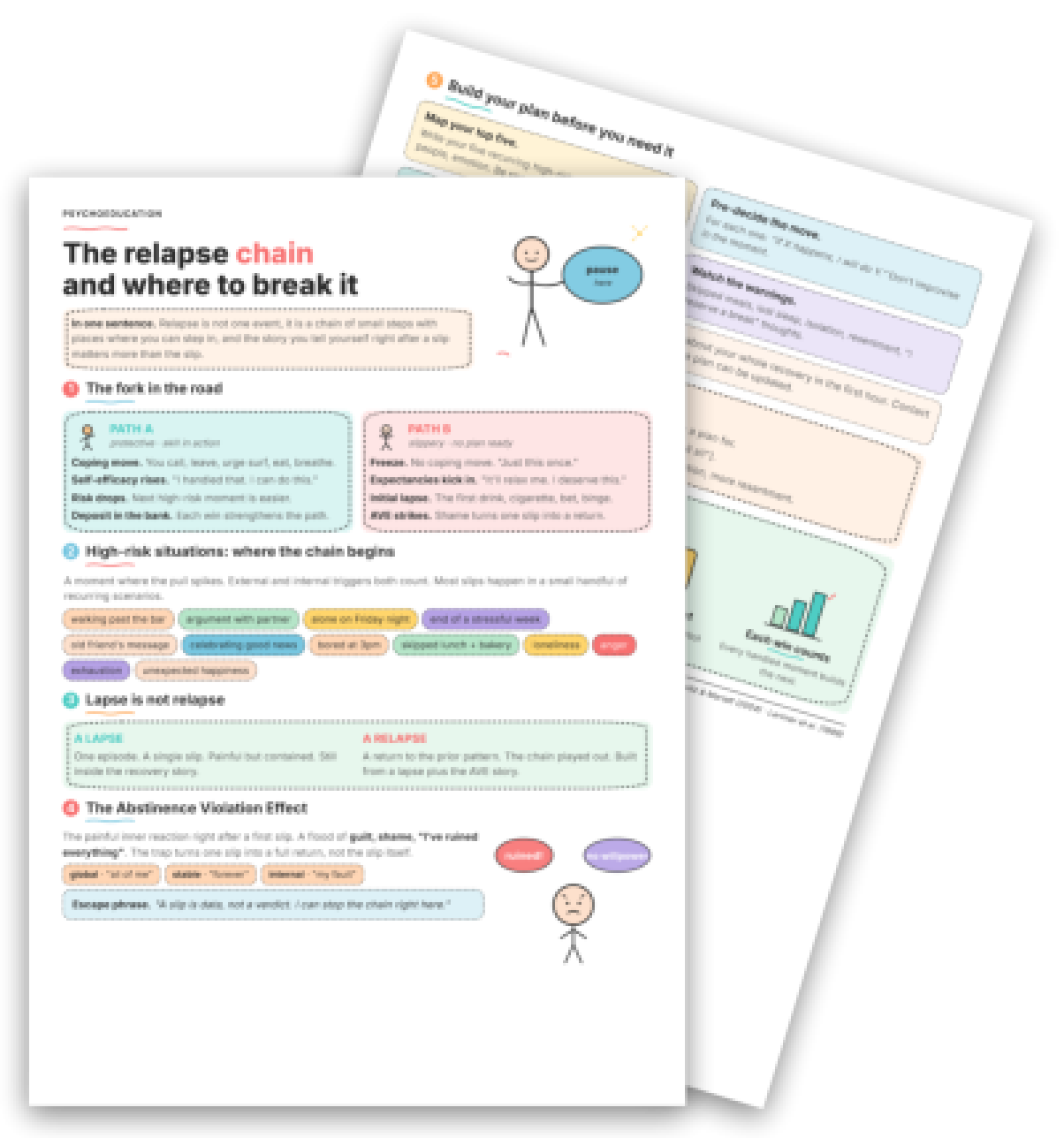
The fiche organizes the model into five sequenced panels, grounded in the original Marlatt & Gordon (1985) framework and the Witkiewitz & Marlatt (2004) reformulation.
- "The fork in the road" maps Path A (a coping move is deployed, self-efficacy rises, risk drops) against Path B (no plan, expectancies activate, initial lapse occurs, AVE strikes). The side-by-side layout makes the branching moment visible in a way that a spoken explanation cannot match.
- "High-risk situations" lists twelve concrete recurring scenarios across emotional, interpersonal, and contextual domains: walking past the bar, alone on Friday night, unexpected happiness. For patients who struggle to identify personal triggers, the list functions as a recognition prompt rather than a blank page.
- The lapse-vs-relapse panel defines each briefly, contrasting "a single slip, painful but contained" with "a return to the prior pattern, built from a lapse plus the AVE story."
- "The Abstinence Violation Effect" renders the AVE's three attributional dimensions (global, stable, internal) visually, alongside the reframe: "A slip is data, not a verdict."
- "Build your plan before you need it" closes with four concrete preparedness prompts: mapping the top five high-risk situations, pre-deciding if-then implementation intentions, playing the tape forward past the first ten minutes, and monitoring early warning signs.
A "To discuss in session" checklist at the foot of the fiche gives patients explicit return triggers: a recurring high-risk situation without a plan, a live AVE script after a slip, or stacking early warnings.
> Key point: The fiche is a visual support that facilitates the explanation of the relapse chain in session. It is not a standalone self-monitoring form. The clinician uses it as a shared reference during psychoeducation, then the patient keeps it as a concrete anchor between appointments.
750+ clinical tools
A library built with and for clinicians, ready to use in session and extend between appointments.
Access all the toolsWhen and How to Introduce the Fiche
The fiche fits naturally into the psychoeducation phase, once the therapeutic alliance is established and the patient has articulated at least one high-risk situation. In motivational interviewing contexts, it pairs well with building discrepancy around change or a decisional balance exercise once ambivalence begins to resolve. You can also use it alongside lapse and relapse management tools when the chain has already partially played out.
Introduce it without pathologizing: "I'd like to show you a map of how most slips actually unfold, so we can locate where the chain usually breaks for you." Work through sections one to three together, pausing at the patient's own scenarios from the high-risk list. Section four (the AVE) is often most useful immediately after an actual lapse, when the shame response is live rather than theoretical.
For section five planning, coping skills for addictions and evaluating coping strategy effectiveness are natural complements. The early-warning monitoring aligns directly with identifying and coping with triggers, and the if-then structure connects cleanly to ACT choice point work for patients already familiar with that framework. When shame is the primary AVE driver, a guided shame exercise can deepen what the fiche opens.
One limit worth naming: patients in acute destabilization may need containment before the chain structure is clinically useful. In those situations, lead with coping in crisis strategies and return to the fiche once affect is regulated.
The fiche does not replace the case formulation or the treatment plan. It renders one of the most clinically essential models in relapse prevention visible, shared, and workable in the room.
Use it with your patients
Share this tool in the mobile app and follow the work between sessions.
Sources
- Marlatt, G. A., & Gordon, J. R. (1985). Relapse Prevention: Maintenance Strategies in the Treatment of Addictive Behaviors. Guilford Press.
- Marlatt, G. A., & Donovan, D. M. (2005). Relapse Prevention: Maintenance Strategies in the Treatment of Addictive Behaviors (2nd ed.). Guilford Press.
- Witkiewitz, K., & Marlatt, G. A. (2007). Relapse Prevention. In G. A. Marlatt & D. M. Donovan (Eds.), Relapse Prevention (2nd ed.). Guilford Press.
Your session continues in your patients' pocket
Use with a patientYour resources, available everywhere
The handouts, exercises, programs and audios above: you choose which ones to make available to your patients, in the mobile app dedicated to them.
And far more than a library
The app goes well beyond resources, to support your patients every day:
Related categories
Explore other clinical resources by category.

Mood
Evidence-based worksheets and clinical tools for mood disorders: CBT, ACT, and positive psychology resources for psychologists and therapists.

Behaviours
Clinical hub for behaviors in therapy: worksheets and tools for coping, eating disorders, CBT formulation, and maladaptive behavioral patterns.

Understand
Clinical hub for the therapeutic aim 'Understand': worksheets and tools to build patient insight across CBT, ACT, schema therapy and more.

Prevent relapse
Prevention as a therapeutic aim: clinical framing, risk stratification, and printable resources for relapse prevention and early intervention in mental health.

CBT
CBT worksheets, cognitive restructuring exercises & behavioral tools for clinicians. Evidence-based resources for every phase of cognitive behavioral therapy.

Anxiety
Clinical hub for anxiety disorders: CBT and ACT worksheets, psychoeducation sheets, and exercises for assessment and treatment across the anxiety spectrum.