
Clinical picture. M., a man in his early forties, presented with alcohol use disorder and a history of brief abstinence periods consistently broken by weekend cravings triggered by boredom and social isolation. His previous approach had been effortful suppression, which he described as exhausting and ultimately ineffective. The clinician introduced the urge-surfing framework using the informational sheet, walking M. through the wave model and asking him to locate the physical sensations of a recent craving in his body rather than to resist them. Over three sessions, M. began narrating his urges in session using the four reminder phrases, noting that peak intensity felt shorter once he stopped treating it as a threat to defeat. At six-week follow-up he reported two high-craving episodes that had not resulted in drinking, attributing this partly to leaving the triggering location within two minutes as pre-decided.
Urge Surfing: PDF Worksheet, Tools and Exercises for Distress Tolerance
A printable PDF worksheet presenting the wave model, trigger mapping, and ready-to-use phrases to teach urge surfing visually in session.
Clinical vignettes
Urge Surfing in Alcohol Relapse Prevention
Urge Surfing for Binge-Eating Urges
Clinical picture. T., a woman in her late twenties, was seen for recurrent binge eating linked to late-evening stress and loneliness after work. She had tried distraction strategies with limited success, often describing the urge as something she had to outrun. The clinician used the informational sheet to reframe the urge as a time-limited wave, inviting T. to track its rise and fall on a simple paper log for two weeks rather than to act or resist. T. returned reporting that several urges had peaked and then dropped without any behavioural response, an experience she found genuinely surprising. She still binged on two occasions, but her self-critical response was less severe, and she began to distinguish trigger states (loneliness, fatigue) from the urge itself, which opened space for subsequent functional analysis work.
Explaining urge surfing verbally tends to flatten the concept into a reassurance ("it'll pass") that patients immediately distrust at the peak of an urge. This fiche PDF gives the wave model a shape on paper, making the 20-to-30-minute arc something a patient can actually hold onto outside the room.
Use this resource with your patients
Handout, exercises and materials ready to use, right inside SessionFuel.
Why urge surfing resists verbal explanation
When working with addiction, binge eating, self-harm, or any behaviour driven by craving, the central psychoeducation problem is always the same: patients at the peak of an urge experience it as infinite. Asking someone in acute interoceptive distress to trust a curve they have never tracked in themselves tends to produce polite compliance in session and collapse at home.
A second difficulty is structural. Most patients default to one of two stances: white-knuckling (which amplifies the urge through suppression, a dynamic documented in work on thought suppression and intrusive thoughts) or acting on it. The third option, observing the urge without feeding it, requires a frame that is concrete enough to locate in the body when the wave is already rising. A verbal sketch rarely provides that.
What the fiche contains: a visual support for the explanation
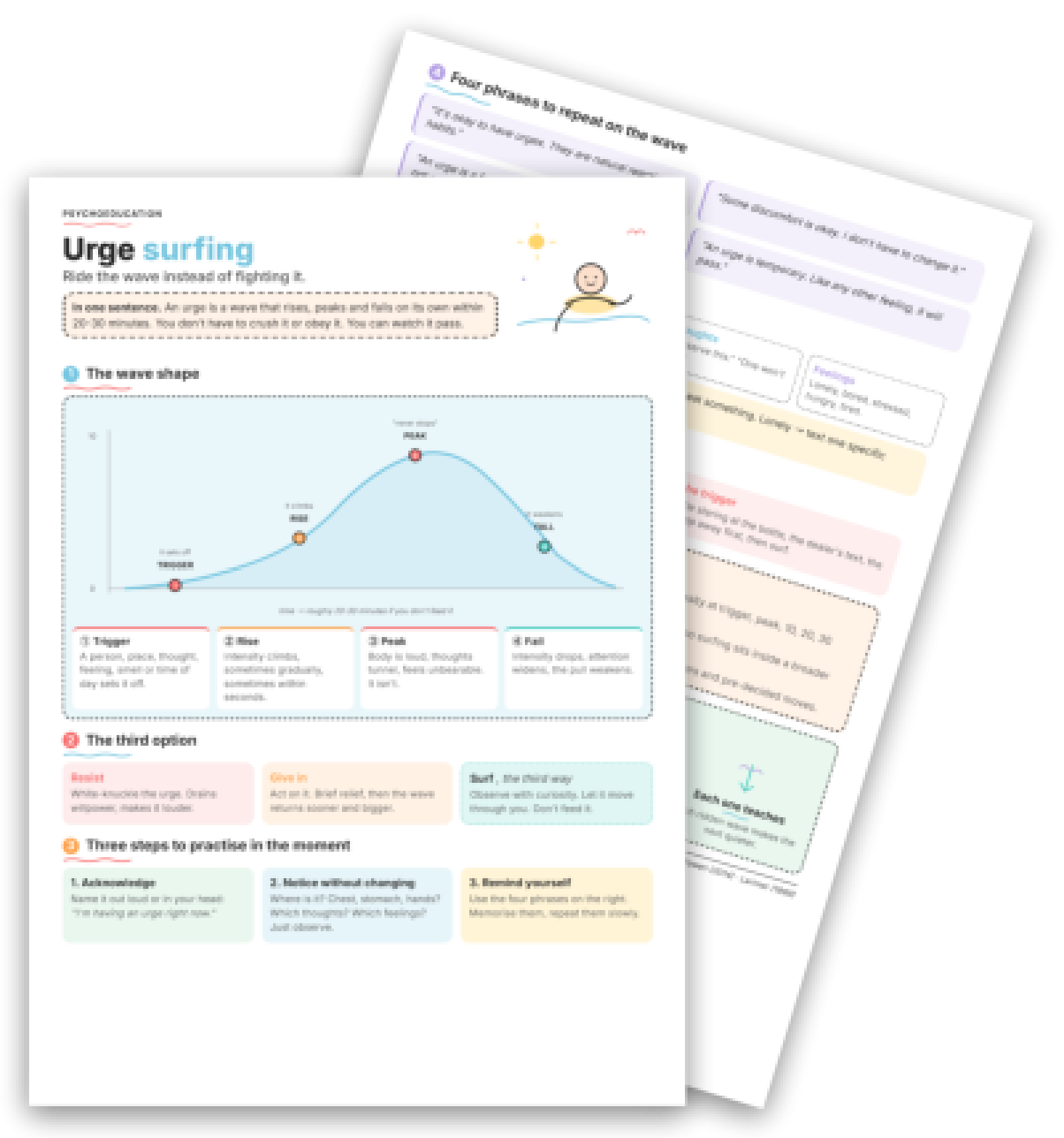
The sheet moves through six panels, from theory to application, and the whole point is to work through it with the patient rather than hand it over cold.
Panel one shows the wave diagram: a curve labelled trigger → rise → peak → fall, annotated with "roughly 20-30 minutes if you don't feed it." Pointing to the peak label while reading aloud "'never stops' is what peaks feel like" does something a verbal explanation cannot: it separates the subjective experience from the objective trajectory. The patient can see where they usually abort.
Panel two names the three-option model: resist, give in, or surf. Having all three options side by side makes the cost structure legible. Panel three lays out three steps (acknowledge, observe somatically, repeat four phrases) and prints those phrases verbatim on the sheet, including "An urge is a feeling, not a must. I can feel this and not act." The patient leaves with the exact words to use mid-wave.
Panels five and six cover trigger mapping and common pitfalls. The pitfalls panel distinguishes fake surfing ("watching it so it goes away faster") from genuine non-controlling observation, and specifies that surfing while in direct proximity to the cue fails because stimulus exposure keeps the urge fed. The sheet closes with a "To discuss in session" callout that flags three junctures requiring clinical judgment, including urges involving high-overdose-risk substances, where surfing must sit inside a broader safety plan.
> Key point: The fiche is a visual teaching support you work through together in session; it is not a self-administered checklist. The wave diagram and three-option model carry the explanatory load, and the patient leaves with a reference card for the moment the urge actually hits.
The content maps naturally onto DBT distress tolerance skills and sits alongside tools like TIPP skills and radical acceptance. The wave model also connects directly to Marlatt and Gordon's relapse model, whose craving arc underpins the original protocol.
750+ clinical tools
A library built with and for clinicians, ready to use in session and extend between appointments.
Access all the toolsWhen and how to introduce it in session
The fiche is well placed once an avoidance or craving pattern is established in the formulation, usually from session two or three onward. For patients whose profile includes adaptive vs. maladaptive coping work, it provides a concrete behavioral alternative. Within addiction coping skills work, it pairs naturally with lapse and relapse management.
Introduce it without labelling past behaviour: "I'd like to show you something that maps what happens physiologically when a craving hits, so we can look at it together." Walk through the wave diagram first, ask where the patient typically bails out, then go through the three steps and the four phrases together. The trigger identification work the patient has already done feeds directly into panel five, making it straightforward to co-construct pre-decided moves.
One clinical limit worth naming: if the urge targets serious self-harm, orient to the safety callout on the sheet first and ensure surfing sits inside a safety plan. Pairing the fiche with coping in crisis strategies and DBT ACCEPTS skills gives patients in higher-risk situations a fuller toolkit. For patients who find observational distance difficult to build from a purely behavioral frame, ACT cognitive defusion techniques can reinforce the non-controlling stance, and grounding techniques may need to come first if affect tolerance is still being built.
The fiche does not replace the therapeutic frame; it makes the explanation precise enough that a patient can actually use it at 2 a.m., alone, when the wave is already rising.
Use it with your patients
Share this tool in the mobile app and follow the work between sessions.
Sources
- Marlatt, G. A., & Gordon, J. R. (1985). Relapse Prevention: Maintenance Strategies in the Treatment of Addictive Behaviors. Guilford Press.
- Bowen, S., Chawla, N., Grow, J., & Marlatt, G. A. (2021). Mindfulness-Based Relapse Prevention for Addictive Behaviors: A Clinician's Guide (2nd ed.). Guilford Press.
- Harris, J. S., Stewart, D. G., & Stanton, B. C. (2017). Urge surfing as aftercare in adolescent alcohol use: A randomized control trial. Mindfulness, 8(1), 144-149.
Your session continues in your patients' pocket
Use with a patientYour resources, available everywhere
The handouts, exercises, programs and audios above: you choose which ones to make available to your patients, in the mobile app dedicated to them.
And far more than a library
The app goes well beyond resources, to support your patients every day:
Related categories
Explore other clinical resources by category.

Emotions
Clinical resources on emotion regulation: worksheets, coping tools, CBT, REBT, and ACT exercises for therapists working across diagnoses and age groups.

Behaviours
Clinical hub for behaviors in therapy: worksheets and tools for coping, eating disorders, CBT formulation, and maladaptive behavioral patterns.

Build awareness
Clinical worksheets and tools to build awareness in therapy: cognitive distortions, schemas, emotions, ACT and CBT resources for practitioners.

Regulate
Clinical resources for emotion regulation: worksheets, ACT exercises, and psychoeducation tools for affect regulation across diagnoses. For clinicians.

Prevent relapse
Prevention as a therapeutic aim: clinical framing, risk stratification, and printable resources for relapse prevention and early intervention in mental health.

ACT
Clinical hub for Acceptance and Commitment Therapy (ACT): worksheets, exercises, programs and audio resources for practitioners using the ACT model.