
M., a 38-year-old professional, had been abstaining from alcohol for six weeks when he drank three glasses of wine at a work event. He arrived at his next session describing the evening as proof that his efforts had been wasted. The clinician introduced the lapse-relapse distinction using the informational sheet, locating the event at station 5 of the change loop and inviting M. to examine what followed the drinks, not only the drinks themselves. M. noted he had returned to his usual routine the next morning and had not drunk since. Framing the episode as a recoverable single-night lapse, rather than a collapse of progress, reduced his shame enough to allow functional analysis of the situational trigger.
HandoutBehaviours & addictionsMood & depressionPrevent relapseBuild awarenessCBTMotivational interviewing
Lapse and Relapse Management: PDF Worksheet, Tools and Exercises
A visual PDF worksheet, clinical tools, and structured exercises to help patients distinguish a lapse from a relapse and turn a slip into a learning moment.
Clinical vignettes
Reframing a Lapse in Alcohol Reduction
Distinguishing Relapse from Failure in Binge Eating
T., a woman in her mid-forties working on binge eating, reported a two-week return to nightly episodes following a family bereavement, accompanied by the belief that her six months of structured work had been cancelled out. The clinician used the sheet's lapse-relapse distinction to help T. name what had occurred: a relapse shaped by a discrete stressor, not a permanent reversal of her acquired skills. They reviewed the 'what the hell' effect by name, identifying the moment her internal narrative shifted from 'one hard evening' to 'I have already broken it'. T. left the session with a written re-entry plan focused on station 6, with the explicit understanding that skill retention does not depend on an unbroken record.
The session immediately after a reported slip is one of the harder consultation moments: the patient arrives flooded with shame, convinced they are back to square one, and a purely verbal reframe tends to bounce off that conviction. This fiche PDF gives you a shared visual framework to use in the room when that moment arrives, so the explanation lands rather than slides.
Use this resource with your patients
Handout, exercises and materials ready to use, right inside SessionFuel.
Why the lapse/relapse distinction rarely holds when explained verbally
The core clinical problem is not information deficit. Most patients know, at some level, that a lapse is not a relapse. The difficulty is that shame activates all-or-nothing thinking the instant a slip occurs, and any deviation gets cognitively coded as total failure. A discursive reframe delivered by the clinician is usually insufficient to shift that framing in the moment.
There is a second difficulty: patients rarely carry a working vocabulary for what just happened. Without a clear distinction between "brief, one-off, recoverable" and "a return to the old way of living", they conflate any deviation with full collapse. This is precisely the abstinence violation effect described by Polivy & Herman (2002), named in the fiche as the "what the hell" effect: the thought "I have already broken it, I might as well keep going" does more clinical damage than the slip itself. Naming that mechanism and showing it visually are two different things.
What the fiche contains: a loop, a taxonomy, and five questions
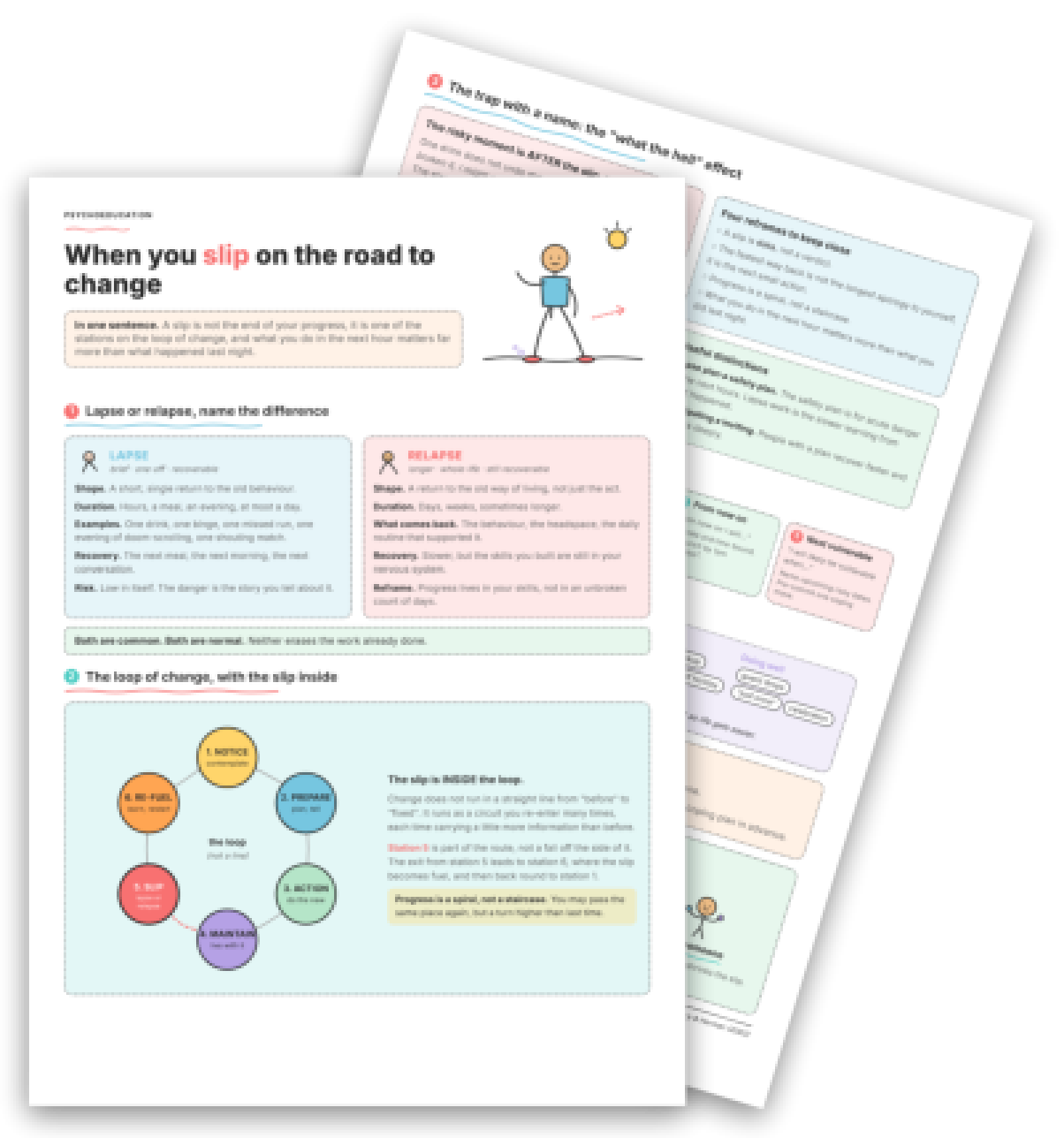
The fiche PDF is organised across five panels, each doing specific clinical work.
Panel 1 sets out the lapse/relapse distinction in explicit, contrasting terms across duration, shape, and recovery path. The language is precise and non-pathologising: a lapse is "hours, a meal, an evening, at most a day" and recovery is "the next meal, the next morning, the next conversation". Having those definitions visible to both clinician and patient cuts through cognitive noise faster than oral explanation.
Panel 2 presents the loop of change, grounded in Prochaska & DiClemente's transtheoretical model, as a six-station circuit: notice, prepare, action, maintain, slip, re-fuel. The decisive clinical move here is visual: the slip is drawn inside the loop, not outside it. Patients immediately see that station 5 leads to station 6, then back to station 1. That single diagram achieves what ten minutes of explanation often does not. For patients already engaged in building discrepancy and motivation for change, this panel extends that work concretely into the maintenance phase.
Panel 3 names the "what the hell" effect and lists four classic shame-cognitions to catch ("I am back to square one", "I knew I could not do this"), alongside four reframes, including "A slip is data, not a verdict". This is ready-made psychoeducation that the visual format makes scannable. The patient can return to it between sessions without reconstructing what was said in the room.
Panels 4 and 5 carry structured clinical content. Panel 4 offers five questions designed to convert a slip into usable learning: the understandable reasons, what was learnt, the branch point two hours before the slip, a concrete plan from now on, and upcoming vulnerable moments. Panel 5 maps high-risk situations across five domains: strong feelings, people and places, body states, transitions, and periods of doing well. That last category is worth pausing on explicitly in session; it is counterintuitive, and the fiche names why: "vigilance softens just as life gets easier." This pairs naturally with identifying emotional triggers and with auditing adaptive versus maladaptive coping patterns.
> Key point: the fiche is a visual support that facilitates the explanation of lapse and relapse management in session. The five questions in panel 4 are designed to be walked through jointly with the clinician, not handed to the patient to complete alone between appointments.
Clinical library
750+ clinical tools
A library built with and for clinicians, ready to use in session and extend between appointments.
Access all the toolsSeveral resource types
Psychoeducation handouts
Understand at a glance
Interactive exercises
To do and fill in
Interactive programs
A structured path
Audios
Meditation and relaxation
Psychometric tests
Automatic scoring
When and how to propose it
The fiche is most useful at two moments. The first is proactively, in the maintenance phase of a behaviour change programme, before any slip has occurred. Presenting the loop of change while things are going well normalises the slip station and dramatically reduces the cognitive damage if one does happen. This fits naturally alongside building new habits, evaluating coping strategy effectiveness, and goal-setting for sustainable behaviour change. For patients working on motivation, linking it to a structured programme for finding motivation to change gives the fiche a clear position in the overall arc.
The second moment is reactively, in the session immediately after a reported lapse. A useful introduction: "Before we talk through what happened, I want to show you a map that names exactly what you are describing. Let's locate where you are on it." That framing positions the patient as making sense of a predictable process rather than confessing a personal failure.
For patients with addictive behaviours, the high-risk taxonomy in panel 5 pairs directly with coping skills for addiction recovery planning. For patients where maintaining hope and resilience is fragile, panel 2's spiral metaphor offers an image to hold between sessions. A note on contraindications: in acute crisis presentations, the fiche is not the right first move; the distinction between a lapse plan and a safety plan is stated explicitly in the fiche itself, and it is worth voicing that distinction when you introduce the resource.
The fiche does not replace the therapeutic framework; it makes the explanation precise, fast, and visible, and leaves the patient with a concrete reference when the shame-spiral is most likely to take over.
Use it with your patients
Share this tool in the mobile app and follow the work between sessions.
Sources
- Marlatt, G. A., & Gordon, J. R. (1985). Relapse Prevention: Maintenance Strategies in the Treatment of Addictive Behaviors. Guilford Press.
Patient mobile app
Your session continues in your patients' pocket
Use with a patientYour resources, available everywhere
The handouts, exercises, programs and audios above: you choose which ones to make available to your patients, in the mobile app dedicated to them.
Psychoeducation handoutsInteractive exercisesInteractive programsAudiosPsychometric tests
And far more than a library
The app goes well beyond resources, to support your patients every day:
Standardized tests
Therapy journal
Gamification
Wellbeing challenges
Introspection prompts
Therapist homework
Related categories
Explore other clinical resources by category.

Mood
Evidence-based worksheets and clinical tools for mood disorders: CBT, ACT, and positive psychology resources for psychologists and therapists.

Behaviours
Clinical hub for behaviors in therapy: worksheets and tools for coping, eating disorders, CBT formulation, and maladaptive behavioral patterns.

Build awareness
Clinical worksheets and tools to build awareness in therapy: cognitive distortions, schemas, emotions, ACT and CBT resources for practitioners.

Prevent relapse
Prevention as a therapeutic aim: clinical framing, risk stratification, and printable resources for relapse prevention and early intervention in mental health.

CBT
CBT worksheets, cognitive restructuring exercises & behavioral tools for clinicians. Evidence-based resources for every phase of cognitive behavioral therapy.

Motivational interviewing
Clinical hub for Motivational Interviewing resources: worksheets, exercises and programs to support MI-based behaviour change work in your practice.