
Clinical picture. A. is a woman in her late thirties referred for panic disorder with prominent agoraphobic avoidance; she had stopped using public transport and was working from home exclusively by the time treatment began. After twelve sessions combining psychoeducation, interoceptive exposure, and situational work, she had resumed commuting and attending social events with only mild anticipatory anxiety. In the final session the clinician introduced the Therapy Blueprint worksheet, inviting A. to write, in her own words, what her panic had looked like, what had kept it running (notably pulse-checking and a water bottle carried everywhere), and a specific if-then plan for any future wobble. A. identified 'racing heart means danger' as her core catastrophic story and wrote a counter-statement grounded in her own exposure experiences rather than the clinician's phrasing. She left with a single handwritten page she described as 'a record I actually trust, because I wrote it.'
Therapy Blueprint for Panic: PDF Worksheet, Tools and Exercises
A one-page visual consolidation tool clinicians can use near the end of panic work to anchor learning, name early warning signs, and give patients a concrete relapse plan.
Clinical vignettes
Blueprint as Consolidation at Discharge
Blueprint Revisited After Relapse Scare
Clinical picture. T. is a man in his mid-forties with a history of panic disorder, treated successfully two years prior, who returned for two booster sessions after a cluster of panic attacks following a period of occupational stress. The clinician retrieved the blueprint T. had completed at the end of his original course; reviewing it together, T. recognised that he had quietly reinstated several safety behaviours, including sitting near exits at meetings and avoiding caffeine entirely, which the blueprint had explicitly flagged as warning signs. Rather than restarting a full treatment course, the clinician used the document as a structured anchor, prompting T. to update the future-plan section to reflect the new context. By the second booster session T. reported the attacks had subsided and attributed this partly to having a concrete reference point that reminded him what he already knew.
Patients near the end of panic work can articulate Clark's model fluently, complete interoceptive exposures without avoidance, and report significant symptom reduction, and then arrive at a wobble three months later with no map. This fiche PDF is designed for exactly that gap: a single visual consolidation tool the clinician uses in session to co-construct the patient's personal panic narrative across past, present, and future, leaving them with something concrete to return to on a bad day.
Use this resource with your patients
Handout, exercises and materials ready to use, right inside SessionFuel.
Why the End of Panic Work Is Clinically Tricky
The final phase of CBT for panic tends to collapse the explicit knowledge the patient has built. Discharge feels abstract. Patients know they improved, but the mechanism, what kept it going, what changed it, lives in scattered session notes and half-remembered metaphors. Without a structured consolidation, the panic maintenance cycle risks being forgotten precisely when it is most needed.
There is also a subtler problem: many patients confuse the absence of panic with the end of vulnerability. They stop monitoring early warning signs and discard the toolkit that built their gains. When a stressor reactivates symptoms, the relapse feels like proof they were never really better, not information to work with.
An oral summary at the end of a session rarely holds. The support visuel changes this: a patient who has written their own blueprint has encoded the formulation in their own language, in a format they can find.
What the Fiche Contains
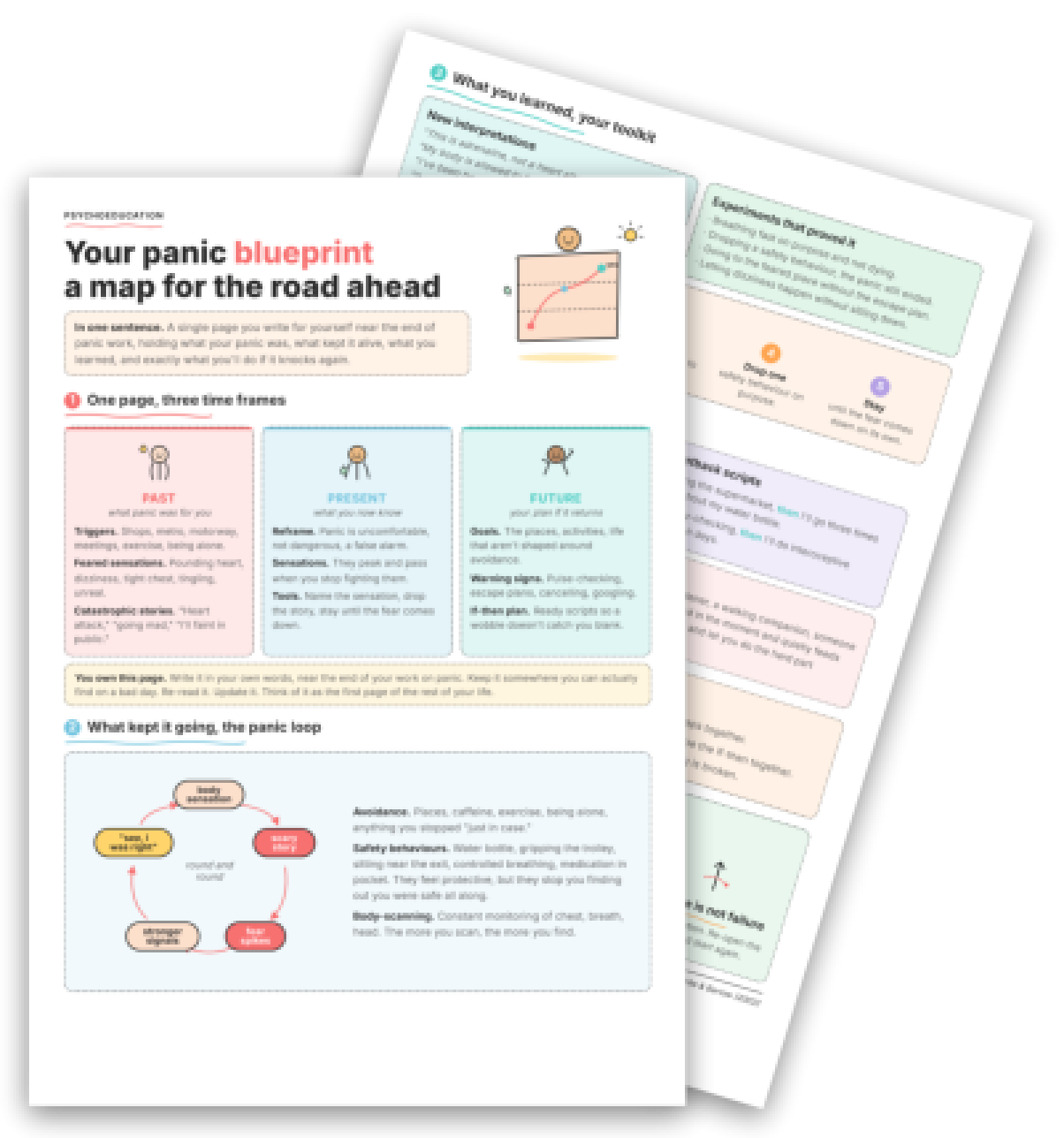
The fiche is structured around four numbered panels that flow from formulation to action plan.
Panel 1 maps three time frames on a single page: PAST (triggers, feared sensations, catastrophic stories, the patient fills in their own specifics: "Shops, metro, motorway, meetings, exercise, being alone"), PRESENT (the reframe: "Panic is uncomfortable, not dangerous, a false alarm"; sensations and tools), and FUTURE (avoidance-free goals, warning signs, if-then scripts). This tri-temporal layout, visible at a glance, gives the patient a coherent account of where they were, what shifted, and where they are headed. It is far more legible than any verbal summary.
Panel 2 diagrams the panic loop explicitly, body sensation, scary story, fear spike, stronger signal, confirmation bias, alongside the three maintenance mechanisms that tend to be hardest to surrender: avoidance, safety behaviours, and body-scanning. Seeing all three together on a printable supports the conversation about which the patient is still carrying.
Panel 3 is the patient's personal toolkit: new interpretations in their own words, the interoceptive and situational experiments they completed, and the five moves now available to them (Catch, Name, Slow exhale, Drop one, Stay). Naming experiments they actually ran, "Breathing fast on purpose and not dying", "Dropping a safety behaviour, the panic still ended", consolidates the learning far better than generic instructions.
Panel 4 builds the if-then plan: early warning signs to watch for (pulse-checking, googling, cancelling, skipping exercise), scripted responses for specific scenarios, and a named support network with guidance on what not to ask of them. The fiche also includes a "To discuss in session" block specifying three clinical moments: drafting the blueprint mid-completion in session, flagging a warning sign before acting on it, and bringing a wobble as data rather than failure.
> Key takeaway: the Blueprint is not a homework form the patient completes alone. It is a visual support the clinician and patient build together, anchoring the full formulation in the patient's own language and leaving them with a one-page resource they can find and re-read.
750+ clinical tools
A library built with and for clinicians, ready to use in session and extend between appointments.
Access all the toolsWhen and How to Introduce It
Introduce the Blueprint in the penultimate or final session of active panic work, after the exposure hierarchy has been substantially completed and the patient has direct experiential evidence that panic subsides without escape. You might frame it: "What I'd like us to do today is write down everything you've learned about your panic in a format you can actually use on a difficult day." Framing it as a collaborative writing exercise, not an evaluation, keeps the alliance intact.
For patients with residual safety behaviours, panels 2 and 3 together support a direct conversation about what is still functioning as a crutch. For those with high relapse anxiety, the if-then scripts in panel 4 de-catastrophise the idea of a wobble before it happens.
A natural pairing: combine the Blueprint with your existing lapse and relapse framework and, where habituation was a core concept in the work, reference it in the panel 3 toolkit section. The Blueprint does not replace the therapeutic frame; it makes the patient's hard-won learning portable.
Use it with your patients
Share this tool in the mobile app and follow the work between sessions.
Sources
- Salkovskis, P. M. (1991). The importance of behaviour in the maintenance of anxiety and panic: A cognitive account. Behavioural and Cognitive Psychotherapy, 19(1), 6-19.
- Clark, D. M., Salkovskis, P. M. (2009). Cognitive Therapy for Panic Disorder: IAPT Manual. Oxford Cognitive Therapy Centre.
- Craske, M. G., Barlow, D. H. (2022). Mastery of Your Anxiety and Panic: Workbook (5th ed.). Oxford University Press.
- National Institute for Health and Care Excellence (NICE) (2011). Generalised anxiety disorder and panic disorder in adults: management (CG113).
Your session continues in your patients' pocket
Use with a patientYour resources, available everywhere
The handouts, exercises, programs and audios above: you choose which ones to make available to your patients, in the mobile app dedicated to them.
And far more than a library
The app goes well beyond resources, to support your patients every day:
Related categories
Explore other clinical resources by category.

Anxiety
Clinical hub for anxiety disorders: CBT and ACT worksheets, psychoeducation sheets, and exercises for assessment and treatment across the anxiety spectrum.

Build awareness
Clinical worksheets and tools to build awareness in therapy: cognitive distortions, schemas, emotions, ACT and CBT resources for practitioners.

Prevent relapse
Prevention as a therapeutic aim: clinical framing, risk stratification, and printable resources for relapse prevention and early intervention in mental health.

CBT
CBT worksheets, cognitive restructuring exercises & behavioral tools for clinicians. Evidence-based resources for every phase of cognitive behavioral therapy.
Trauma
Clinical hub on trauma and PTSD: assessment, differential diagnosis, treatment phases, and printable resources for practitioners. 155 chars.

Mood
Evidence-based worksheets and clinical tools for mood disorders: CBT, ACT, and positive psychology resources for psychologists and therapists.