
Clinical picture. M., a 34-year-old accountant, presented with recurrent panic attacks triggered by any perceived cardiac irregularity; he had reduced physical activity and avoided caffeine entirely for two years. After reviewing the informational sheet with his therapist, he understood that avoidance was sustaining his fear rather than protecting him. The therapist introduced stair-climbing as a first in-session exercise, with M. remaining in the office while his heart rate rose. He reported strong anticipatory anxiety that subsided within four minutes without any safety behaviour. Across three sessions of graded provocations, M. began self-initiating brief runs before work, noting that his catastrophic appraisals of tachycardia had become noticeably less automatic.
Fear of Body Sensations: PDF Worksheet, Tools and Exercises for Interoceptive Exposure
A visual PDF worksheet clinicians can use in session to explain interoceptive exposure, break the avoidance loop, and give patients a concrete practice guide to take home.
Clinical vignettes
Interoceptive Exposure in Panic Disorder
Dizziness Exposure After Vestibular Clearance
Clinical picture. L., a 29-year-old teacher, described persistent fear of dizziness following a single episode of vertigo eighteen months prior; all medical and vestibular investigations had returned normal results. She had stopped turning quickly, avoided crowded corridors, and sat near exits as standard practice. Using the exposure menu from the sheet, the clinician guided her through one minute of slow chair-spinning in session, then asked her to stay seated and observe what followed. L. noted that the dizziness peaked and faded within ninety seconds and that she did not lose control or fall, which she had expected. Homework was set with a simple log; by the fourth week she reported that corridor avoidance had dropped substantially and her anticipatory vigilance before school was reduced.
Interoceptive exposure is one of the most evidence-based components of CBT for panic disorder, yet it remains stubbornly difficult to explain verbally. Patients understand the logic in the room, then go home and avoid the very sensations they agreed to provoke. This PDF worksheet bridges that gap by making the rationale, the exercise menu, and the prediction-tracking structure visible and portable, so the explanation lands in session and the practice actually happens between appointments.
Use this resource with your patients
Handout, exercises and materials ready to use, right inside SessionFuel.
Why Fear of Body Sensations Resists Verbal Explanation Alone
The core mechanism here is well established: catastrophic misappraisal of benign physiological signals maintains the fear, and safety behaviours (sitting down, slowing the breath, scanning the pulse, leaving the situation) prevent disconfirmation. What trips patients up, though, is that the logic of deliberate provocation sounds paradoxical when you say it aloud. "Spin in a chair on purpose to get dizzy" meets genuine resistance, not because patients distrust you, but because avoidance operates below the level of rational consent.
A verbal explanation also tends to leave the prediction-testing structure implicit. Patients hear "stay with the sensation until it passes" without retaining the precise sequence: write the catastrophic prediction before, observe what actually happens, note it immediately after. Without that sequence externalised on paper, the corrective learning that Craske's inhibitory model describes simply does not consolidate. The CBT model of fear of body sensations makes this maintenance loop visible; this worksheet gives you the practical counterpart, something the patient can hold, read, and return to.
What the Worksheet Contains, and Why the Visual Format Matters
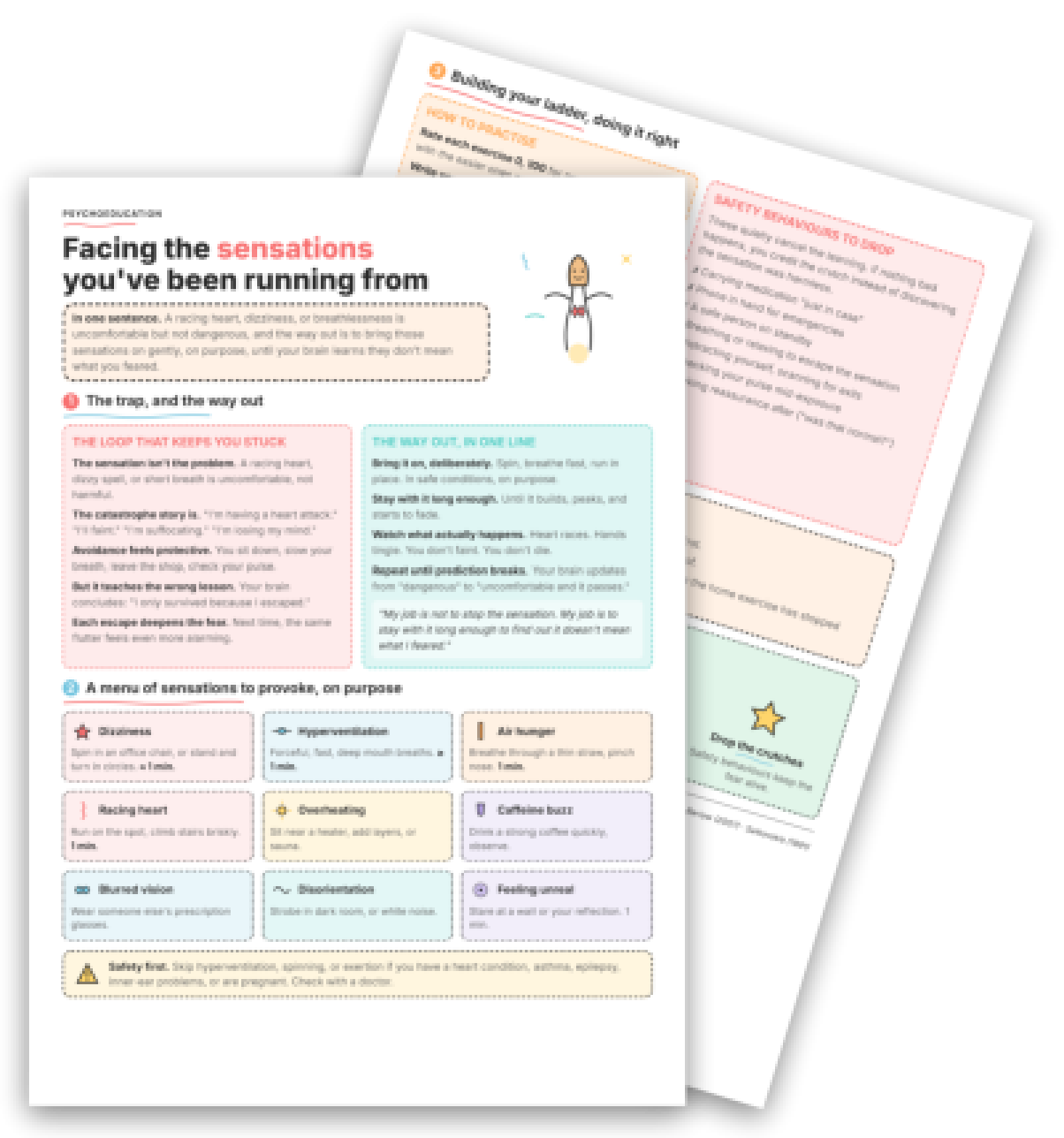
The fiche is structured across three panels, each designed to support a distinct moment of the psychoeducation.
- Panel 1: "The trap, and the way out" maps the full maintenance cycle: the sensation itself is not the problem ("A racing heart, dizzy spell, or short breath is uncomfortable, not harmful"), the catastrophic story is ("I'm having a heart attack / I'll faint / I'm losing my mind"), and each escape deepens the fear. The visual contrast between the loop that keeps patients stuck and the one-line exit strategy makes it far easier to point to than to narrate.
- Panel 2: A menu of nine interoceptive exercises with standardised durations: spinning in a chair for dizziness, forceful mouth breathing for hyperventilation, breathing through a straw for air hunger, stair climbing for a racing heart, and five further exercises targeting overheating, caffeine buzz, blurred vision, disorientation, and derealisation. The menu format lets you and the patient choose a starting point together based on which sensations are most feared, mirroring the construction of a graded exposure hierarchy.
- Panel 3: "Building your ladder, doing it right" gives explicit instructions for prediction-testing (rate predicted distress 0-100, write the specific catastrophe before, record what actually happened after) and lists seven safety behaviours to drop, including carrying medication "just in case," checking the pulse mid-exposure, and seeking reassurance afterwards. This section also cues the patient on three specific situations worth bringing back to session, preserving the collaborative frame.
> Key takeaway: This worksheet is a visual support that facilitates in-session explanation of interoceptive exposure. It is not a self-help questionnaire the patient fills out alone. Use it as a shared reference while you build the rationale together, then send it home as a structured practice guide.
The safety warning embedded in Panel 2 (contraindications including cardiac conditions, asthma, epilepsy, inner-ear pathology, and pregnancy) is worth reading aloud before handing the sheet over, not as a disclaimer but as a clinical check that belongs in the conversation.
750+ clinical tools
A library built with and for clinicians, ready to use in session and extend between appointments.
Access all the toolsWhen and How to Introduce the Worksheet in Clinical Practice
This fiche fits naturally once the avoidance cycle has been mapped and the patient understands the maintenance model, typically from session two or three onward in a panic-focused protocol. It is equally useful in health anxiety presentations where somatic hypervigilance is prominent, and in social anxiety cases where blushing, heart racing, or voice tremor are the feared triggers.
A practical introduction might be: "I'd like to show you something that explains what we'll be doing together over the next few weeks. It's not a homework form yet, just a map." Going through Panel 1 first anchors the rationale before you move to the exercise menu. Resist the pull to assign all nine exercises at once. Collaboratively rate predicted distress for two or three, select the lowest-rated one as the first rung, and agree on how many repetitions constitute a "clearly disconfirmed" prediction. The anxiety physical sensations monitoring exercise can run in parallel if you need a baseline of which sensations are most activating before building the ladder.
For debrief, ask specifically whether the patient used any of the listed safety behaviours. The graded exposure self-report tool pairs well here for tracking progression rung by rung. If derealisation is a prominent feared sensation, the depersonalisation resource offers complementary psychoeducation. And if the feared sensations extend to losing mental control rather than fainting or cardiac events, consider also introducing the fear of losing control of the mind worksheet.
The worksheet does not replace your formulation or the therapeutic alliance. What it does is externalise a protocol that is genuinely hard to hold in memory, giving both you and the patient a shared reference point that keeps prediction-testing central, safety behaviours visible, and the corrective learning on track.
Use it with your patients
Share this tool in the mobile app and follow the work between sessions.
Sources
- Barlow, D. H., & Craske, M. G. (2007). Mastery of Your Anxiety and Panic: Therapist Guide (4th ed.). Oxford University Press.
Your session continues in your patients' pocket
Use with a patientYour resources, available everywhere
The handouts, exercises, programs and audios above: you choose which ones to make available to your patients, in the mobile app dedicated to them.
And far more than a library
The app goes well beyond resources, to support your patients every day:
Related categories
Explore other clinical resources by category.

Anxiety
Clinical hub for anxiety disorders: CBT and ACT worksheets, psychoeducation sheets, and exercises for assessment and treatment across the anxiety spectrum.

Health
Somatic health clinical resources for practitioners: worksheets, psychoeducation, and exercises for somatic symptom disorder, chronic pain, and more.

Understand
Clinical hub for the therapeutic aim 'Understand': worksheets and tools to build patient insight across CBT, ACT, schema therapy and more.

Exposure
Exposure therapy clinical resources for practitioners: worksheets, hierarchies, and psychoeducation tools for anxiety, PTSD, OCD, and avoidance-based presentations.

CBT
CBT worksheets, cognitive restructuring exercises & behavioral tools for clinicians. Evidence-based resources for every phase of cognitive behavioral therapy.

Trauma
Clinical hub on trauma and PTSD: assessment, differential diagnosis, treatment phases, and printable resources for practitioners. 155 chars.