
Clinical picture. M., a man in his late thirties, presented with a longstanding fear of heights that had led him to refuse a promotion requiring a glass-walled office on the fourteenth floor. He reported white-knuckle gripping of railings, avoidance of escalators, and a habitual crouch whenever he approached any drop. Using the exposure worksheet in session, the clinician and M. collaboratively placed him at rung 8 (riding an escalator while looking down) as a challenging but workable starting point, identifying his key safety behaviour as fixing his gaze at floor level. Over three weeks he repeated the step in different locations and without gaze-avoidance, then moved to standing on a second-floor balcony; his subjective distress remained present but no longer drove the avoidance decisions he had been making at work.
Fear of Heights: PDF Worksheet, Tools and Exercises for Exposure Practice
A 20-step exposure ladder, safety-behaviour mapping, and session-ready psychoeducation tools for clinicians treating acrophobia in CBT practice.
Clinical vignettes
Graded Ladder, Dropped Safety Behaviours
Prediction Testing on a High Bridge
Clinical picture. R., a woman in her mid-forties, described a specific fear that she would "lose control and jump" whenever she stood near an open height, a cognition that had kept her from crossing a pedestrian bridge on her daily commute for two years. The clinician introduced the worksheet's prediction-testing frame: R. wrote her explicit forecast before each exposure and recorded what actually occurred. Beginning with imaginal rehearsal and progressing to standing at a first-floor window without holding the frame, she reached rung 14 (crossing a real high bridge) by session eight. She reported that the feared loss of control never materialised, which she identified as more persuasive than any prior verbal reassurance had been.
Acrophobia is one of the most prevalent specific phobias, and yet graded exposure is chronically under-delivered in routine practice. The friction is rarely conceptual: most clinicians know the inhibitory learning model. The friction is translational, getting a patient from intellectually accepting the rationale to actually standing on a third-floor balcony, hands off the rail, without smuggling in every safety behaviour they own. This PDF worksheet is a visual support that does that translational work in session, on paper, in front of the patient, before a single live exposure is assigned.
Use this resource with your patients
Handout, exercises and materials ready to use, right inside SessionFuel.
Why exposure for fear of heights stalls before it starts
The avoidance reinforcement cycle in acrophobia is particularly compelling because each detour (skipping the glass elevator, refusing the plane window seat, staying glued to the inner wall of a rooftop bar) delivers immediate relief. Oral explanations of the maintenance cycle rarely dislodge that. Without a visual, patients miss the subtler point: their safety behaviours do the same maintaining work as full avoidance. Gripping the rail with both hands, running a silent reassurance loop, crouching near the edge rather than standing at it, all of these prevent the brain from collecting new evidence. The threat appraisal never updates.
The second sticking point is calibration. Patients presenting with significant acrophobia tend to either catastrophise the exposure task entirely or, at the other extreme, rush past easier rungs and conclude the approach fails them. Explaining variability verbally ("do the same balcony at different times, with and without a companion") lands very differently from seeing it spelled out as a clinical principle alongside a ranked, 20-step ladder. The Comfort, Stretch and Panic Zones worksheet can support this calibration discussion if you need an additional visual frame before introducing the ladder itself.
750+ clinical tools
A library built with and for clinicians, ready to use in session and extend between appointments.
Access all the toolsWhat the worksheet contains, and what the visual adds
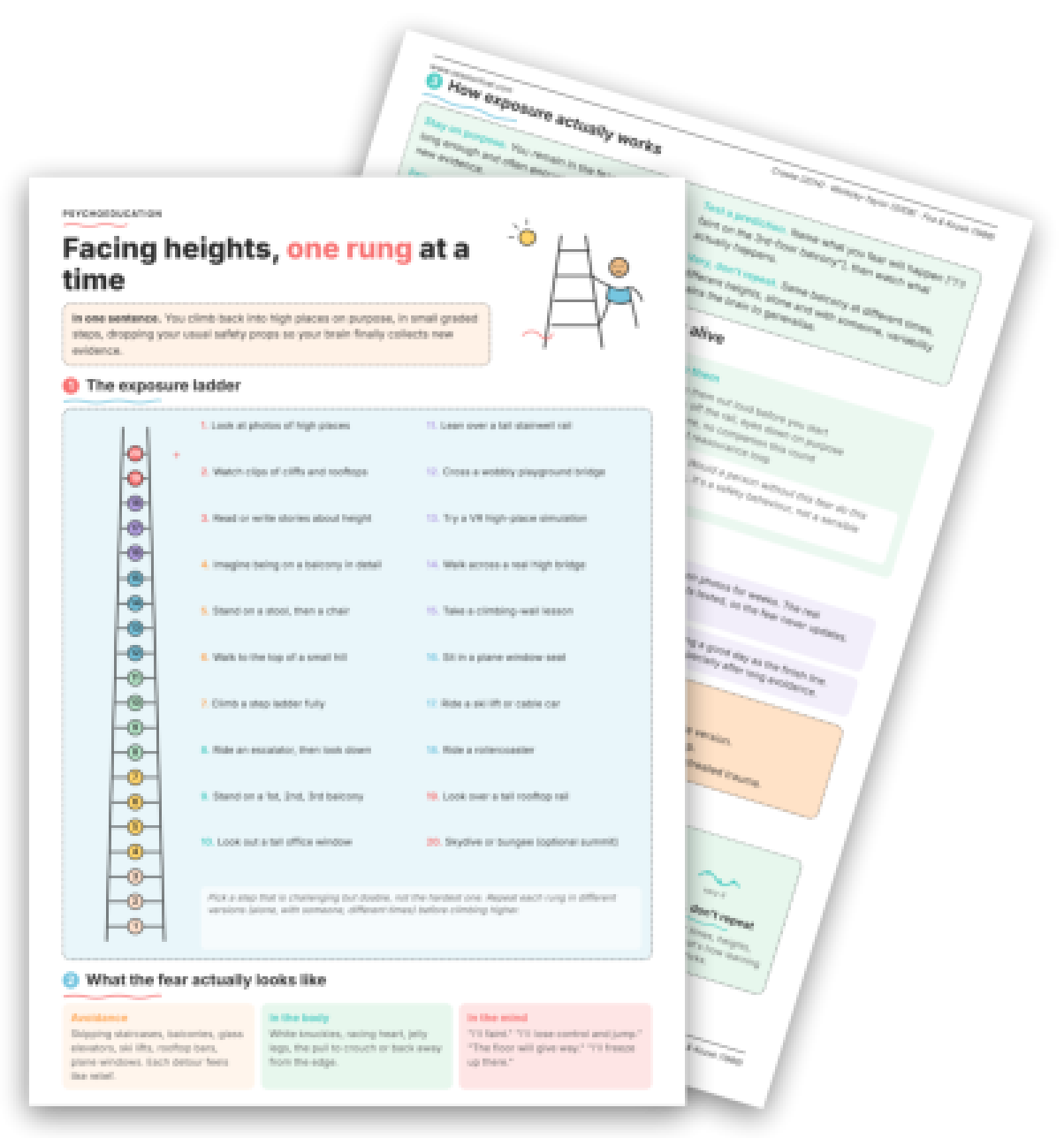
The fiche organises the psychoeducation into six labelled sections you walk through with the patient, not a questionnaire they complete alone.
- The exposure ladder: 20 concrete steps, from "Look at photos of high places" (step 1) to optional summit items like skydiving (step 20), with bridge crossings, climbing walls, and ski lifts distributed across the middle range. Each rung is specific enough to generate a behavioural plan in session without improvisation. The Exposure Hierarchy: Fear Ladder worksheet can complement this if you want to build a fully personalised hierarchy alongside the pre-printed ladder.
- What the fear looks like: a three-column breakdown of avoidance patterns, somatic responses (white knuckles, racing heart, jelly legs), and cognitions ("I'll faint," "I'll lose control and jump," "the floor will give way"). Seeing the cognitive layer listed next to the bodily layer helps patients recognise their own profile, and reduces the shame that often accompanies the physical symptoms. For patients with prominent fear of the sensations themselves, the Fear of Body Sensations worksheet sits alongside this section naturally.
- How exposure works: four principles drawn directly from Craske's inhibitory learning model (2014) and Foa and Kozak's emotional processing framework (1986): stay on purpose, test a specific prediction, fear does not need to reach zero, vary rather than simply repeat.
- Safety props: a named list of subtle maintaining behaviours, with the built-in clinical test the fiche phrases as: "Would a person without this fear do this here?" This is the section patients most resist and most need in writing. The Changing Avoidance worksheet pairs well here if safety behaviours are entrenched.
- Common traps: too fast, too slow, props on board, one-and-done. Naming the failure modes before they occur reframes early setbacks as expected rather than diagnostic.
- A debrief prompt block labelled "To discuss in session," which the patient can use to flag sticking points between contacts, including explicit contraindication markers (heart conditions, balance disorders, pregnancy, untreated trauma).
> Key takeaway: this fiche PDF is a visual support for in-session psychoeducation, not a patient self-help handout. Its job is to anchor the oral explanation, give the patient vocabulary they can point back to, and leave a concrete reference for when the next exposure opportunity arrives outside the office.
Use it with your patients
Share this tool in the mobile app and follow the work between sessions.
When and how to introduce the worksheet
The fiche fits most naturally once the formulation is shared and the patient understands that avoidance is maintaining the fear, typically session two or three in a CBT protocol for specific phobia. Introduce it before assigning any homework exposure, so the patient has the conceptual language to report back accurately on what happened and which safety behaviours were still present.
A low-threshold opening: "I have a sheet that maps out exactly what we've been describing. Let me show you where you are on this ladder right now." Locate their current functional level on the printed rungs together, then identify one step above it as the first target. The Graded Exposure List exercise and the Graded Exposure Self-Report tool pair directly as between-session homework once the first rung is agreed.
For patients who catastrophise the prospect of any exposure, work through the cycle of avoidance first, and consider the anticipatory fear decatastrophizing exercise before the first live rung. If acrophobia sits within a broader anxiety presentation, the full Exposure Therapy program provides a wider psychoeducation frame across sessions. Where the fear overlaps with panic about visible anxiety symptoms in public heights (rooftop bars, ski lifts), the Fear of Appearing Anxious worksheet addresses that specific maintaining cognition directly. Clinicians working in an ACT frame will find the Confronting Avoidance worksheet a compatible companion.
On contraindications: the fiche's built-in "To discuss in session" block flags the main clinical cautions. Apply particular care when there is comorbid PTSD: in-vivo height exposure can be destabilising before adequate stabilisation work is in place, and the standard ladder sequencing may need to be paused or restructured entirely.
The worksheet does not replace the therapeutic frame or the collaborative exposure planning you do together. It makes the explanation cleaner, the vocabulary shared, and the patient's next concrete step visible.
Your session continues in your patients' pocket
Use with a patientYour resources, available everywhere
The handouts, exercises, programs and audios above: you choose which ones to make available to your patients, in the mobile app dedicated to them.
And far more than a library
The app goes well beyond resources, to support your patients every day:
Related categories
Explore other clinical resources by category.

Anxiety
Clinical hub for anxiety disorders: CBT and ACT worksheets, psychoeducation sheets, and exercises for assessment and treatment across the anxiety spectrum.

Understand
Clinical hub for the therapeutic aim 'Understand': worksheets and tools to build patient insight across CBT, ACT, schema therapy and more.

Exposure
Exposure therapy clinical resources for practitioners: worksheets, hierarchies, and psychoeducation tools for anxiety, PTSD, OCD, and avoidance-based presentations.

CBT
CBT worksheets, cognitive restructuring exercises & behavioral tools for clinicians. Evidence-based resources for every phase of cognitive behavioral therapy.

Trauma
Clinical hub on trauma and PTSD: assessment, differential diagnosis, treatment phases, and printable resources for practitioners. 155 chars.

Mood
Evidence-based worksheets and clinical tools for mood disorders: CBT, ACT, and positive psychology resources for psychologists and therapists.