
Clinical picture. A., a woman in her early thirties, presents with longstanding social anxiety and a pattern of systematic avoidance: she declines work meetings, eats lunch alone, and has not initiated a phone call in several months. Her comfort zone has narrowed considerably over the past two years. During a psychoeducation session, the clinician introduces the three-zone model using the informational sheet, inviting A. to map her own recent situations onto each ring. A. immediately places "calling the pharmacy" in the panic zone; with gentle prompting, she relocates it to the outer edge of stretch once she notices she can still think through what she would say. Over the following week she completed the call, reported tolerable anxiety throughout, and described a small but concrete shift in her sense of agency.
Comfort, Stretch & Panic Zones: PDF Worksheet, Tools and Exercises
A visual psychoeducation tool helping clinicians explain the three zones of learning, distinguish productive discomfort from overwhelm, and calibrate exposure work in session.
Clinical vignettes
Locating the Stretch Zone in Social Anxiety
Reframing Overexposure After a Setback
Clinical picture. M., a man in his mid-forties recovering from a depressive episode, had been encouraged by a well-meaning family member to "just push through" and return to his previous workload abruptly. He arrived at the session describing a full week of shutdown, poor sleep, and mounting avoidance, which he interpreted as personal failure. The clinician used the three-zone worksheet to distinguish stretch-level effort from panic-level demand, normalising that the brain does not consolidate learning under conditions of overwhelm. Together they identified two tasks at the stretch threshold rather than the full workload, and agreed on deliberate returns to the comfort zone each evening as recovery, not regression. At the next appointment M. reported completing both tasks and noted that framing rest as a functional zone had reduced his self-criticism around it.
Most patients who present with avoidance already know they are avoiding. What they cannot do is distinguish the discomfort they should stay with from the overwhelm that signals genuine shutdown. That gap, productive discomfort versus panic, is exactly where verbal explanation tends to fail. This fiche PDF gives you a concrete visual structure to close it.
Use this resource with your patients
Handout, exercises and materials ready to use, right inside SessionFuel.
Why the Stretch/Panic Distinction Resists Verbal Explanation
Clinicians working with graded exposure or behavioral activation frequently encounter two opposite failure modes in the same patient population. The first is the avoider: almost everything stays in the comfort zone, stretch invitations are declined, and the world quietly contracts. The second is the pusher: the patient bypasses stretch entirely, crashes into panic, interprets the distress as proof they cannot cope, and retreats further than before.
The problem is not a lack of motivation. It is the absence of a functional map. When you explain the concept verbally, patients typically nod, but then apply it poorly between sessions. Without a spatial metaphor they can hold onto, mild anxiety that is workable and overwhelm that shuts learning down both feel like "anxiety," and both trigger the same response: avoidance, or more forcing, depending on the patient's default pattern.
The third pattern the fiche names, the oscillator, is clinically common and undernamed: a patient who swings between rigid avoidance and harsh self-pressure with no language for the productive middle. Naming it with a shared vocabulary, supported by a visual, changes the conversation. It also maps directly onto what Yerkes and Dodson described in 1908 and what Vygotsky formalised as the zone of proximal development: growth requires an optimal arousal window, not maximal effort.
750+ clinical tools
A library built with and for clinicians, ready to use in session and extend between appointments.
Access all the toolsWhat the Fiche Contains: A Visual Map for the Three Zones
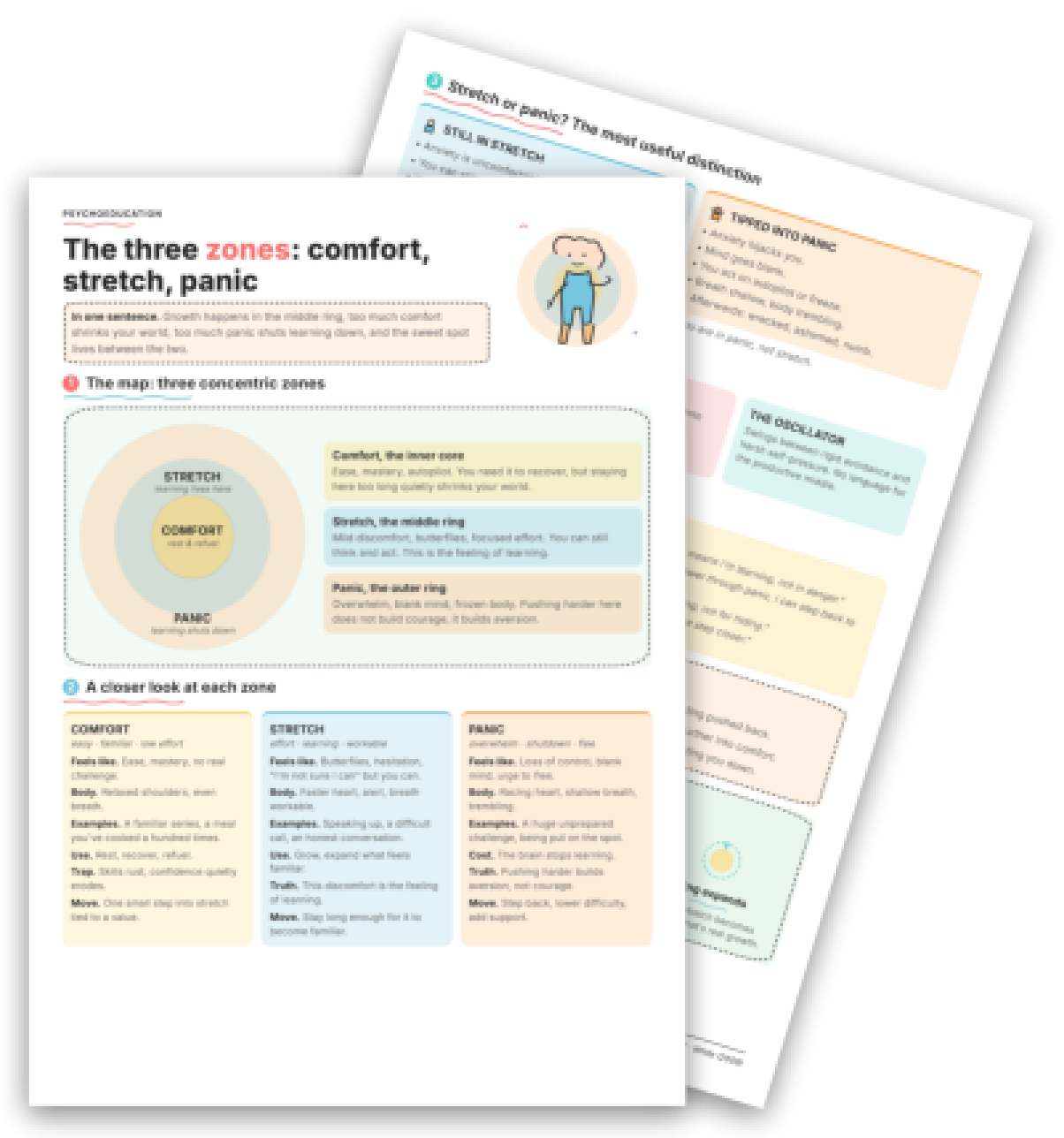
The fiche PDF is organised across five panels, each building on the last. The first panel is the key visual: three concentric rings labelled Comfort (rest and refuel), Stretch (learning lives here), and Panic (learning shuts down). Patients can look at this diagram and immediately locate themselves spatially, something oral explanation alone cannot achieve.
Panels two and three do the clinical heavy lifting. Panel two breaks each zone into six dimensions: what it feels like, what the body does, concrete examples, its primary use, its trap or cost, and a one-line move to shift zone. The fiche's framing here is precise: "This discomfort is the feeling of learning" for stretch, and "Pushing harder here does not build courage, it builds aversion" for panic. These phrasings travel well into between-session work because patients can recall them without rereading the fiche.
Panel three offers the most clinically useful distinction: a two-column table separating still in stretch from tipped into panic, across cognition (can you still think and plan?), body (breath workable versus shallow and trembling), and the post-event signature (tired and a bit proud versus wrecked and ashamed). This is the functional test of whether a recent exposure attempt genuinely built tolerance or triggered a trauma-adjacent response.
Panel four names the three behavioural patterns (avoider, pusher, oscillator), and panel five provides calibration phrases the patient can internalise: "One size smaller, one step closer", or "Comfort is for resting, not for hiding."
> Key takeaway: The fiche is a visual support that facilitates the explanation in session. It is not a self-administered questionnaire. The clinician uses the concentric diagram to anchor the concept spatially, the two-column table to debrief real situations, and the phrases as portable coping tools the patient leaves with.
Use it with your patients
Share this tool in the mobile app and follow the work between sessions.
When and How to Introduce the Fiche in Session
The fiche fits most naturally in the psychoeducation phase of any work involving avoidance patterns, graded exposure, or psychological flexibility. You can introduce it as early as the second or third session, once a functional formulation is in place and before exposure proper begins.
For avoidant profiles, you might open with: "Before we build your exposure list, I want to give you a map that explains why some discomfort actually means you're in the right place." For pusher or perfectionist profiles, including those captured by the fiche's discussion of the perfectionism-adjacent crash-and-retreat pattern, the entry is different: "I notice that when you push yourself, it tends to go very far, very fast. This diagram might help us understand what's happening there."
The debrief is where the fiche earns its place. After an exposure attempt, you can return to panel three with the patient and ask: looking at these two columns, where were you? The answer often surfaces shame (panic misread as failure) or overconfidence (stretch misread as crisis) that no questionnaire would catch as efficiently.
The fiche is less indicated, at least initially, for patients in acute crisis or with severe dissociative responses to panic, where the calibration model requires significant adaptation. In those cases, intolerance of uncertainty work or somatic stabilisation takes precedence before introducing a growth-oriented frame.
The fiche does not replace the clinical formulation, and it does not tell patients what to do. What it does is give both you and the patient a shared, visible language for a distinction that changes how every subsequent exposure, avoidance analysis, or coping assessment is framed. That shared language is what makes the concept stick.
Your session continues in your patients' pocket
Use with a patientYour resources, available everywhere
The handouts, exercises, programs and audios above: you choose which ones to make available to your patients, in the mobile app dedicated to them.
And far more than a library
The app goes well beyond resources, to support your patients every day:
Related categories
Explore other clinical resources by category.

Anxiety
Clinical hub for anxiety disorders: CBT and ACT worksheets, psychoeducation sheets, and exercises for assessment and treatment across the anxiety spectrum.

Identity
Clinical resources for self-identity work in therapy: CBT, ACT, schema tools for clinicians addressing self-concept, core beliefs, and identity disruption.

Emotions
Clinical resources on emotion regulation: worksheets, coping tools, CBT, REBT, and ACT exercises for therapists working across diagnoses and age groups.

Cognition
Printable cognitive therapy worksheets and clinical tools for therapists: CBT, ACT, schema work, defusion, distortions, and belief restructuring.

Understand
Clinical hub for the therapeutic aim 'Understand': worksheets and tools to build patient insight across CBT, ACT, schema therapy and more.

Build awareness
Clinical worksheets and tools to build awareness in therapy: cognitive distortions, schemas, emotions, ACT and CBT resources for practitioners.