
Clinical picture. M., a woman in her mid-forties, presented with longstanding generalised anxiety and a pattern of progressively narrowing her social and professional life to avoid situations that triggered worry. Her previous therapy had focused primarily on reducing anxious arousal, with limited lasting benefit. The clinician introduced the ACT informational sheet during the second session, using the hexaflex to name what had been happening: fusion with catastrophic thoughts and experiential avoidance organised around the goal of feeling less anxious. M. identified strongly with the "control backfires" reframe, noting that her avoidance had not reduced distress but had cost her activities she described as meaningful. She left the session with a single committed-action task tied to a stated value, rather than an anxiety-management homework, and returned the following week having completed it with moderate discomfort present throughout.
Acceptance and Commitment Therapy: PDF Worksheet, Tools and Exercises
A printable psychoeducation sheet introducing the ACT model to patients: the hexaflex, key reframes, stuck patterns, and six concrete exercises to try between sessions.
Clinical vignettes
ACT Psychoeducation in Chronic Anxiety
Values Clarification After Prolonged Depression
Clinical picture. T., a man in his early thirties, had been treated for recurrent depressive disorder and described feeling "emptied out" after two years of illness-related withdrawal. He arrived at the session holding the informational sheet he had read at home and pointed to the values segment, saying he could not identify a single direction that felt real to him. The clinician used this opening to distinguish values as ongoing orientations from goals as fixed endpoints, and to normalise that prolonged avoidance often dulls value awareness rather than erasing it. Together they traced one small area of past meaning, and T. proposed a brief, concrete behavioural step for the coming week, framed explicitly as an experiment rather than a test of readiness. The exchange shifted the session from symptom review toward what the patient wanted his days to move toward, a reorientation he described as unfamiliar but not unwelcome.
Introducing ACT verbally in a first or second session often leaves patients nodding politely while privately filing the whole framework under "sounds like mindfulness." The model is genuinely counter-intuitive, and without a visual anchor, the core reframe collapses into abstract instruction. This fiche PDF gives you a compact, printable support to walk through the ACT architecture together, in session, so the concept lands rather than evaporates.
Use this resource with your patients
Handout, exercises and materials ready to use, right inside SessionFuel.
Why ACT Is Hard to Explain Without a Visual Anchor
The central clinical challenge is that ACT's logic runs against the patient's intuitive goal. Most people arrive in therapy expecting to feel better as a precondition for living better. Explaining verbally that the therapeutic aim is not symptom reduction but psychological flexibility tends to produce polite confusion, mild suspicion, or a silent assumption that you are asking them to simply accept their suffering.
The six processes of the hexaflex, taken one by one in oral explanation, can each seem reasonable. Taken together, they form an interdependent system that is almost impossible to hold in working memory without a diagram. Defusion, self-as-context, and values routinely get flattened into a single idea ("be more present") unless the patient can see how they are distinct and how they feed the centre. The fiche solves this by mapping all six processes visually, making their relationships concrete before you say a word about any individual component.
A second obstacle is that common confusions surface predictably: patients conflate acceptance with resignation, defusion with thought replacement, mindfulness with relaxation. Anticipating and clearing these in session takes significant time if done from scratch each time.
What the Fiche Contains: A Visual Map of the ACT Model
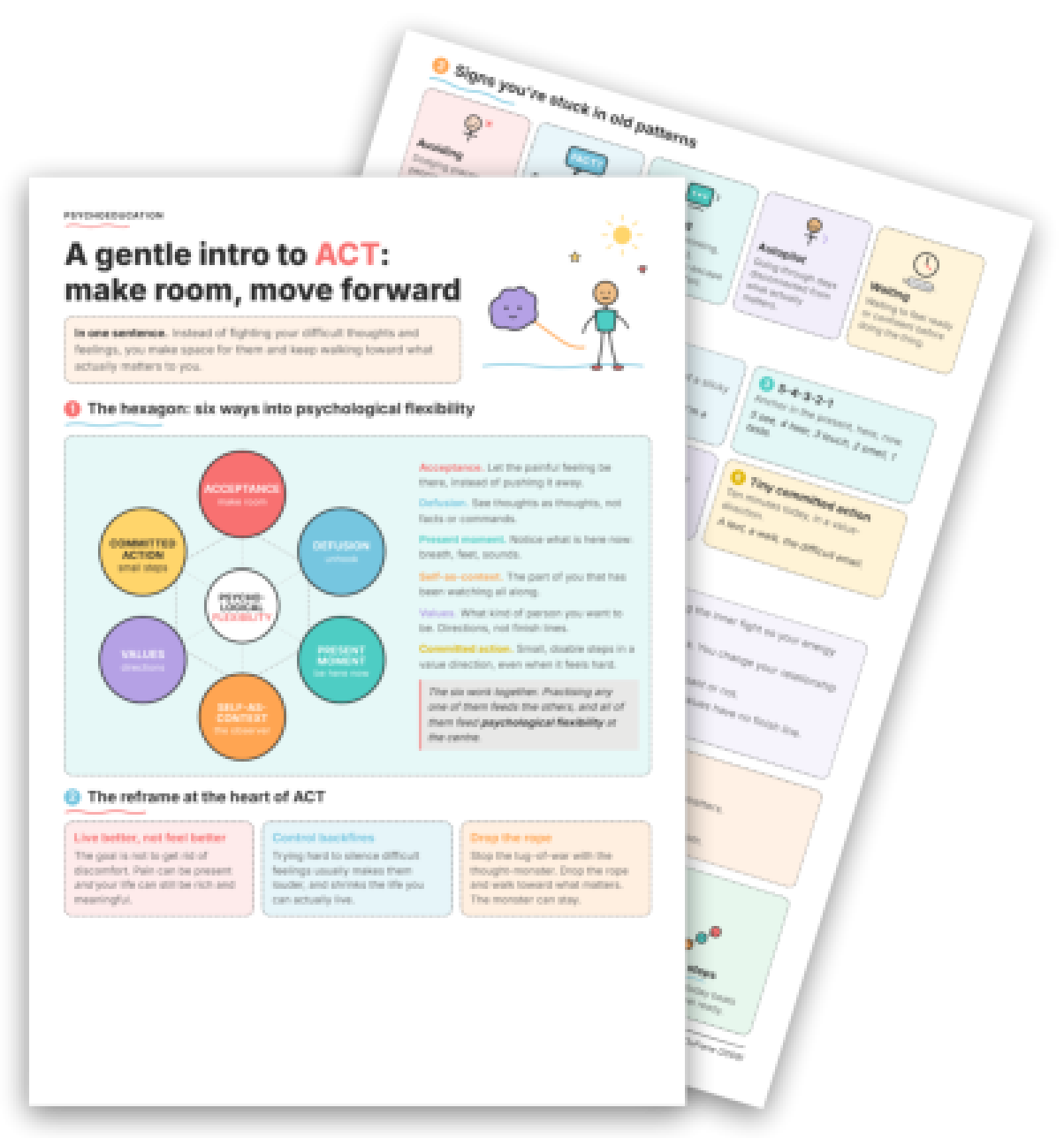
The fiche PDF is structured across five named panels, all grounded in Hayes (2019), Harris (2009), and Wilson and DuFrene (2009).
The opening panel names the whole approach in a single sentence ("Instead of fighting your difficult thoughts and feelings, you make space for them and keep walking toward what actually matters to you") before the hexagon diagram lays out the six processes: acceptance, defusion, present moment, self-as-context, values, and committed action. Crucially, the diagram labels the centre as psychological flexibility, showing the practitioner and patient together that each process feeds the same capacity. You can use the ACT Hexaflex model as a dedicated companion sheet if you want to go deeper on any single vertex.
A second panel presents the three core reframes: that the goal is to live better, not feel better; that control efforts backfire by amplifying distress and shrinking the patient's life; and the "drop the rope" tug-of-war metaphor. These reframes are stated plainly, in patient-readable language, which means you can annotate them in session rather than transcribe them.
The third panel, "Signs you're stuck in old patterns," lists five recognisable behaviours: avoiding, fusing, numbing, running on autopilot, and waiting to feel ready. Patients often identify two or three of these immediately, which makes this panel clinically generative. It maps directly onto the cycle of avoidance and the confronting avoidance work you may already be doing.
The fourth panel offers six brief between-session practices: naming the feeling and letting it sit for sixty seconds; the defusion phrase technique ("I'm having the thought that..."); a 5-4-3-2-1 grounding sequence; a values check-in; the workability question ("Toward my values, or away?"); and a ten-minute committed action. The sixth panel lists common confusions to clear up, including the distinction between values and goals, which pairs naturally with the values exploration exercises and the life values assessment available on this site.
> Key point: This fiche is a visual support that facilitates the explanation of ACT in session. It is not a questionnaire the patient completes alone. The diagram, the reframes, and the practices are there for you to point to, annotate, and discuss together, leaving the patient with a concrete reference they can return to between appointments.
750+ clinical tools
A library built with and for clinicians, ready to use in session and extend between appointments.
Access all the toolsWhen and How to Introduce the Fiche in Session
This sheet works best at the transition from assessment to treatment rationale, typically sessions two or three, once you have a shared formulation and the patient has expressed some curiosity about how the work will proceed. It is particularly well-suited to patients with generalised anxiety, depression, or chronic avoidance patterns, as well as those who have already tried symptom-focused approaches without lasting benefit.
To introduce it without overpromising, you might say: "I want to show you the map we'll be working from. It might look different from what you expected, but let me walk you through it and we can talk about what fits." This positions the fiche as a shared object, not a diagnosis or a homework assignment.
When debriefing, attend to which of the six stuck patterns the patient highlights and which of the six practices they are curious about. Their response guides the next session's entry point. For structured follow-through, the ACT for Depression program and the psychological flexibility exercises extend the work autonomously between sessions.
One limit worth naming: patients in acute crisis or with very limited mentalisation capacity may find the hexaflex premature. In those cases, a single-panel focus, such as the active acceptance sheet or the Choice Point tool, often makes a more manageable entry point into ACT work.
The fiche does not replace the formulation conversation; it makes that conversation more efficient and leaves the patient with something to read, revisit, and bring back to the next session.
Use it with your patients
Share this tool in the mobile app and follow the work between sessions.
Sources
- Hayes, S. C., Strosahl, K. D., Wilson, K. G. (1999). Acceptance and Commitment Therapy: An Experiential Approach to Behavior Change. Guilford Press.
- Hayes, S. C., Strosahl, K. D., Wilson, K. G. (2012). Acceptance and Commitment Therapy: The Process and Practice of Mindful Change (2nd ed.). Guilford Press.
- Hayes, S. C., Smith, S. (2005). Get Out of Your Mind and Into Your Life: The New Acceptance and Commitment Therapy. New Harbinger Publications.
- Dove Medical Press (2025). Psychological Flexibility and Mental Health: Theoretical Foundations, Empirical Evidence, and Clinical Applications. Psychology Research and Behavior Management.
Your session continues in your patients' pocket
Use with a patientYour resources, available everywhere
The handouts, exercises, programs and audios above: you choose which ones to make available to your patients, in the mobile app dedicated to them.
And far more than a library
The app goes well beyond resources, to support your patients every day:
Related categories
Explore other clinical resources by category.

Identity
Clinical resources for self-identity work in therapy: CBT, ACT, schema tools for clinicians addressing self-concept, core beliefs, and identity disruption.

Emotions
Clinical resources on emotion regulation: worksheets, coping tools, CBT, REBT, and ACT exercises for therapists working across diagnoses and age groups.

Cognition
Printable cognitive therapy worksheets and clinical tools for therapists: CBT, ACT, schema work, defusion, distortions, and belief restructuring.

Understand
Clinical hub for the therapeutic aim 'Understand': worksheets and tools to build patient insight across CBT, ACT, schema therapy and more.

Build awareness
Clinical worksheets and tools to build awareness in therapy: cognitive distortions, schemas, emotions, ACT and CBT resources for practitioners.

Engage & motivate
Clinical hub: printable worksheets and exercises to build therapeutic engagement and motivation across ACT, CBT, and integrative practice. For clinicians.