
Clinical picture. M., a woman in her mid-thirties, presented with generalised anxiety and a long-standing pattern of self-reproach whenever she noticed physical tension or worry. During psychoeducation, the clinician introduced the informational sheet on mindfulness, focusing on the distinction between awareness and acceptance. When the clinician described the "old move" of labelling anxiety as stupid and the resulting tightening, M. recognised the pattern immediately and noted she had never considered that noticing tension without correcting it was even an option. Over the following two sessions she reported practising the breath-awareness exercise briefly before difficult work calls, not with a goal of becoming calm, but simply to observe what was present. Her self-reported rumination after these calls decreased modestly, and she described feeling slightly less depleted at the end of the day.
Mindfulness: PDF Worksheet, Tools and Exercises for Clinical Practice
A printable PDF worksheet with concrete tools and exercises to explain mindfulness clearly in session, address common misconceptions, and give patients a visual reference they can actually use.
Clinical vignettes
Awareness Without Self-Criticism in GAD
Reframing Mind-Wandering in Chronic Low Mood
Clinical picture. T., a man in his late forties with recurrent depressive episodes, had attempted mindfulness-based apps twice and abandoned them, convinced he was "doing it wrong" each time his attention drifted. The clinician used the informational sheet to clarify that noticing the mind has wandered and returning attention is the practice itself, not a sign of failure. T. found this reframe substantive rather than reassuring: it removed the performance element that had consistently derailed him. He resumed a brief daily breathing practice with that framing in place, and within three weeks reported fewer hours spent in ruminative loops about past conversations. He remained symptomatic, though his relationship to intrusive thoughts had shifted enough to warrant integrating the practice into the broader treatment plan.
Patients rarely leave a verbal explanation of mindfulness without nodding. They also rarely return the following week having practiced. The gap between intellectual assent and actual engagement is precisely where this fiche PDF earns its place: it gives the concept a visual structure that holds up outside the session.
Use this resource with your patients
Handout, exercises and materials ready to use, right inside SessionFuel.
Why mindfulness resists explanation in session
The core difficulty is semantic drift. Patients hear "present moment" and hear relaxation. They hear "acceptance" and hear surrender. The clinically decisive distinction between noticing and approving, between allowing and fixing, collapses in spoken language without something concrete to point at.
There is also the myth problem. Patients embedded in a cultural fog around mindfulness tend to carry at least one of the four major misconceptions into the room: that it means emptying the mind, that it is relaxation, that it is positive thinking, or that it requires a particular spiritual posture. Each of these, if unaddressed, produces premature dropout or hollow practice. For those working within MBCT (Segal, Williams and Teasdale), ACT, or any third-wave CBT framework, naming these myths explicitly, at the outset, saves multiple sessions of troubleshooting.
The fiche does both of these things visually, where oral explanation cannot.
What the fiche contains
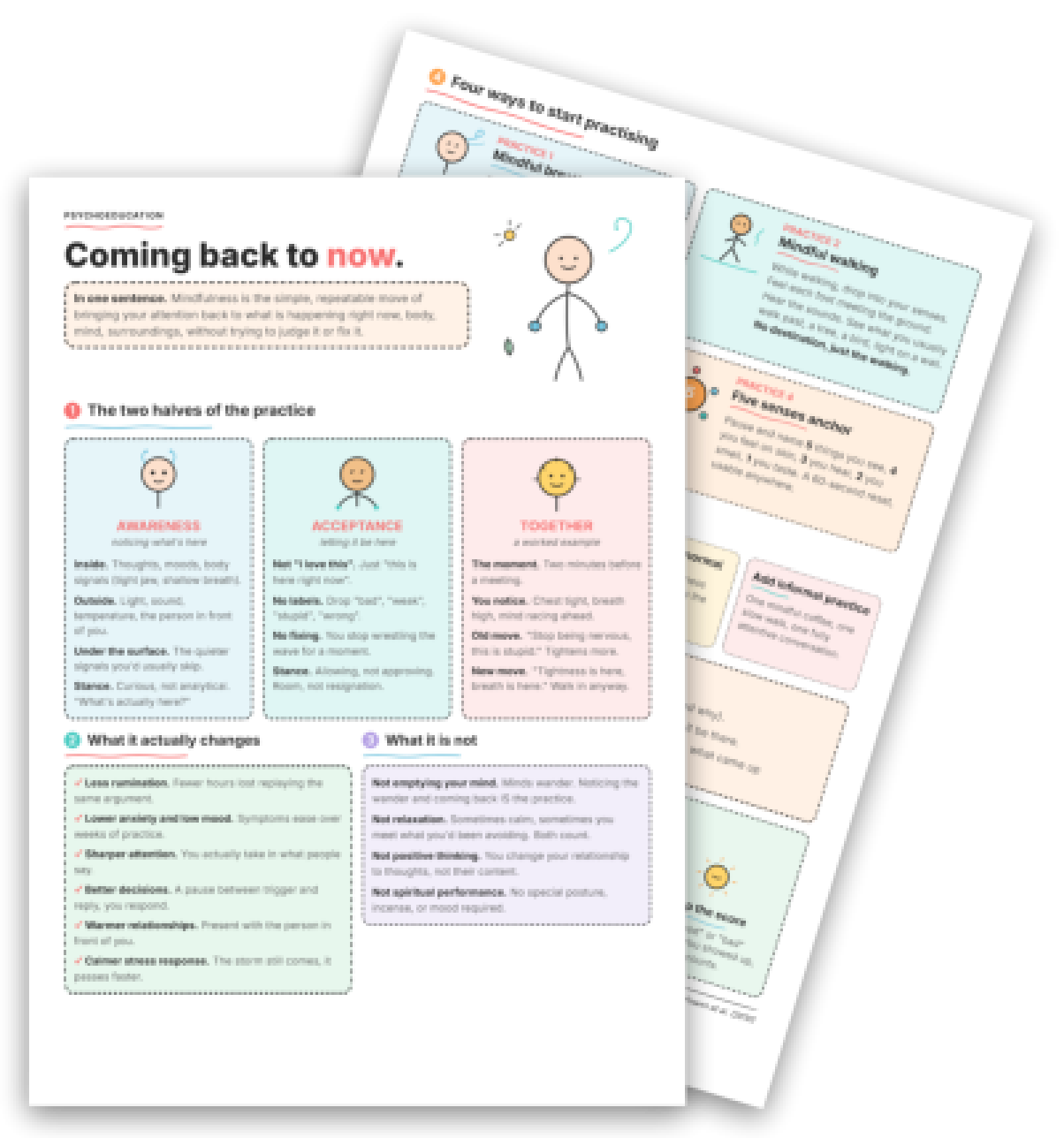
The resource opens with a single defining sentence: "the simple, repeatable move of bringing your attention back to what is happening right now, body, mind, surroundings, without trying to judge it or fix it." Spare by design, it cuts through the abstraction patients usually carry in.
The structural core is a two-column panel separating Awareness ("noticing what's here") from Acceptance ("letting it be here"), with a third "Together" column showing a worked example: tight chest, racing mind before a meeting, the old move of self-criticism that tightens things further, and the new move of simply naming what is present and walking in anyway. Seeing these as distinct panels clarifies something that spoken explanation reliably blurs. You can point at the diagram and ask: "Which half feels harder for you right now?" That question alone opens useful clinical territory.
A second panel lists six evidence-based effects, including reduced rumination, lower anxiety and depressed mood, and a faster return to baseline after acute stress. This is useful material for ambivalent patients and maps directly onto the meta-analytic literature (Hofmann et al., 2010). The fiche then addresses the four major misconceptions directly, and offers four graded practices: mindful breathing (5 minutes), mindful walking, a body scan moving attention through the body in 15 to 30 seconds per zone, and a five senses anchor ("5 things you see, 4 you feel on skin, 3 you hear, 2 you smell, 1 you taste"), a 60-second reset usable in any context. That last practice pairs naturally with the sensory grounding exercise for cognitive overwhelm you may already use for acute flooding.
The fiche closes with three structured "To discuss in session" prompts, covering which practice felt most natural, moments of fighting one's own experience, and judgments about the practice itself ("I'm bad at this"). These feed directly into the next session's debrief.
> To note: the fiche is a visual support designed to facilitate the in-session explanation of mindfulness; it leaves the patient with a concrete reference between appointments, not a questionnaire to fill out alone.
750+ clinical tools
A library built with and for clinicians, ready to use in session and extend between appointments.
Access all the toolsWhen and how to introduce it
This resource works well from the second or third session onward, once the alliance is established and the rationale for a present-moment approach has been signaled. It is particularly indicated for patients presenting with rumination (see the rumination psychoeducation program), generalized anxiety, or as preparation for exposure work where distress tolerance is a prerequisite.
Introduce it by running through the two-halves panel together before handing the page over: "Let me show you a way of mapping this that I find clearer than just describing it." Going through the diagram in session prevents the patient from encountering the framework cold.
If the debrief surfaces judgments about practice ("this isn't working"), that is an entry point for cognitive defusion work or psychological flexibility exercises. For patients who respond better to audio than text, pairing the fiche with a short body scan audio or a brief present-moment grounding audio gives the practice immediate, embodied form. Clinicians integrating DBT skills may find it useful alongside DBT Mindfulness What and How Skills. A family mindfulness schedule is available for parents seeking to extend informal practice into the household, and a dedicated mindfulness meditation guide provides supplementary exercises for patients ready to deepen formal practice.
The fiche does not replace the clinical frame; it makes the explanation land, and gives the patient something to return to between sessions.
Use it with your patients
Share this tool in the mobile app and follow the work between sessions.
Sources
- Kabat-Zinn, J. (2013). Full Catastrophe Living: Using the Wisdom of Your Body and Mind to Face Stress, Pain, and Illness (Revised and Updated Edition). Bantam Books.
- Segal, Z. V., Williams, J. M. G., & Teasdale, J. D. (2013). Mindfulness-Based Cognitive Therapy for Depression (2nd ed.). Guilford Press.
Your session continues in your patients' pocket
Use with a patientYour resources, available everywhere
The handouts, exercises, programs and audios above: you choose which ones to make available to your patients, in the mobile app dedicated to them.
And far more than a library
The app goes well beyond resources, to support your patients every day:
Related categories
Explore other clinical resources by category.

Anxiety
Clinical hub for anxiety disorders: CBT and ACT worksheets, psychoeducation sheets, and exercises for assessment and treatment across the anxiety spectrum.

Mood
Evidence-based worksheets and clinical tools for mood disorders: CBT, ACT, and positive psychology resources for psychologists and therapists.

Emotions
Clinical resources on emotion regulation: worksheets, coping tools, CBT, REBT, and ACT exercises for therapists working across diagnoses and age groups.

Cognition
Printable cognitive therapy worksheets and clinical tools for therapists: CBT, ACT, schema work, defusion, distortions, and belief restructuring.

Understand
Clinical hub for the therapeutic aim 'Understand': worksheets and tools to build patient insight across CBT, ACT, schema therapy and more.

Build awareness
Clinical worksheets and tools to build awareness in therapy: cognitive distortions, schemas, emotions, ACT and CBT resources for practitioners.