
Clinical picture. M., a man in his late thirties with a third depressive episode, presented with marked psychomotor slowing and near-total withdrawal from daily activities; he had stopped cooking, answering messages, and leaving the flat. During session four, the clinician introduced the informational sheet and spent time on the action lever, naming the mechanism explicitly: motivation follows behaviour, not the reverse. M. agreed to one anchor task, watering his two indoor plants each morning, framed as a fixed cue rather than a mood-dependent choice. At the two-week review he reported completing the task on eleven of fourteen days and described a modest but stable reduction in the subjective sense of inertia, with no other intervention variable changed in that interval.
Four Strategies to Overcome Depression: PDF Worksheet, Tools and Exercises
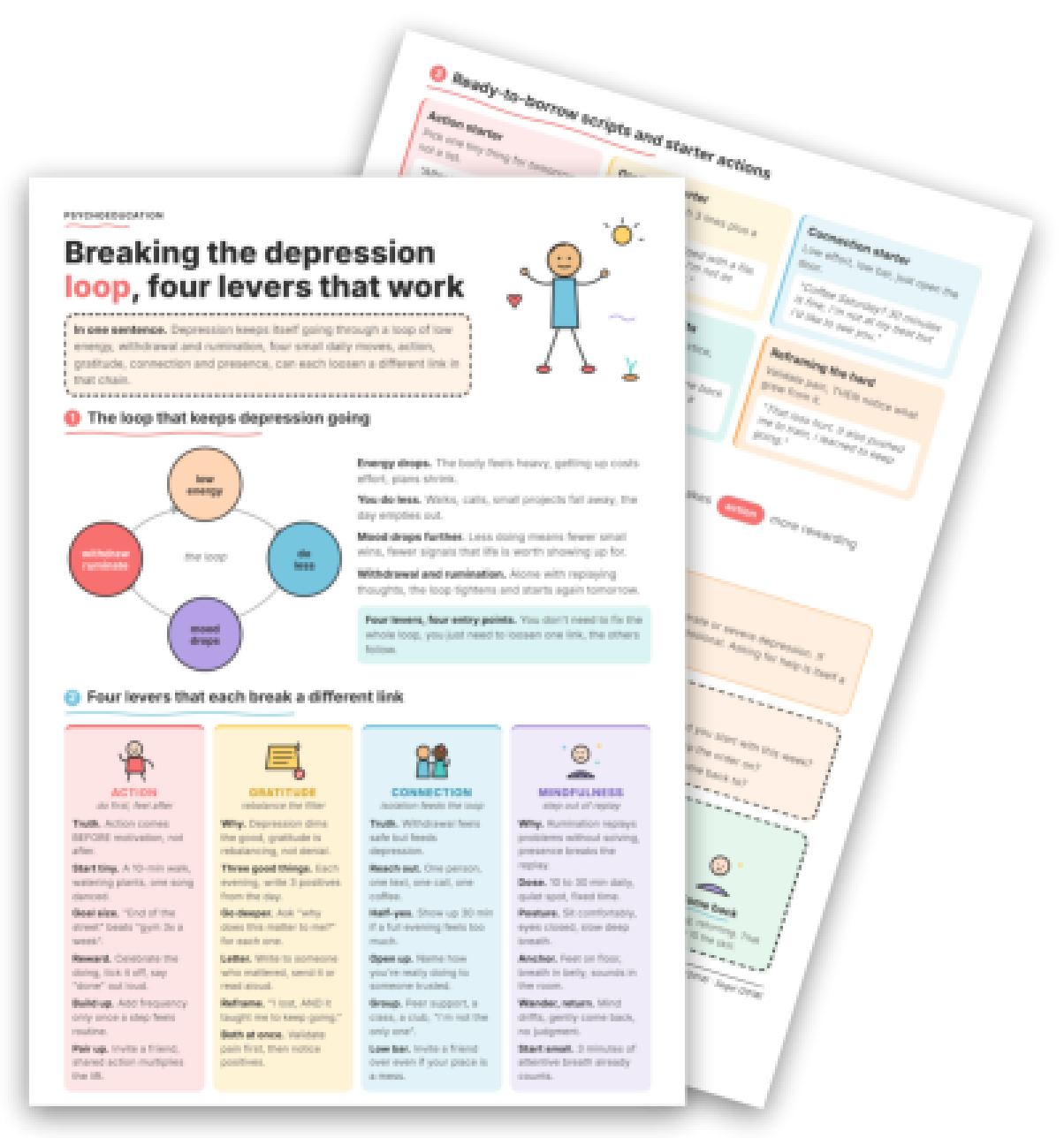
A visual psychoeducation fiche clinicians can use in session to explain the depression maintenance loop and introduce four concrete, evidence-based levers for change.
Clinical vignettes
Action Before Motivation in Recurrent MDD
Using Gratitude to Shift Attentional Bias
Clinical picture. S., a woman in her mid-fifties being treated for a moderate depressive episode with prominent negative cognitive filtering, consistently discounted neutral or positive daily events as irrelevant. The clinician introduced the gratitude lever from the four-strategy sheet, taking care to frame it as attentional rebalancing rather than positive thinking, and validated her pain before suggesting the exercise. She began a brief evening log of three specific events, adding a short note on why each one mattered to her personally. After three weeks she reported that the filter had not disappeared but that she was catching herself dismissing things more quickly, which she found slightly more tolerable; the clinician noted this as a workable entry point for subsequent cognitive work.
Explaining the depression maintenance cycle to a patient who is already caught inside it is one of the more delicate moments in clinical work. The concept makes sense on paper, yet patients frequently hear it as another proof that they are broken rather than as a map they can use. This fiche PDF gives you a concrete visual support to change that dynamic, turning the explanation into a shared exercise and leaving the patient with something tangible to carry out of the session.
Use this resource with your patients
Handout, exercises and materials ready to use, right inside SessionFuel.
Why the Depression Loop Resists Explanation in Session
The behavioral maintenance model of depression (low energy → doing less → mood drop → withdrawal and rumination → loop restart) is theoretically well-established, drawing on Jacobson's work on behavioral activation and reinforced by Cuijpers' meta-analytic data on its efficacy. The clinical problem is not the model itself; it is that patients inside the loop experience it as identity, not mechanism. When you describe the cycle verbally, many patients nod and then locate the cause in themselves ("I just can't be bothered") rather than in the self-reinforcing structure.
A companion difficulty: rumination actively blocks the processing that would let them see the loop from outside. The fiche works precisely against this. Rather than asking the patient to hold an abstract model in working memory while fatigued, it externalizes the cycle as a clear visual diagram they can point at, name, and annotate together with you. This is where understanding the cycle of depression as a visual artefact earns its clinical value.
What the Fiche Contains, and What the Visual Format Makes Visible
The fiche is structured around four numbered panels, each serving a distinct clinical function.
Panel 1 renders the depression loop as a closed-circuit diagram: "low energy → do less → mood drops → withdraw / ruminate → the loop". In session, this single image does what ten minutes of verbal explanation often cannot: it lets the patient see that the loop is a maintenance mechanism, not a character trait. You can ask them to place themselves on the diagram in the current week, which immediately shifts the frame from "I am depressed" to "I am inside a loop I can enter at any point."
Panel 2 maps the four levers (Action, Gratitude, Connection, Mindfulness) with explicit sub-points for each. Crucially, the fiche names the clinical logic of each lever, not just its technique. Under Action, for example: "Action comes BEFORE motivation, not after." That single line reframes the most common obstacle in behavioral activation work. Under Mindfulness, the rationale is stated plainly: "Rumination replays problems without solving, presence breaks the replay", which pairs naturally with constructive vs harmful rumination work you may already be doing.
Panel 3 provides ready-to-borrow scripts: concrete starter phrases for each lever ("After lunch I'll walk 10 minutes. Some days only 5, that still counts."; "Coffee Saturday? 30 minutes is fine."). These are particularly useful for patients who block on the implementation step. You can read a script aloud together, adapt it to the patient's language, and it becomes the homework brief.
Panel 4 shows graphically how the four levers reinforce each other, closing with a "When to seek more help" safety notice and three in-session discussion questions.
> Key takeaway: this fiche is a visual psychoeducation support you use in session, not a questionnaire the patient fills alone. The layout does the explanatory work, freeing you to focus on the patient's response rather than on building the model from scratch each time.
750+ clinical tools
A library built with and for clinicians, ready to use in session and extend between appointments.
Access all the toolsWhen and How to Propose the Fiche
The fiche fits naturally from the second or third session onward, once a shared formulation is in place. It works particularly well for patients who intellectualise ("I know what depression is") but have not yet shifted behaviour, and for those whose avoidance is making a structured weekly activity plan feel unreachable.
To introduce it without triggering the "homework I'll fail" response, you might say: "I'd like to show you a diagram we'll look at together. You don't have to do anything with it right now; I just want to see which part of this map matches your week." Starting from Panel 1 and asking the patient to locate themselves in the loop is usually enough to open a productive conversation.
Debrief by asking the three discussion questions printed directly on the fiche: which of the four levers feels most impossible right now, and which of the others might be the first entry point. That question alone operationalises the session. Pair the fiche with coping skills tailored to depression, a motivation-rebuilding program, or progress tracking between sessions depending on where the patient currently sits in their recovery.
One limit to flag: the fiche explicitly notes that these levers support recovery and do not replace treatment for moderate-to-severe presentations. For patients with significant anhedonia or psychomotor retardation, begin with the Connection or Gratitude levers rather than Action, and map the emotional landscape of their depression before pushing behavioural scheduling. The fiche doesn't replace the formulation; it makes one element of it visible and actionable.
Use it with your patients
Share this tool in the mobile app and follow the work between sessions.
Sources
- Martell, C. R., Addis, M. E., Jacobson, N. S. (2001). Depression in Context: Strategies for Guided Action. W. W. Norton.
- Kim, J. et al. (2025). Associations between Social Isolation, Withdrawal, and Depressive Symptoms in Young Adults: A Cross-Sectional Study. BMC Psychiatry.
- Segal, Z. V., Williams, J. M. G., Teasdale, J. D. (2013). Mindfulness-Based Cognitive Therapy for Depression, Second Edition. Guilford Press.
Your session continues in your patients' pocket
Use with a patientYour resources, available everywhere
The handouts, exercises, programs and audios above: you choose which ones to make available to your patients, in the mobile app dedicated to them.
And far more than a library
The app goes well beyond resources, to support your patients every day:
Related categories
Explore other clinical resources by category.

Mood
Evidence-based worksheets and clinical tools for mood disorders: CBT, ACT, and positive psychology resources for psychologists and therapists.

Understand
Clinical hub for the therapeutic aim 'Understand': worksheets and tools to build patient insight across CBT, ACT, schema therapy and more.

Build awareness
Clinical worksheets and tools to build awareness in therapy: cognitive distortions, schemas, emotions, ACT and CBT resources for practitioners.

Regulate
Clinical resources for emotion regulation: worksheets, ACT exercises, and psychoeducation tools for affect regulation across diagnoses. For clinicians.

CBT
CBT worksheets, cognitive restructuring exercises & behavioral tools for clinicians. Evidence-based resources for every phase of cognitive behavioral therapy.

Mindfulness (MBSR/MBCT)
Clinical hub for MBSR and MBCT resources: guided audios, body scans, psychoeducation programmes, and mindfulness exercises for practitioner use in session.