
Clinical picture. M., a woman in her late twenties, presents with borderline personality disorder and a longstanding pattern of cancelling plans whenever low mood intensifies, which reliably deepens her isolation over the following days. During a session focused on the emotion-regulation informational sheet, the clinician walked through the emotion-action loop with her, and M. recognised that withdrawing was sustaining the sadness rather than relieving it. They agreed on a graded opposite-action experiment: she would send one brief message to a friend within 24 hours, attending fully to posture and tone rather than going through the motions. At the next session M. reported that the contact had felt hollow at first, then slightly less effortful than expected, and that her mood had lifted marginally by the evening.
DBT Emotion Regulation Skills: PDF Worksheet, Tools and Exercises
A printable PDF fiche presenting four core DBT skills clinicians can use as a visual psychoeducation scaffold to explain the emotion-action loop and its levers in session.
Clinical vignettes
Opposite Action in Recurrent Social Withdrawal
Check the Facts for Interpretation-Driven Anger
Clinical picture. T., a man in his mid-thirties with a history of recurrent depression and marked emotional reactivity, described an incident in which a colleague's brief email reply triggered several hours of intense anger and a near-confrontation. The clinician introduced the Check the Facts lever from the informational sheet and invited T. to separate the observable event from the layer of meaning he had added. T. identified that the factual data was a short reply, whereas his interpretation was deliberate dismissal, and rated his anger as fitting the interpretation rather than the fact. He left the session with a written prompt to use before responding to work messages when activation was above a 6 out of 10, which he reported using twice before the following appointment.
When patients describe being "overwhelmed" by an emotion, they typically mean they acted on the urge and paid the price afterward. Explaining the emotion-urge-action loop verbally is possible; getting the distinction to stick, session after session, is harder. This fiche PDF gives you a visual scaffold to do that work faster, with more conceptual precision, and with less repetition.
Use this resource with your patients
Handout, exercises and materials ready to use, right inside SessionFuel.
Why the emotion-urge-action loop resists oral explanation
The mechanism at the heart of Linehan's emotion regulation module is clinically elegant but easy to misread: emotions generate action urges, behaviors feed the emotion back, and the loop sustains itself. Patients follow this when you describe it. What they miss is the bidirectionality, it is acting on the urge that keeps the loop running, not the emotion itself. That distinction is the whole leverage point, and it rarely lands from words alone.
The four skills compound the problem. Patients routinely collapse Opposite Action into suppression, use Check the Facts as a rumination vehicle (one long "short pass"), and treat PLEASE as optional self-care rather than the physiological prerequisite every other skill depends on. Without a shared visual reference, correcting those misconceptions mid-session costs time that belongs to formulation work or affect labeling.
What the fiche contains: four skills mapped visually
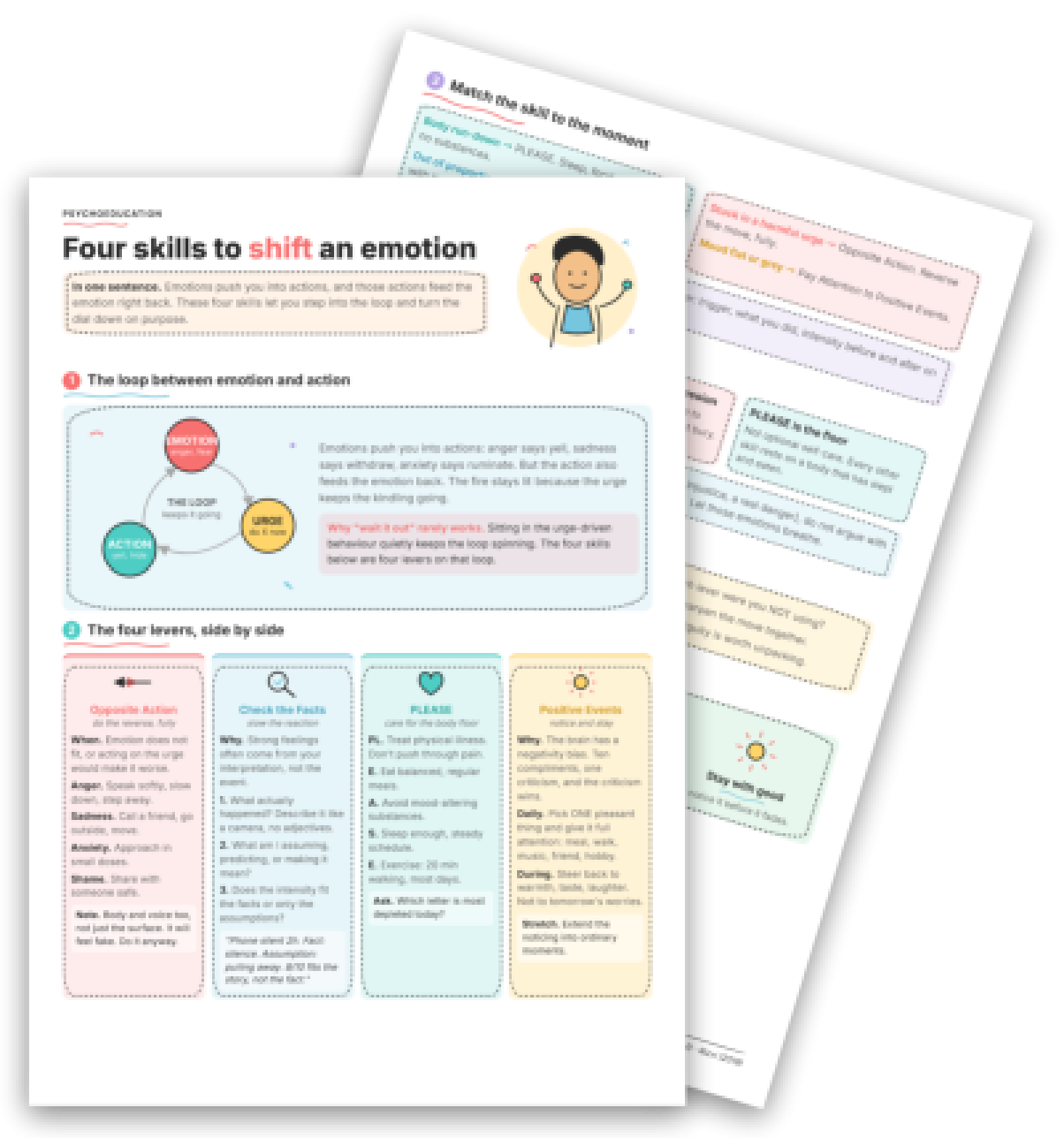
Panel 1 is a labeled diagram of the loop itself ("The loop keeps it going"), showing emotion, urge, and action as three linked nodes. That single image replaces two minutes of verbal framing and anchors the shared vocabulary for every session that follows.
Panel 2 lays the four skills out side by side:
- Opposite Action: specific behavioral examples per emotion (anger, sadness, anxiety, shame), with the clinical note that body and voice must shift too, "It will feel fake. Do it anyway."
- Check the Facts: a three-question sequence separating observable event from interpretation, with a worked example ("Phone silent 2h. Fact: silence. Assumption: pulling away. 8/10 fits the story, not the fact.")
- PLEASE: mnemonic covering physical illness, eating, substance avoidance, sleep, and exercise, framed throughout as "the floor, not optional self-care"
- Pay Attention to Positive Events: grounded in negativity bias, with an instruction to attend during the experience, steering back to the present rather than the next worry
Panel 3 is a matching grid: presenting state points directly to the indicated skill. Body run-down points to PLEASE; disproportionate affect to Check the Facts; harmful urge to Opposite Action; grey mood to Positive Events. This is where the visual format does its most direct clinical work, you orient the patient to this grid rather than holding the mapping while tracking them simultaneously. It connects naturally to adaptive and maladaptive coping distinctions you may already be using.
Panel 4 names the common traps explicitly: rumination masquerading as fact-checking, Opposite Action confused with suppression, PLEASE deprioritized. Panel 5 ("To discuss in session") provides three ready-made debriefing prompts, including: "When you cannot tell if the emotion fits the facts or only your story: that ambiguity is worth unpacking."
> To retain: this fiche PDF is a visual support that facilitates in-session psychoeducation on the DBT emotion regulation model, not a self-directed questionnaire, but a shared reference the clinician uses to build a common framework and leave the patient a concrete anchor between appointments.
750+ clinical tools
A library built with and for clinicians, ready to use in session and extend between appointments.
Access all the toolsWhen and how to introduce it in session
The fiche fits well from the second or third session onward, once the initial anamnesis is complete and a preliminary formulation exists. It is particularly indicated for:
- patients with marked emotional lability, impulsive behavioral responses, or coping cycles that alternate between avoidance and acting-out
- presentations where you are also building DBT ACCEPTS distress tolerance or DBT DEAR MAN skills, this fiche provides the foundational emotion regulation layer those tools sit on
- patients reporting that the same urge keeps winning the same way without understanding why
A neutral introduction works well: "I'd like to show you a map of how emotions and actions influence each other, something we can use together today and that you can keep." Avoid framing it as a form to fill in alone; its value is in walking through it jointly.
In subsequent sessions, return to Panel 3 as a tracking device: which skill did the patient reach for, which did they sidestep, and what got in the way? The emotion-behavior connection and rumination traps that surface there map directly onto Panel 4. For patients who struggle with the positive-events component, an activity menu for behavioral activation or a structured emotion regulation program extends that work concretely.
One limit to flag: Panel 4 includes an explicit caveat that if the emotion fits the facts, real loss, real injustice, real danger, Check the Facts is not the appropriate tool. Naming that in session prevents the fiche from being used to invalidate legitimate affect. The fiche makes the conceptual groundwork of DBT emotion regulation clear faster; it does not do the clinical discrimination for you.
Use it with your patients
Share this tool in the mobile app and follow the work between sessions.
Sources
- Linehan, M. M. (2015). DBT Skills Training Manual, Second Edition. The Guilford Press.
- Linehan, M. M. (2015). DBT Skills Training Handouts and Worksheets, Second Edition. The Guilford Press.
- Fassbinder, E., Schweiger, U., Martius, D., Brand-de Wilde, O., & Arntz, A. (2016). Emotion Regulation in Schema Therapy and Dialectical Behavior Therapy.
Your session continues in your patients' pocket
Use with a patientYour resources, available everywhere
The handouts, exercises, programs and audios above: you choose which ones to make available to your patients, in the mobile app dedicated to them.
And far more than a library
The app goes well beyond resources, to support your patients every day:
Related categories
Explore other clinical resources by category.

Anxiety
Clinical hub for anxiety disorders: CBT and ACT worksheets, psychoeducation sheets, and exercises for assessment and treatment across the anxiety spectrum.

Mood
Evidence-based worksheets and clinical tools for mood disorders: CBT, ACT, and positive psychology resources for psychologists and therapists.

Emotions
Clinical resources on emotion regulation: worksheets, coping tools, CBT, REBT, and ACT exercises for therapists working across diagnoses and age groups.

Understand
Clinical hub for the therapeutic aim 'Understand': worksheets and tools to build patient insight across CBT, ACT, schema therapy and more.

Build awareness
Clinical worksheets and tools to build awareness in therapy: cognitive distortions, schemas, emotions, ACT and CBT resources for practitioners.

Regulate
Clinical resources for emotion regulation: worksheets, ACT exercises, and psychoeducation tools for affect regulation across diagnoses. For clinicians.