
Clinical picture. T., a man in his late thirties, presented with low mood and recurring interpersonal conflict at work, reporting his emotional experience almost exclusively as 'feeling bad' or 'not right.' During a session focused on a recent argument with a colleague, the clinician introduced the Basic Emotions Reference sheet and invited T. to scan the four family columns while describing the incident. T. identified 'irritated' and 'offended' quickly, then paused at the sadness column and added 'disappointed,' which he had not previously named. This granular labelling opened a brief but productive conversation about the violated expectation underlying the conflict, rather than the surface exchange itself, and T. left with a clearer sense of what the situation had actually cost him.
Basic Emotions: PDF Worksheet, Tools and Exercises for Clinical Practice
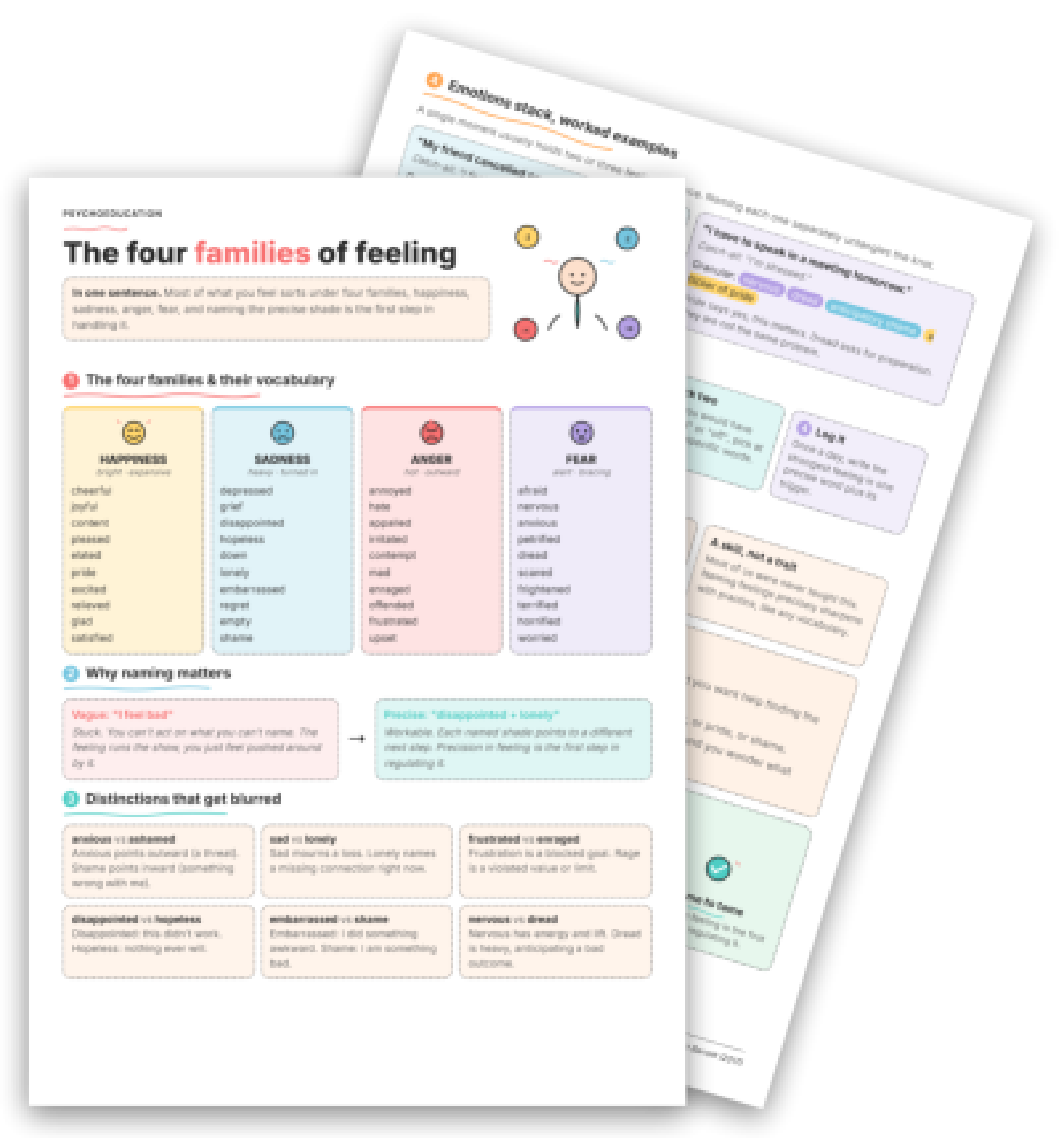
A printable visual reference on the four emotion families, their precise vocabulary, common confusions, and how naming feelings is the first step in regulating them.
Clinical vignettes
Untangling 'I Just Feel Bad'
Shame and Anxiety Distinguished
Clinical picture. M., a woman in her mid-forties with generalised anxiety and a history of self-critical rumination, described a recurring state she called 'pure anxiety' before social gatherings. The clinician used the Basic Emotions Reference sheet to walk through the distinction between anxious and ashamed, pointing to the sheet's note that anxiety orients toward an external threat while shame orients inward toward a perceived defect in the self. M. read both descriptors slowly and said, unprompted, that what she felt before parties was 'more the shame one.' Reframing her experience shifted the focus of subsequent sessions from arousal regulation toward the self-critical schema driving her avoidance, a direction that had not emerged in earlier work.
Patients rarely struggle to feel; they struggle to name. In session, the difference between "I feel bad" and "I feel disappointed and lonely" is clinically significant, yet that precision is hard to produce under the simple pressure of a spoken question. This basic emotions PDF worksheet offers a structured visual scaffold to make that shift happen in the room, not just in theory.
Use this resource with your patients
Handout, exercises and materials ready to use, right inside SessionFuel.
Why Emotion Labeling Resists an Oral Explanation
The core difficulty is not conceptual. Most patients understand, abstractly, that emotions can be distinguished. What fails is retrieval under emotional load: when a patient is activated, they default to the broadest available label. Asking "can you be more specific?" without a reference often lands as an implicit criticism, or simply produces a synonym ("stressed" becomes "overwhelmed").
The second obstacle is affective alexithymia in its milder, subclinical forms. Many patients have genuinely impoverished emotional vocabulary, not because of a primary alexithymia diagnosis, but because, as the fiche notes plainly, "most of us were never taught this." Oral instruction alone does not provide the scaffolding they need. A visual grid does.
There is also a clinical cost to imprecision. When a patient conflates anxious with ashamed, or disappointed with hopeless, the intervention that follows risks addressing the wrong target entirely. Granular labeling is not a soft warm-up activity; it is a prerequisite to accurate cognitive restructuring and to any coherent emotion regulation work.
What the Basic Emotions Reference Contains
The fiche is organised across six numbered panels, all grounded in Ekman's basic emotion framework and referencing Lieberman (2007) and Feldman Barrett (2017).
Panel 1 lays out the four families: happiness, sadness, anger, and fear, each with ten precise vocabulary items. The visual layout is deliberately wide: four columns in parallel so the patient can scan horizontally and register differences in register ("cheerful" vs "elated," "irritated" vs "enraged") at a glance, something a spoken list cannot replicate.
Panel 2 makes the clinical argument explicit in two columns: "Vague: 'I feel bad', Stuck" on the left, "Precise: 'disappointed + lonely', Workable" on the right. This is the visual hinge of the whole fiche. You can point to it directly rather than restating the argument.
Panel 3 is particularly useful: it lists six distinctions that get blurred in clinical presentations, including anxious vs ashamed, frustrated vs enraged, and nervous vs dread. Each pair has a one-line differentiation. This is where you save the most consultation time: instead of constructing these distinctions from scratch, the fiche already has them.
Panel 4 shows two worked examples of stacked emotions ("My friend cancelled on me" yields "disappointed, lonely, irritated, rejected"). This normalises emotional complexity and disrupts the common patient belief that they should feel only one thing at a time.
Panels 5 and 6 give the patient a four-step daily practice (pause, scan, pick two words, log it) and a set of clinician prompts under "To discuss in session," which you can use verbatim to orient the debrief.
> To remember: this fiche is a visual support that facilitates the explanation in session; it gives the patient something to look at, scan, and return to at home. It is not a self-administered questionnaire.
750+ clinical tools
A library built with and for clinicians, ready to use in session and extend between appointments.
Access all the toolsWhen and How to Introduce the Fiche
The fiche fits naturally in early-to-mid treatment, once the therapeutic alliance is established but before you move into more demanding cognitive or exposure work. For patients beginning behavioral activation for depression, or those starting graded exposure for anxiety, building an emotion vocabulary first prevents the imprecision that stalls those protocols.
It is particularly indicated when you notice a patient consistently defaulting to two or three catch-all words, or when they express difficulty distinguishing shame from anxiety, or sadness from loneliness. It also works well as an introduction to deeper anger psychoeducation work or fear-focused programs, where precise labeling of secondary emotions is essential.
A low-threat introduction in session: "I'd like to show you a reference I use with many patients. It's a map of four emotion families with more precise words than the usual ones. Let's just look at it together for a moment." From there, you can ask the patient to circle whatever applied to them during the past week. The debrief writes itself: which words did they circle, which families were absent, which distinctions from Panel 3 resonated or surprised them.
For patients working on identifying their core emotion patterns, or building the mental health foundations needed before deeper work, the fiche also serves as a concrete take-home that reinforces session content without requiring autonomous self-monitoring skills they may not yet have.
The fiche does not replace your formulation or the relational container. It makes one specific part of the work, naming feelings precisely, faster, clearer, and more memorable.
Use it with your patients
Share this tool in the mobile app and follow the work between sessions.
Sources
- Ekman, P. (2007). Emotions Revealed: Recognizing Faces and Feelings to Improve Communication and Emotional Life (2nd ed.). Henry Holt and Co..
- Willroth, E. C., Marquez, C. M. (2021). Cultivating Emotional Granularity. Frontiers in Psychology, 12, 703658.
Your session continues in your patients' pocket
Use with a patientYour resources, available everywhere
The handouts, exercises, programs and audios above: you choose which ones to make available to your patients, in the mobile app dedicated to them.
And far more than a library
The app goes well beyond resources, to support your patients every day:
Related categories
Explore other clinical resources by category.

Identity
Clinical resources for self-identity work in therapy: CBT, ACT, schema tools for clinicians addressing self-concept, core beliefs, and identity disruption.

Emotions
Clinical resources on emotion regulation: worksheets, coping tools, CBT, REBT, and ACT exercises for therapists working across diagnoses and age groups.

Build awareness
Clinical worksheets and tools to build awareness in therapy: cognitive distortions, schemas, emotions, ACT and CBT resources for practitioners.

CBT
CBT worksheets, cognitive restructuring exercises & behavioral tools for clinicians. Evidence-based resources for every phase of cognitive behavioral therapy.

Emotion-focused
Emotion-focused therapy clinical resources: worksheets, exercises & programs for EFT practitioners working with individuals and couples.

Integrative
Integrative therapy clinical resources: worksheets, psychoeducation programs, and exercises for eclectic, multimodal practice across orientations.