
Clinical picture. A child, referred to here as T., aged 6, was brought for an initial assessment following teacher concerns about emotional dysregulation in class; the parents reported that T. consistently answered questions about feelings with a flat "I don't know" or said nothing at all. During the session the clinician placed the twelve-face sheet on the table between them and asked T. to point to whichever face looked closest to how school felt that morning. Without hesitation T. pressed a finger on the scared face, then, after a pause, also on the bored face. This small gesture opened a ten-minute conversation that verbal prompting alone had not been able to start. The clinician sent the sheet home and recommended a brief daily pointing check-in before school, which the parents reported using consistently across the following two weeks.
Printable Emotion Faces: PDF Worksheet, Tools and Exercises
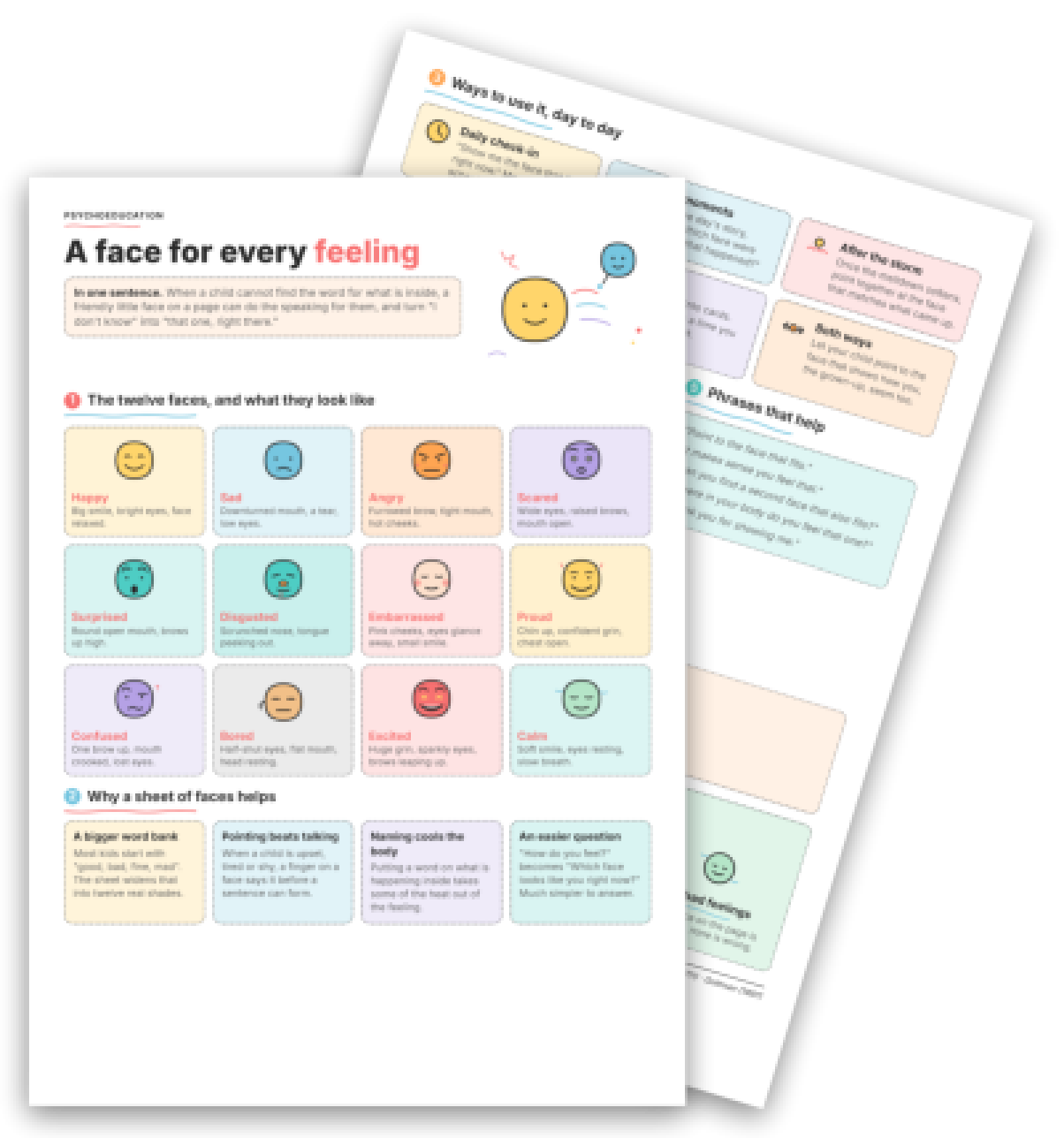
A visual psychoeducation tool clinicians can use in session to help young patients name feelings, build emotional vocabulary, and move past 'I don't know'.
Clinical vignettes
Pointing Past the Silence
After the Meltdown, a Label
Clinical picture. M., aged 8, presented with a diagnosis of ADHD and a history of intense emotional outbursts followed by prolonged shutdown; caregivers described a recurring pattern in which M. was unable to engage in any repair conversation for up to an hour after an episode. The clinician introduced the emotion-faces sheet as a low-demand bridge, suggesting that parents wait for the shutdown to soften and then simply place the sheet nearby without speaking. On the third occasion the caregiver tried this, M. picked up the sheet independently and pointed to the angry face, then to the embarrassed face. That sequence gave the caregiver a concrete starting point for a calm, brief exchange rather than a stalled attempt at verbal reflection. Over subsequent weeks the exercise appeared to shorten the post-episode shutdown window, though the clinician noted this remained one component within a broader parent-coaching intervention.
For many young patients, "How do you feel right now?" lands as an unanswerable question. Not because the emotion is absent, but because the word is. This PDF worksheet gives clinicians a concrete visual anchor to use directly in session, replacing the blank stare with a pointed finger and a named feeling.
Use this resource with your patients
Handout, exercises and materials ready to use, right inside SessionFuel.
Why Oral Emotion Labeling Falls Short With Young Patients
The gap between experiencing an emotion and encoding it linguistically is one of the most consistent obstacles in child and adolescent work. Pre-schoolers and early primary-age children typically operate with a minimal lexicon: good, bad, fine, mad. Even older children, when distressed, tired, or in a high-arousal state, lose access to the verbal pathway. Asking for a sentence then is asking for the most cognitively demanding response at the worst possible moment.
This is also where the basic emotion recognition work outlined by Ekman (cited in the fiche) becomes clinically useful. The concept is solid; the delivery is the problem. A spoken explanation of twelve discrete emotional states moves too fast, leaves no trace, and asks the child to hold the whole vocabulary in working memory simultaneously. Younger children with ADHD or executive function difficulties, or those with limited emotion regulation skills, are particularly disadvantaged by a purely verbal approach.
The Printable Emotion Faces fiche resolves this by replacing the question with a menu.
What the Fiche Contains: A Visual Lexicon for Session Use
The single-page printable displays twelve illustrated faces, each with a brief sensory description of what it looks like: "Happy: big smile, bright eyes, face relaxed"; "Confused: one brow up, mouth crooked, lost eyes"; "Calm: soft smile, eyes resting, slow breath." Embarrassment, pride, disgust, and boredom sit alongside the more commonly targeted affects, widening the child's available vocabulary well beyond the usual four.
Beyond the face grid, the fiche includes five clinician-oriented sections covering why pointing works better than talking, practical daily-use formats (daily check-in, post-meltdown anchoring, a cut-out card game), scripted phrases to model for caregivers ("Where in your body do you feel that one?", "Can you find a second face that also fits?"), and explicit build-on prompts: adding intensity, adding somatic location, adding the precipitating trigger.
This last layer connects naturally to CBT work with children and to understanding how emotions motivate actions, framing the fiche as a first step in a broader formulation rather than a standalone activity.
> Key point: The fiche is a visual support that facilitates the explanation of emotion labeling in session. It is not a questionnaire the child fills out alone. The clinician uses it as a shared reference point, on the desk or held between you, to turn an abstract concept into something the child can see, point at, and take home.
The printed layout does something oral psychoeducation cannot: it makes all twelve options simultaneously visible, so the child is choosing rather than retrieving.
750+ clinical tools
A library built with and for clinicians, ready to use in session and extend between appointments.
Access all the toolsHow and When to Introduce It in Session
The fiche fits naturally from a first or second session onward, once basic rapport is established. It is particularly well-matched to work with children aged four to ten, to sessions involving a caregiver (who can use the same vocabulary between appointments), and to any profile where verbal expression is a bottleneck: selective mutism, post-trauma shutdown, fight-or-flight activation, or simply shyness.
You can introduce it by placing it on the table and saying: "Here are twelve faces. I'm going to ask you to point to the one that looks most like you right now, and then we'll talk about it together." No labeling pressure, no open-ended question.
When debriefing, push gently into the build-on prompts the fiche provides: intensity scaling, body localisation, and trigger identification. These three steps connect directly to somatic awareness work and to basic emotion psychoeducation, and they map onto the same vocabulary used in emotion thermometer exercises and coping strategy work with younger patients.
One note of caution: for children who process facial cues differently (including some autistic profiles), the fiche itself notes it should be treated as "vocabulary, not as 'how a feeling should look.'" Frame it explicitly as a menu of options, not a prescriptive display. Pairing it with a Belief-O-Meter for Children or a CBT cognitive model for kids can extend the session once the emotional vocabulary is in place.
The fiche does not replace the relational frame; it makes the entry point into emotional work visible, portable, and low-pressure enough for the patients who need it most.
Use it with your patients
Share this tool in the mobile app and follow the work between sessions.
Sources
- Denham, S. A. (1998). Emotional Development in Young Children. Guilford Press.
- (2026) Emotion-specific vocabulary is associated with preschoolers' emotion knowledge and behavioral emotion regulation. Scientific Reports, 16, 38847.
Your session continues in your patients' pocket
Use with a patientYour resources, available everywhere
The handouts, exercises, programs and audios above: you choose which ones to make available to your patients, in the mobile app dedicated to them.
And far more than a library
The app goes well beyond resources, to support your patients every day:
Related categories
Explore other clinical resources by category.

Identity
Clinical resources for self-identity work in therapy: CBT, ACT, schema tools for clinicians addressing self-concept, core beliefs, and identity disruption.

Emotions
Clinical resources on emotion regulation: worksheets, coping tools, CBT, REBT, and ACT exercises for therapists working across diagnoses and age groups.

Understand
Clinical hub for the therapeutic aim 'Understand': worksheets and tools to build patient insight across CBT, ACT, schema therapy and more.

Build awareness
Clinical worksheets and tools to build awareness in therapy: cognitive distortions, schemas, emotions, ACT and CBT resources for practitioners.

CBT
CBT worksheets, cognitive restructuring exercises & behavioral tools for clinicians. Evidence-based resources for every phase of cognitive behavioral therapy.

Emotion-focused
Emotion-focused therapy clinical resources: worksheets, exercises & programs for EFT practitioners working with individuals and couples.