
Clinical picture. M., a man in his late thirties, presented with recurrent outbursts at work and a longstanding belief that his anger was a character defect requiring suppression. During a session focused on psychoeducation, the clinician introduced the function-of-emotions framework and invited him to consider anger as a boundary signal rather than a malfunction. M. was asked to recall a recent episode and identify what limit had been crossed; he named, with some surprise, a pattern of colleagues routinely dismissing his input in team meetings. The session closed without any behavioral prescription, simply with the reframe that the emotion had been carrying accurate information he had not yet been able to receive. At the next appointment he reported a modest but noticeable reduction in the intensity of his outbursts, which he attributed to feeling less at war with the feeling itself.
The Function of Emotions: PDF Worksheet, Tools and Exercises
A printable psychoeducation fiche and clinical exercises to help patients understand what each emotion is signaling, and how to respond rather than react.
Clinical vignettes
Anger as Signal, Not Flaw
Persistent Sadness and Unheard Loss
Clinical picture. L., a woman in her mid-fifties referred for adjustment difficulties following early retirement, described a low-grade sadness she found both inexplicable and embarrassing given that the retirement had been her own choice. The clinician used the informational sheet to introduce the idea that an emotion persisting over time often signals that its message has not yet been received or acted upon. Together they worked through the listening step: L. identified that sadness was pointing to a loss of professional identity and daily structure that she had not consciously acknowledged as a genuine loss. She had been attempting to reframe the transition as purely positive, which, as the sheet frames it, amounted to deleting the signal along with the information it carried. Naming the loss explicitly, without any immediate problem-solving, was sufficient to begin loosening the emotional stasis she had described.
Most patients arrive with a working assumption that emotions are the problem. The reframe that each emotion is a messenger with a specific job tends to make sense in the moment, then dissolve before the next session. This fiche PDF gives you a printable, visual support to make the functional model of emotions legible during the consultation itself, not just memorable in theory.
Use this resource with your patients
Handout, exercises and materials ready to use, right inside SessionFuel.
Why "emotions as messengers" resists verbal explanation
The model is clinically grounded across frameworks: from Greenberg's emotion-focused therapy, to the DBT emotion regulation skills module, to ACT's emphasis on willingness and psychological flexibility. Yet patients reliably stumble on two points when you work at the oral level alone.
First, they conflate the signal and its volume. A patient with chronic anxiety may correctly hear "fear signals threat" and immediately conclude that their hypervigilance is therefore justified. The distinction between a valid signal and a dysregulated intensity needs to be seen on paper to stick.
Second, shame and guilt collapse into a single undifferentiated mass. This matters clinically: shame produces hiding and self-attack with no exit; guilt produces repair. Patients entrenched in a shame loop have no actionable next step. Articulating the difference mid-session, while holding the alliance, is harder than expected, particularly with patients presenting low self-esteem, defectiveness schemas, or a pattern of emotional reasoning.
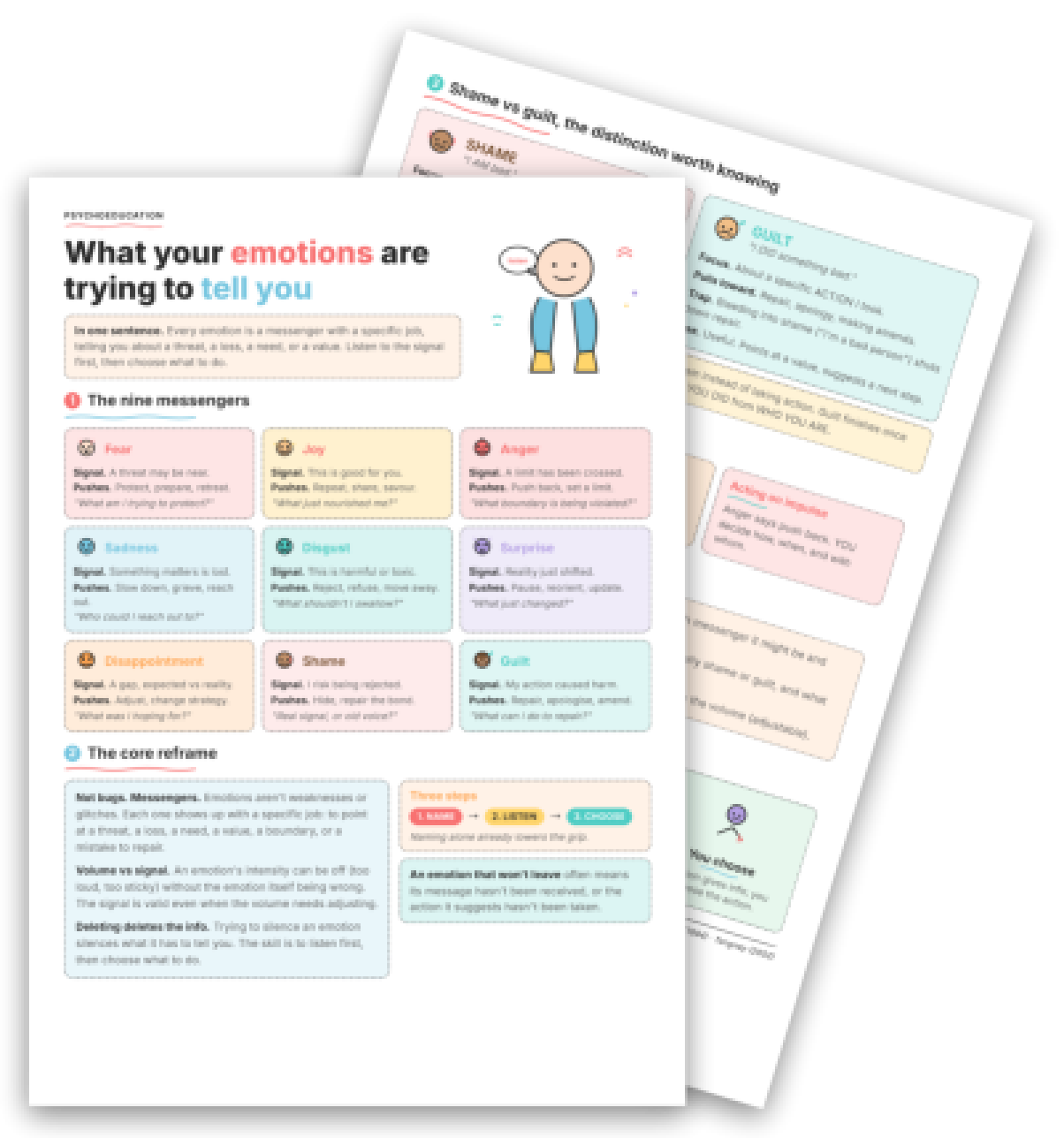
What the fiche contains: a six-panel visual map
The fiche is built across six panels, all structured as a visual support for in-session psychoeducation, not as a self-administered questionnaire.
Panel 1 lays out nine emotion messengers: Fear, Joy, Anger, Sadness, Disgust, Surprise, Disappointment, Shame, and Guilt. Each is formatted identically: the signal the emotion carries, the action it pushes toward, and a reflective question. For anger: "Signal. A limit has been crossed. Pushes. Push back, set a limit. 'What boundary is being violated?'" Placing this on the desk lets a patient locate their current experience on the map in real time, rather than holding an abstract schema.
Panel 2 frames the core reframe: emotions as messengers, not bugs or weaknesses. It introduces the three-step sequence Name → Listen → Choose and makes explicit that "an emotion's intensity can be off (too loud, too sticky) without the emotion itself being wrong." This is the sentence that often shifts something for patients who have spent years fighting their own affective life.
Panel 3 presents a side-by-side shame vs. guilt comparison, the panel with the highest immediate clinical yield. The layout makes the asymmetry visible at a glance: shame ("I AM bad") has no natural off switch; guilt ("I DID something bad") resolves through repair and then ends. You can point directly at this panel when working through shame-related material or introducing a guilt and responsibility exercise between sessions.
Panels 4 through 6 address common traps, including meta-emotions (the secondary "I shouldn't be angry" layer that generates more suffering than the original signal), session discussion prompts, and a compact summary the patient can keep as a reference card.
> Key takeaway: the fiche is a visual support that facilitates the explanation of emotion function in session; it lives on the desk as a shared reference point, not as a form the patient fills out alone at home.
750+ clinical tools
A library built with and for clinicians, ready to use in session and extend between appointments.
Access all the toolsWhen and how to introduce the fiche
This tool fits best in the early-to-mid phase of treatment, once a working alliance is in place and the patient has some exposure to the framework you are using. It is particularly useful with patients who present with emotional inhibition, strong avoidance of internal states, or a habit of judging their own emotional reactions as signs of weakness.
A simple introduction: "I'd like to show you a map of what emotions are actually designed to do. Let's go through it together." Placing the fiche on the desk before turning to the session's main material lets you use whatever the patient brings as live illustration for the panels.
For debrief, ask which of the nine messengers appeared most that week and whether the patient noticed confusing shame with guilt. With patients working on anger, panels 1 and 4 anchor a concrete discussion about the gap between signal and impulsive action. For patients navigating depression and emotional flatness, the "deleting deletes the info" line in panel 2 often lands with particular force.
The fiche is not a substitute for a structured emotion regulation program or the granular vocabulary work supported by an emotion wheel. It is a one-page anchor that establishes shared language early and leaves the patient with something concrete on their fridge, not just a memory of what you said in session.
Use it with your patients
Share this tool in the mobile app and follow the work between sessions.
Sources
- Tangney, J. P., Dearing, R. L. (2002). Shame and Guilt. Guilford Press.
- Barrett, L. F. (2017). How Emotions Are Made: The Secret Life of the Brain. Houghton Mifflin Harcourt.
Your session continues in your patients' pocket
Use with a patientYour resources, available everywhere
The handouts, exercises, programs and audios above: you choose which ones to make available to your patients, in the mobile app dedicated to them.
And far more than a library
The app goes well beyond resources, to support your patients every day:
Related categories
Explore other clinical resources by category.

Identity
Clinical resources for self-identity work in therapy: CBT, ACT, schema tools for clinicians addressing self-concept, core beliefs, and identity disruption.

Emotions
Clinical resources on emotion regulation: worksheets, coping tools, CBT, REBT, and ACT exercises for therapists working across diagnoses and age groups.

Understand
Clinical hub for the therapeutic aim 'Understand': worksheets and tools to build patient insight across CBT, ACT, schema therapy and more.

Build awareness
Clinical worksheets and tools to build awareness in therapy: cognitive distortions, schemas, emotions, ACT and CBT resources for practitioners.

CBT
CBT worksheets, cognitive restructuring exercises & behavioral tools for clinicians. Evidence-based resources for every phase of cognitive behavioral therapy.

Integrative
Integrative therapy clinical resources: worksheets, psychoeducation programs, and exercises for eclectic, multimodal practice across orientations.