
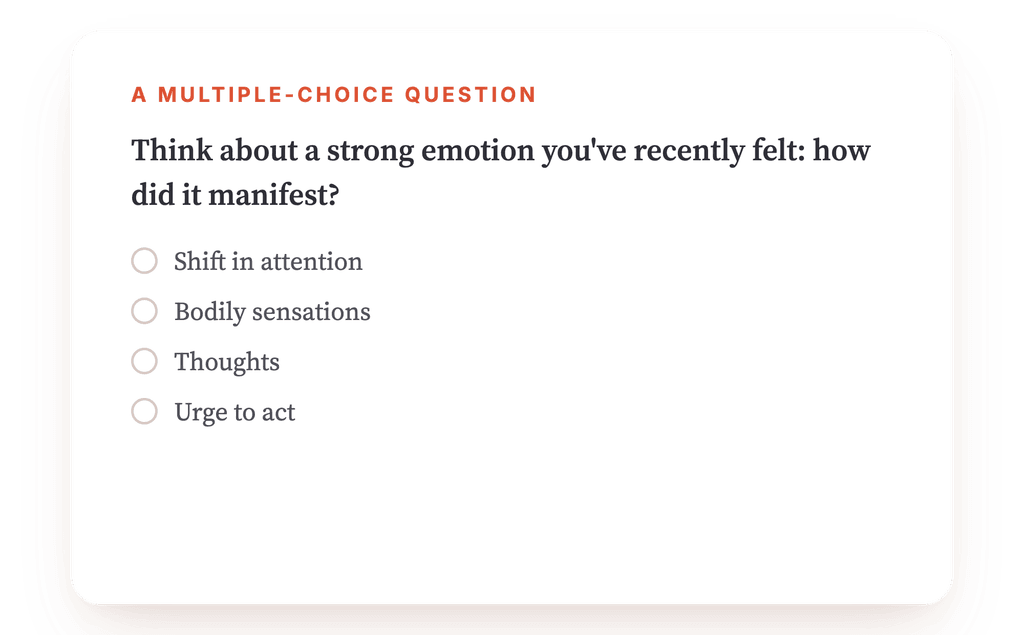
Clinical picture. T., a man in his late forties with a third depressive episode, reported feeling "empty and irritable" but struggled to identify anything beyond those broad descriptors. His psychologist introduced the self-guided emotion program between sessions, starting with Lesson 1, which prompts the patient to reflect on how a recent strong emotion manifested physically, cognitively, and behaviourally. T. completed the lesson at home and returned noting, for the first time, that what he had labeled irritability included a somatic component of chest tightness and an impulse to withdraw, alongside rumination. This granular recognition gave the clinician more precise material to work with in the following session.
Emotions in Depression: A Structured Psychoeducation Program
A 4-lesson autonomous program helping patients understand, recognize, and regulate the emotional patterns that sustain depression.
Clinical vignettes
Naming Emotions in Recurrent Depression
Emotional Awareness in Chronic Low Mood
Clinical picture. M., a woman in her mid-thirties with persistent depressive disorder, described her mood as uniformly flat and expressed doubt that she experienced emotions at all. Her therapist assigned Lesson 2 of the program, which targets emotional awareness and includes structured self-assessment prompts about recognising triggers for both positive and negative states. M. reported mild surprise when the lesson's multiple-choice inventory surfaced shame and loneliness as frequently recurring states she had not previously articulated. That awareness did not resolve her difficulties, but it opened a shared vocabulary that made subsequent sessions more focused.

Use this resource with your patients
Handout, exercises and materials ready to use, right inside SessionFuel.
What makes the emotional dimension of depression hard to address clinically
Depression is not only a cognitive or behavioral condition. The affective landscape it creates, marked by a relentless predominance of negative emotions, is one of the hardest things to work through with patients. Two specific clinical difficulties arise repeatedly. First, patients often struggle to name or even notice what they are feeling: emotional avoidance and the lethargy of depression conspire against the basic step of recognition. Second, they typically hold distorted beliefs about emotions themselves, seeing them as dangerous, permanent, or pointless, which locks in suppression and avoidance rather than regulation. Explaining all of this verbally, across a single consultation, rarely produces durable understanding. What patients need is a structured space to work through these ideas at their own pace, with guided prompts that bring the concepts into their personal experience.
A companion resource like The Cycle of Depression: PDF Worksheet, Tools and Exercises can anchor the broader maintenance loop in session, but it cannot substitute for the patient's own reflective work on their emotional patterns over time.
Clinical library
750+ clinical tools
A library built with and for clinicians, ready to use in session and extend between appointments.
Access all the toolsSeveral resource types
Psychoeducation handouts
Understand at a glance
Interactive exercises
To do and fill in
Interactive programs
A structured path
Audios
Meditation and relaxation
Psychometric tests
Automatic scoring
What this program contains
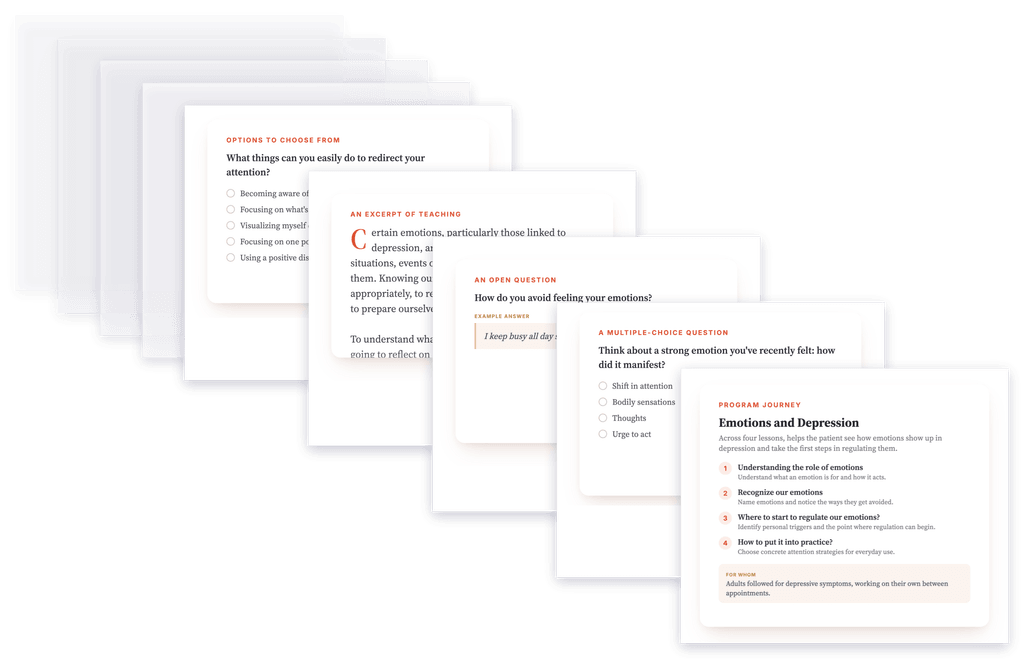
This four-lesson program guides patients through a progressive arc: from grasping what an emotion actually is, to building the skill of recognizing it in real time, to learning concrete regulation strategies.
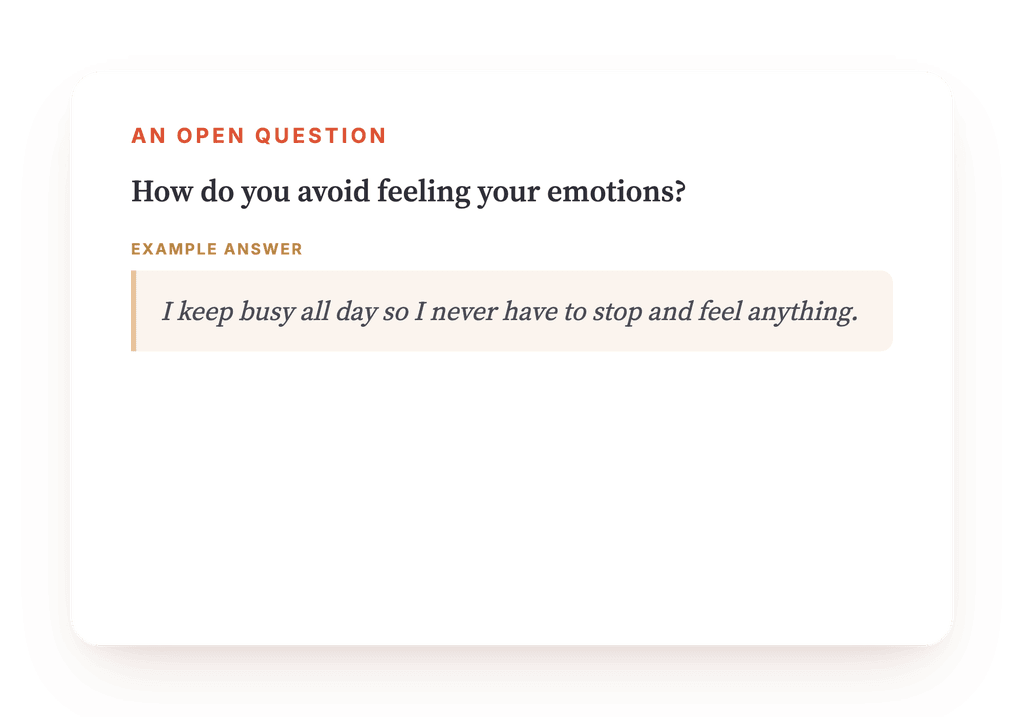
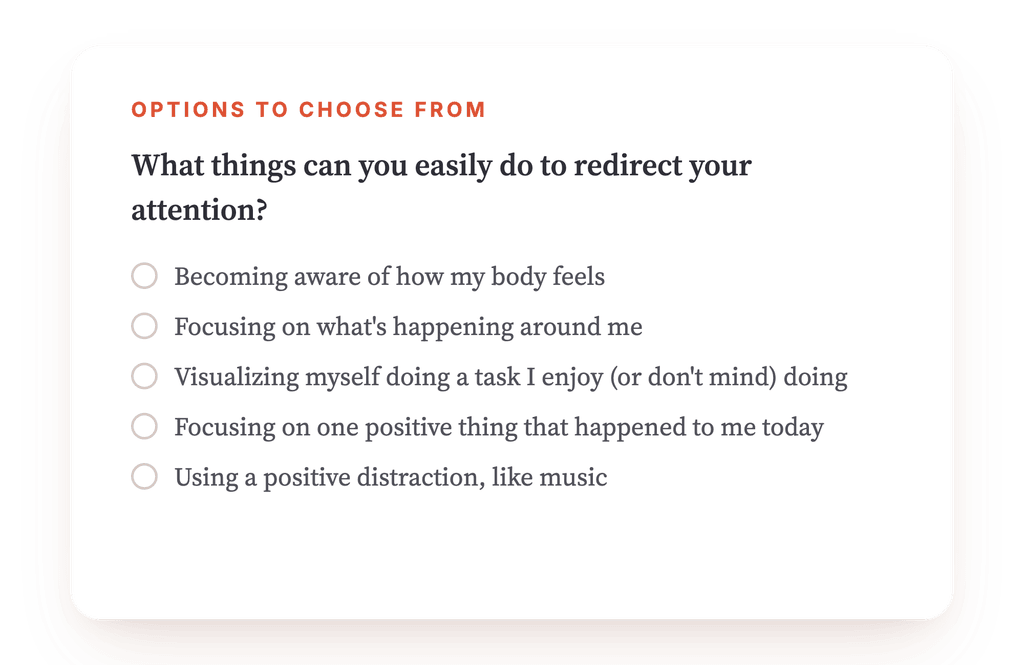
Lesson 1 opens with the function of emotions, explains how depression amplifies the negativity bias, and asks patients to reflect on how their own emotions have maintained the depressive cycle. Lesson 2 targets emotional awareness directly: it addresses both the recognition deficit and the avoidance pattern, and invites patients to map emotions using multiple channels, bodily, cognitive, and motivational, including dimensions such as valence, arousal, and intensity. Lesson 3 establishes the foundations for regulation: identifying personal triggers, constructing if-then response plans, examining unhelpful beliefs about emotions, and beginning the work of cognitive reappraisal and self-compassion. Lesson 4 is the most practice-oriented: it covers attention redirection, expressing emotions clearly to others, constructive self-talk, and building toward positive emotion as a deliberate skill.
Throughout, each lesson combines short psychoeducation texts with multiple-choice questions (for example, patients identify which emotions they experience frequently from a detailed list, or which beliefs they hold about negative emotions) and open-ended reflective prompts that produce written material the clinician can review.
The preview images embedded in this article (an overview map and a few sample cards) show only a small fraction of the program: the complete tool contains many more steps, guided prompts, and psychoeducation texts than what is visible here.
Clinicians working with DBT Emotion Regulation Skills or the The Function of Emotions: PDF Worksheet will find this program extends that conceptual groundwork into sustained, autonomous patient practice.
This program is available to patients through the mobile application that is the dedicated patient-side interface of SessionFuel: the clinician assigns it directly from their SessionFuel account, and the patient then works through each lesson independently on their phone, between appointments.
Use it with your patients
Share this tool in the mobile app and follow the work between sessions.
How to integrate it into your practice
This program suits adult patients presenting with mild to moderate depression who have enough capacity for self-reflection to engage with written prompts. It is equally useful for patients who intellectually understand their depression but have never applied that understanding to their emotional experience specifically.
Introduce it between the first and second consultation as structured homework: frame it as a way to carry the therapeutic work into daily life, not as a reading assignment. Tell patients that the prompts will generate material worth bringing back. Because each lesson produces written responses, you have concrete patient-generated content to open the next consultation with: which emotions they listed, how they described their avoidance, what trigger-response plan they drafted, which attention-redirection strategies felt accessible.
Key insight: the written responses patients produce, especially the trigger maps and if-then plans in Lessons 3 and 4, function as a real-time clinical window into their emotional patterns between consultations, turning homework into genuine assessment data.
Pair this program with Identifying Emotional Triggers or Feel, Reflect, Act Differently for patients who need additional scaffolding around the trigger-to-reaction moment. For patients whose rumination is prominent, Constructive vs Harmful Rumination complements Lesson 3's work on unhelpful thinking patterns. If self-compassion remains blocked, Compassion Focused Therapy offers a useful psychoeducation anchor. The Emotion Regulation Psychoeducation Program and the ACT for Depression program can serve as natural continuations once this program is complete.
Patient mobile app
Your session continues in your patients' pocket
Use with a patientYour resources, available everywhere
The handouts, exercises, programs and audios above: you choose which ones to make available to your patients, in the mobile app dedicated to them.
Psychoeducation handoutsInteractive exercisesInteractive programsAudiosPsychometric tests
And far more than a library
The app goes well beyond resources, to support your patients every day:
Standardized tests
Therapy journal
Gamification
Wellbeing challenges
Introspection prompts
Therapist homework
Related categories
Explore other clinical resources by category.

Mood
Evidence-based worksheets and clinical tools for mood disorders: CBT, ACT, and positive psychology resources for psychologists and therapists.

Emotions
Clinical resources on emotion regulation: worksheets, coping tools, CBT, REBT, and ACT exercises for therapists working across diagnoses and age groups.

Understand
Clinical hub for the therapeutic aim 'Understand': worksheets and tools to build patient insight across CBT, ACT, schema therapy and more.

Build awareness
Clinical worksheets and tools to build awareness in therapy: cognitive distortions, schemas, emotions, ACT and CBT resources for practitioners.

Regulate
Clinical resources for emotion regulation: worksheets, ACT exercises, and psychoeducation tools for affect regulation across diagnoses. For clinicians.

CBT
CBT worksheets, cognitive restructuring exercises & behavioral tools for clinicians. Evidence-based resources for every phase of cognitive behavioral therapy.