
Clinical picture. K., a woman in her early 30s, presents with emotionally unstable personality features and a longstanding pattern of sending regretted messages to her partner during arguments, followed by hours of shame. In session, the clinician introduces the three-mind framework using the psychoeducational sheet, inviting K. to locate herself on a body-based scale rather than a cognitive one. K. recognizes the jaw tension and tunnel vision she had described as her signature for Emotion Mind, and for the first time names a contrasting somatic cue: a slow exhale and a sense of the room widening, which she tentatively labels as Wise Mind. Over the following two weeks she reports pausing twice before sending a message, not because she suppressed the feeling, but because she noticed the body cue was absent. Progress was modest and uneven, consistent with early skill acquisition.
Wise Mind: PDF Worksheet, Tools and Exercises for Clinical Practice
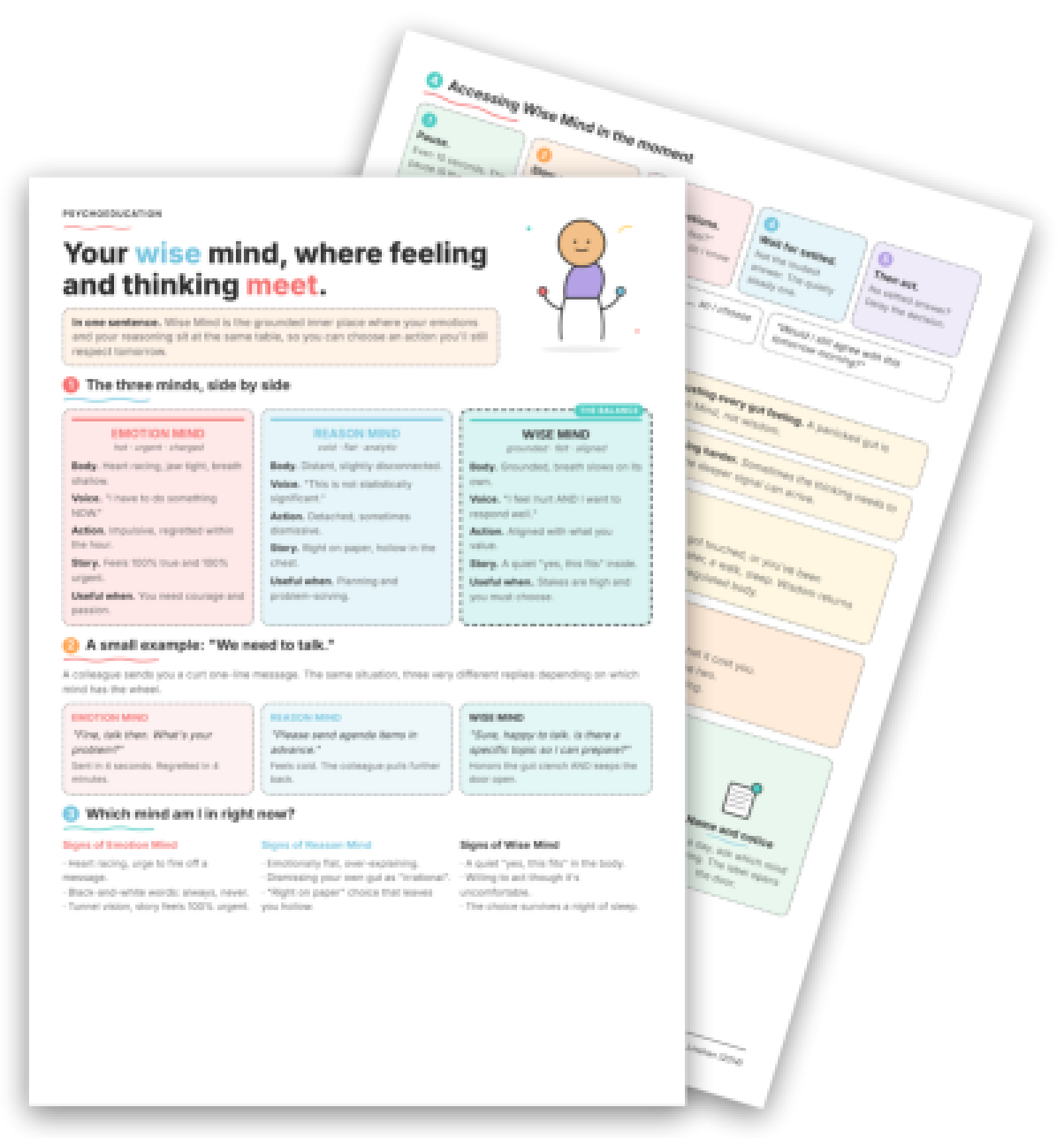
A visual PDF fiche to explain Linehan's three-mind model in session, build a shared vocabulary, and give patients a concrete self-monitoring anchor they can use between appointments.
Clinical vignettes
Wise Mind in Conflict Avoidance
Reason Mind Recognized as Avoidance
Clinical picture. T., a man in his mid-40s referred for adjustment difficulties following a serious medical diagnosis, arrives at sessions well-prepared with printed statistics and treatment comparison tables, yet describes a persistent hollow feeling and an inability to discuss the diagnosis with his spouse. The clinician uses the Wise Mind sheet to name Reason Mind not as a strength in this context but as a protective retreat from intolerable affect. T. pauses when he reads the phrase "right on paper, hollow in the chest" and says quietly that this is exactly where he has been living. Subsequent sessions shifted toward acknowledging the emotional layer alongside the analytic one, which allowed a more open conversation with his spouse to become possible, though significant ambivalence remained.
Explaining Wise Mind verbally tends to land as an abstract platitude: patients nod, but the concept evaporates before the next session. The three-mind distinction is genuinely counterintuitive, particularly for patients who conflate felt truth with wisdom and are chronically suspicious of their own reasoning. This fiche PDF gives you a structured visual to walk through in session, so the concept sticks rather than slides.
Use this resource with your patients
Handout, exercises and materials ready to use, right inside SessionFuel.
Why Wise Mind Resists Explanation in Session
The core difficulty is that Emotion Mind and Reason Mind both feel justified from the inside. A patient deep in emotional flooding isn't aware of cognitive narrowing; a patient locked in over-intellectualization doesn't experience their flatness as a problem. When you describe Wise Mind solely in words, it sounds like a call for moderation, which many patients immediately read as "suppress what you feel and think harder." This misread is precisely the confusion Linehan's model was designed to prevent, and it doesn't dissolve through explanation alone.
A second obstacle is that patients with dysregulation histories (borderline features, complex trauma, affect instability) often have no felt sense of what grounded and aligned actually is in the body. The concept requires an experiential reference point, not just a definition. A DBT-informed conceptual overview can orient them to the broader framework, but you need something more granular for the three-mind distinction itself.
750+ clinical tools
A library built with and for clinicians, ready to use in session and extend between appointments.
Access all the toolsWhat the Fiche Contains
The fiche organizes its content across five numbered panels, making it a genuine support visuel for in-session psychoeducation rather than a take-home questionnaire.
Panel 1 presents the three minds in a side-by-side layout: Emotion Mind (hot · urgent · charged), Reason Mind (cold · flat · analytic), and Wise Mind (grounded · felt · aligned). For each, the fiche gives four lines of content: the body experience, the inner voice, the likely action, and the "story" the mind tells. Crucially, it also names when each mind is useful, pre-empting the mistake of treating Emotion Mind as pathology.
Panel 2 applies the model to a single concrete scenario ("a colleague sends a curt one-line message") and shows three very different replies, each mapped to one mind. The Wise Mind reply, "Sure, happy to talk. Is there a specific topic so I can prepare?", lands differently on the page than in speech because the patient can hold all three responses simultaneously and feel the difference.
Panel 3 provides a real-time self-check: observable signs of Emotion Mind (racing heart, black-and-white language, tunnel vision), signs of Reason Mind (emotional flatness, dismissing gut signals), and signs of Wise Mind ("a quiet 'yes, this fits' in the body," a choice that survives a night of sleep). This is where the visual format earns its keep: patients can scan the list and locate themselves, rather than relying on self-report in a vacuum.
Panel 4 breaks down a four-step access protocol: pause (even ten seconds), slow exhale, two questions ("What do I feel? AND What do I know is true?"), and wait for the steady answer, not the loudest one. Three prompt sentences are printed at the bottom for between-session use, including "I feel ___ AND I think ___ so I choose ___."
Panel 5 addresses the most persistent clinical confusions: Wise Mind is not "calm down and be reasonable," not unconditional trust in gut feelings, and not a permanent state. It also names the conditions that block access (fatigue, hunger, old wounds activated) and redirects toward somatic regulation first, which aligns directly with DBT TIPP skills for dysregulation.
> Key takeaway: the fiche functions as a visual explanation support used by the clinician in session; it is not a self-administered questionnaire. The three-column layout makes the distinction between the minds legible in a way that spoken description simply cannot replicate.
Use it with your patients
Share this tool in the mobile app and follow the work between sessions.
When and How to Introduce It
The fiche fits naturally from the second or third session onward, once the therapeutic alliance is sufficient and you have at least a preliminary emotion regulation picture from the intake. It works particularly well with patients who present with impulsive responding, chronic indecisiveness, emotional dysregulation, or a pattern of regretted decisions.
To introduce it without labeling: "I want to show you a model that a lot of people find useful for those moments when the situation feels urgent and you're not quite sure how to respond. It's from DBT, and it maps three different states you can be in when you have to make a choice." Walk through Panel 1 together, pausing at each column. Then move to the example in Panel 2 and ask which mind they recognize most in themselves right now.
The three checkboxes in the To discuss in session section are well-suited for debriefing: bring a moment this week where one mind clearly drove the wheel, notice whether there is a default tendency, and identify one upcoming situation for practice. These map directly onto the between-session self-monitoring work you may already be assigning.
One clinical note: patients with marked alexithymia will struggle with the body-signal criteria in Panel 3. For these profiles, pair the fiche with somatic awareness work (a grounding or body scan practice) before expecting the quiet "yes, this fits" to be accessible. For patients in acute crisis, move to distress tolerance tools first; Wise Mind is a consolidation skill, not a crisis intervention.
The fiche PDF does not replace the clinical work of schema exploration or trauma processing. What it does is give both you and the patient a shared vocabulary and a portable reference, so that when Emotion Mind is running the session, you can point to Panel 1 together rather than reasoning into the fog.
Your session continues in your patients' pocket
Use with a patientYour resources, available everywhere
The handouts, exercises, programs and audios above: you choose which ones to make available to your patients, in the mobile app dedicated to them.
And far more than a library
The app goes well beyond resources, to support your patients every day:
Related categories
Explore other clinical resources by category.

Emotions
Clinical resources on emotion regulation: worksheets, coping tools, CBT, REBT, and ACT exercises for therapists working across diagnoses and age groups.

Cognition
Printable cognitive therapy worksheets and clinical tools for therapists: CBT, ACT, schema work, defusion, distortions, and belief restructuring.

Understand
Clinical hub for the therapeutic aim 'Understand': worksheets and tools to build patient insight across CBT, ACT, schema therapy and more.

Build awareness
Clinical worksheets and tools to build awareness in therapy: cognitive distortions, schemas, emotions, ACT and CBT resources for practitioners.

Regulate
Clinical resources for emotion regulation: worksheets, ACT exercises, and psychoeducation tools for affect regulation across diagnoses. For clinicians.

DBT
DBT worksheets and exercises for clinicians: distress tolerance, emotion regulation, and interpersonal skills tools for dialectical behavior therapy practice.