
Clinical picture. M., a woman in her early thirties, presents with borderline personality disorder and a pattern of sending hostile messages to her partner during arguments, followed by intense shame and relational rupture. During a session focused on the Wise Mind informational sheet, the clinician walks her through the three-mind framework and asks her to locate a recent conflict on the diagram. M. recognises, with some surprise, that she had been acting entirely from Emotional Mind: she had felt abandoned and had fired off eight messages before her partner had finished their shift. The clinician invites her to rehearse the pause step, naming the mind aloud and placing a hand on her sternum, then to articulate one factual truth alongside the emotional one. By the following session M. reported she had caught herself mid-spiral, named it as Emotional Mind, and waited before replying, describing a faint but noticeable sense of settling in her chest.
Wise Mind: PDF Worksheet, Tools and Exercises for DBT Practice
A printable PDF fiche and concrete exercises to explain the Wise Mind DBT skill in session, establish a shared clinical vocabulary, and give patients a durable reference.
Clinical vignettes
Wise Mind in Acute Relationship Conflict
Reasonable Mind Blocking Grief After Job Loss
Clinical picture. T., a man in his mid-forties referred for adjustment disorder following redundancy, arrives describing an intensive self-imposed job-search schedule he began within days of receiving notice. He reports sleeping poorly and feeling "like a machine" but insists this is the rational response. The clinician introduces the Wise Mind sheet and draws T.'s attention to the Reasonable Mind column, particularly the phrase "pretend you are fine and start applying within the hour." T. sits quietly for a moment and then says the description fits almost exactly. Together they discuss how his structured activity was functioning to suppress distress rather than to support a considered decision, and the clinician suggests holding space for the loss before resuming applications. Over the next two weeks T. reduced his daily application quota and reported that his sleep had begun to stabilise.
Explaining Wise Mind verbally often produces polite agreement and little clinical traction. Patients hear "balance your emotions and your logic," nod, and leave without any felt sense of what the shift actually looks like in a conflict, a job loss, or a crisis decision. This fiche PDF gives you a visual scaffold to anchor the psychoeducation in session and hand patients something concrete to take home.
Use this resource with your patients
Handout, exercises and materials ready to use, right inside SessionFuel.
Why Wise Mind Is Hard to Convey Without a Visual Support
The core difficulty is not complexity, it is abstraction. Emotional Mind and Reasonable Mind feel intuitive in isolation, but the synthesis, the idea that both can be active and honoured simultaneously, rarely lands through words alone. Patients who default to emotional reasoning tend to hear "Wise Mind" as an instruction to suppress feeling. Those with strong intellectualising defences hear it as permission to stay in their heads. Neither reading is correct, and correcting both orally, in the same breath, costs time and risks losing the therapeutic thread.
A second difficulty: the concept is a state, not a trait. Linehan (1993) is explicit on this point, yet patients routinely assume Wise Mind is a stable personality feature they either have or lack. A support visuel makes this movable quality perceptible: you can point to the diagram and say "you shift between these, sometimes minute by minute," which is far more credible than stating it.
What the Fiche Contains: A Visual Tool for In-Session Explanation
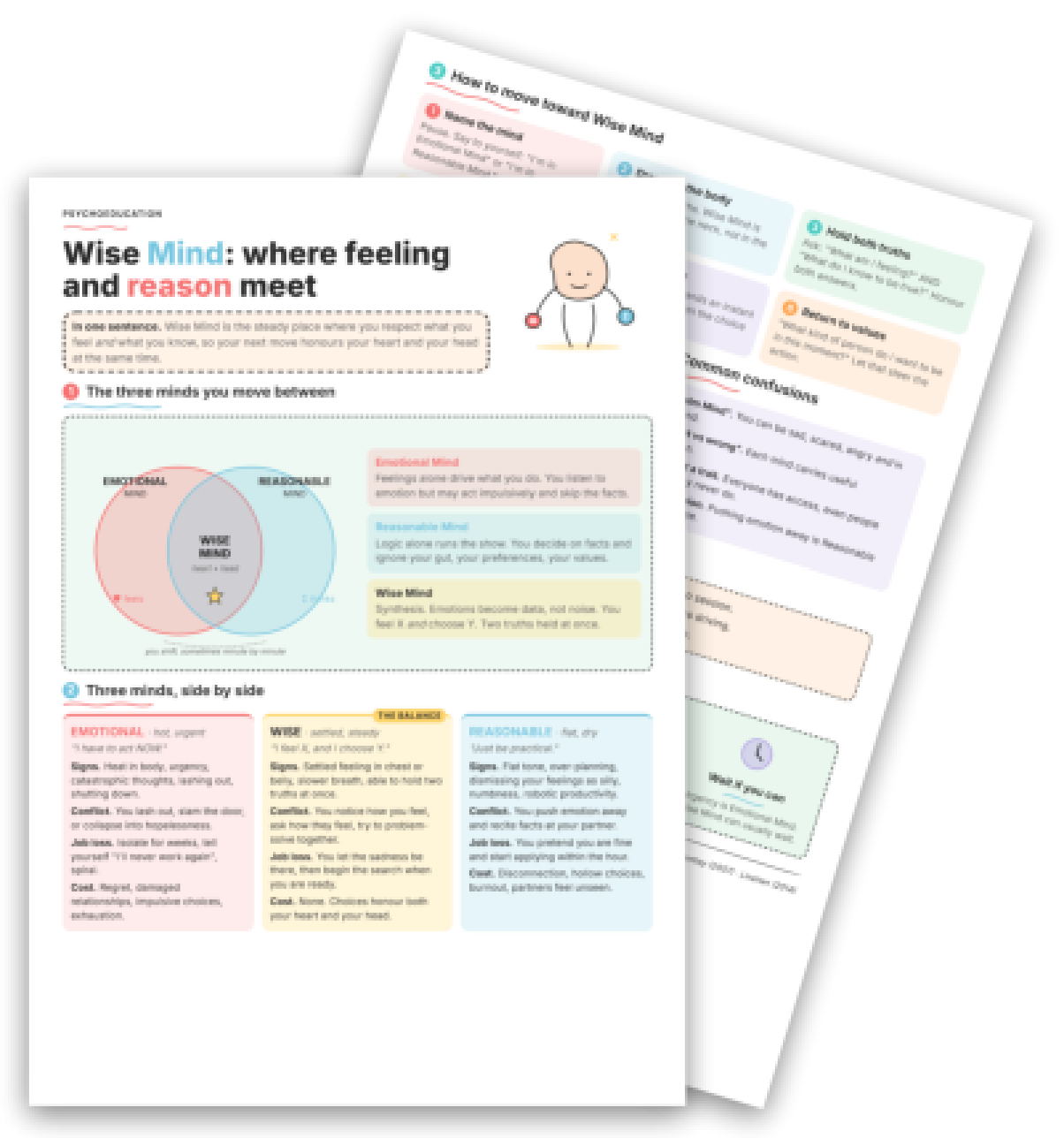
The fiche PDF is structured in seven numbered panels, each designed to carry one piece of the psychoeducation forward.
Panel 1 introduces the three-state model with a simple Venn-style layout: Emotional Mind (♥ feels), Reasonable Mind (Σ thinks), and Wise Mind (heart + head) at the intersection. The visual immediately shows why neither pole is wrong, it shows they are partial, which sidesteps the patient's fear that therapy wants them to stop feeling.
Panel 2 runs a three-column comparison across real-life scenarios, a conflict and a job loss, showing how each mind drives a different response, each with its own cost. The column for Wise Mind carries the phrase "I feel X, and I choose Y", which becomes a usable phrase to rehearse in session. Panels 3 and 4 build on this with a six-step sequence for moving toward Wise Mind ("Name the mind," "Drop into the body," "Hold both truths") and ready-to-use phrases such as "This feeling is real. It is not the whole picture."
Panels 5 and 6 address the most common clinical confusions directly: Wise Mind is not calm Mind (anger is compatible with it), it is not suppression (that is Reasonable Mind in disguise), and it is a state everyone can access. Panel 6 lists three discussion prompts keyed to session work, including "When you find Wise Mind unreachable, explore together what helps you return," which gives you a natural debrief structure.
> Key point: The fiche is a visual support that facilitates the explanation of Wise Mind in session. It is not a questionnaire to fill in alone. The diagrams and parallel columns show what an oral explanation cannot: that the three states are a dynamic continuum, not a judgment about the patient's character.
750+ clinical tools
A library built with and for clinicians, ready to use in session and extend between appointments.
Access all the toolsWhen and How to Introduce It in Session
This fiche fits naturally in early-to-mid DBT work, alongside DBT mindfulness "what" and "how" skills and before moving into the distress tolerance skills module. For clinicians working outside a full DBT protocol, it also integrates smoothly into any CBT or third-wave work where emotion regulation is a target: ACT defusion work, schema therapy, or couples therapy where partners are chronically mis-attuned.
Introduce it by pointing to the three-column comparison rather than leading with the definition: "I want to show you something that maps what happens when you make a decision under pressure." This avoids the feel-reflect-act-differently sequence feeling prescriptive. For patients with high alexithymia or strong emotional reasoning patterns, Panel 2's concrete scenarios (conflict, job loss) give you a traction point before asking them to locate themselves.
To debrief, return to Panel 6 in the following session. Ask which mind was driving the most difficult moment of the week, without evaluating the answer. For patients working through radical acceptance or the TIPP skill in crisis, the Wise Mind fiche serves as the conceptual spine that links those techniques back to a shared vocabulary.
The fiche does not replace the clinical relationship or the formulation of the case; it makes the explanation sharper, earns you a common language faster, and leaves the patient a reference they can use between sessions.
Use it with your patients
Share this tool in the mobile app and follow the work between sessions.
Sources
- Linehan, M. M. (1993). Cognitive-Behavioral Treatment of Borderline Personality Disorder. Guilford Press.
- Linehan, M. M. (1993). Skills Training Manual for Treating Borderline Personality Disorder. Guilford Press.
- Linehan, M. M. (2015). DBT Skills Training Manual, Second Edition. Guilford Press.
- Linehan Institute. DBT Skills Training Manual - Publications and Books.
Your session continues in your patients' pocket
Use with a patientYour resources, available everywhere
The handouts, exercises, programs and audios above: you choose which ones to make available to your patients, in the mobile app dedicated to them.
And far more than a library
The app goes well beyond resources, to support your patients every day:
Related categories
Explore other clinical resources by category.

Emotions
Clinical resources on emotion regulation: worksheets, coping tools, CBT, REBT, and ACT exercises for therapists working across diagnoses and age groups.

Cognition
Printable cognitive therapy worksheets and clinical tools for therapists: CBT, ACT, schema work, defusion, distortions, and belief restructuring.

Understand
Clinical hub for the therapeutic aim 'Understand': worksheets and tools to build patient insight across CBT, ACT, schema therapy and more.

Build awareness
Clinical worksheets and tools to build awareness in therapy: cognitive distortions, schemas, emotions, ACT and CBT resources for practitioners.

Regulate
Clinical resources for emotion regulation: worksheets, ACT exercises, and psychoeducation tools for affect regulation across diagnoses. For clinicians.

DBT
DBT worksheets and exercises for clinicians: distress tolerance, emotion regulation, and interpersonal skills tools for dialectical behavior therapy practice.