
Clinical picture. M., a man in his late thirties, presented with recurrent conflict at work: he would snap at colleagues during team meetings and then spend the rest of the day ruminating on what he had said. He described the pattern as automatic, reporting that he had no sense of a gap between feeling provoked and speaking. The clinician introduced the Feel, Reflect, Act Differently worksheet as a between-session tool, walking through the three moves with a recent incident as the anchor. M. identified the emotion as embarrassment rather than anger, traced the trigger to a moment his input was dismissed in front of the group, and named the unmet need as being taken seriously. By the following session, he reported having used the pause during a similar moment and chosen to respond after the meeting rather than on the spot; the interaction went differently, though he noted the urge to snap had not disappeared.
Feel, Reflect, Act Differently: PDF Worksheet, Tools and Exercises
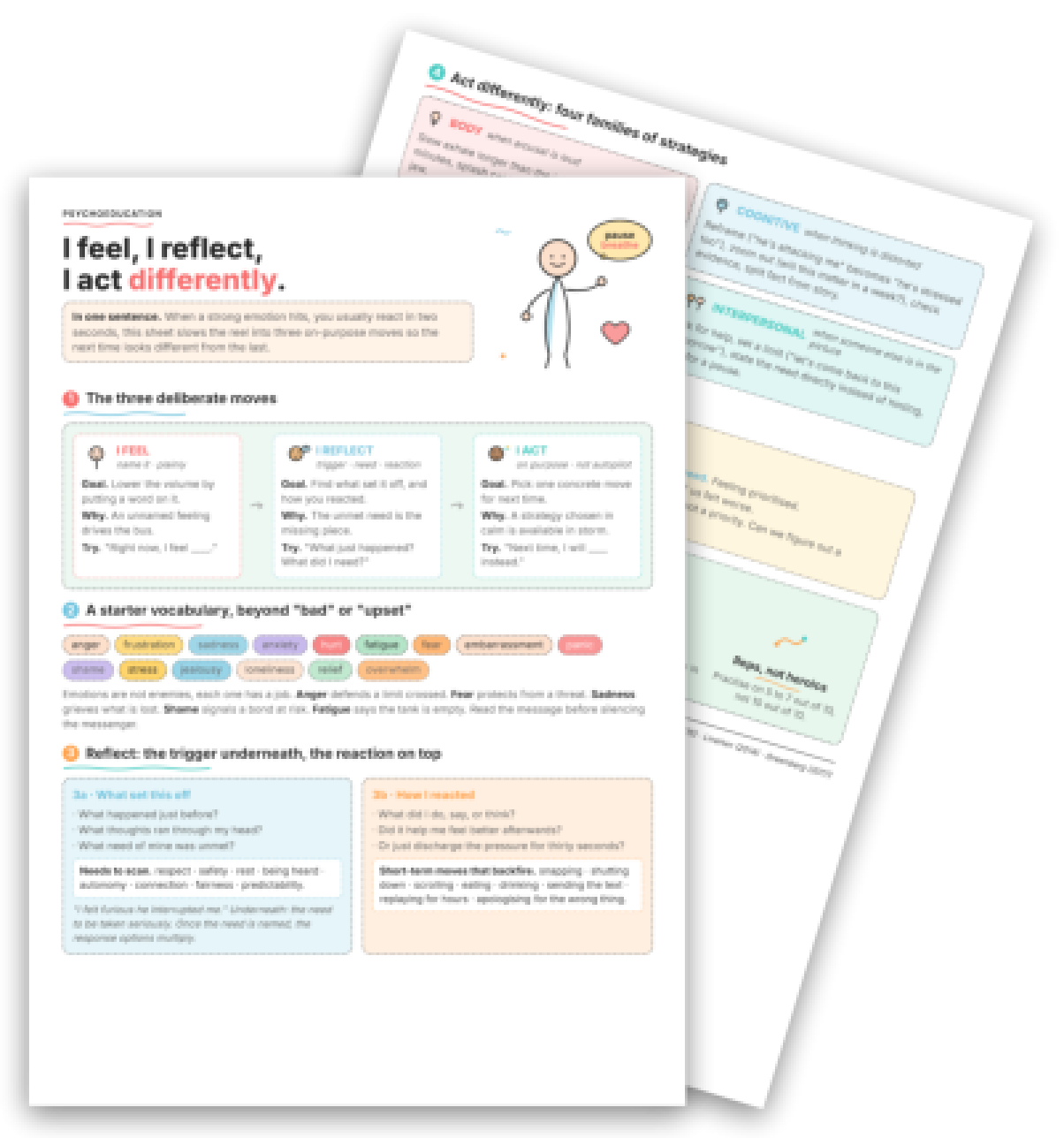
A visual psychoeducation worksheet helping patients slow emotional reactivity into three deliberate moves, name the feeling, trace the trigger, choose a different response.
Clinical vignettes
Naming the Emotion Before the Argument
Interrupting a Shutdown Response
Clinical picture. A., a woman in her mid-twenties managing generalised anxiety, described a habitual pattern of withdrawing and going silent whenever she felt overwhelmed in conversations with her partner. She could not reliably name what she felt in those moments beyond "bad," which left her partner confused and the situation unresolved. The clinician used the worksheet's emotion vocabulary list alongside the three-step structure, inviting A. to reconstruct a recent shutdown episode in session. She identified the feeling as panic, linked it to a need for predictability, and recognised that her withdrawal discharged pressure briefly but left the unmet need intact. As a concrete next-step action, A. chose a short holding phrase to use in the moment; she trialled it once before the following appointment and reported that naming the feeling aloud, even minimally, reduced the intensity enough to stay in the conversation.
Explaining emotion regulation in session is easy. Getting patients to actually slow the reactivity cycle in the moment is not. Most patients can describe what happened; very few can identify the unmet need underneath it, or name what drove them to snap, shut down, or scroll. This PDF worksheet gives you a structured visual anchor to make that gap concrete, and workable, right at the consulting table.
Use this resource with your patients
Handout, exercises and materials ready to use, right inside SessionFuel.
Why Emotional Reactivity Resists Oral Explanation
The core difficulty is temporal: automatic emotional reactions unfold in under two seconds. When you describe this to a patient verbally, they follow along and then walk out the door and react exactly as they always have. The sequence of labelling, reflecting, and choosing a response is cognitively available to them in session; it is not available when the amygdala fires. What is missing is a practice structure they can internalise.
A second problem is vocabulary. Many patients reduce their affective life to "bad", "stressed", or "upset". Without a more differentiated emotional lexicon, the cognitive triangle collapses: you cannot reframe a feeling you cannot name. And without locating the unmet need beneath the reaction, even accurate cognitive restructuring addresses the surface layer while leaving the driver intact, a limit that schema-based formulation and DBT emotion regulation work both highlight.
> Key takeaway: The "Feel, Reflect, Act Differently" worksheet is a visual support that facilitates the explanation in session, not a self-help handout to fill out alone. You use it in session to make the three-move structure tangible, then send it home as a reference patients can return to when arousal is real.
What the Worksheet Contains
The fiche is organised around five numbered sections, each serving a discrete clinical function.
Section 1 presents the three deliberate moves with clean prompts patients can memorise:
- I Feel: "Right now, I feel ____." (goal: lower the volume by labelling)
- I Reflect: "What just happened? What did I need?" (goal: surface the unmet need)
- I Act: "Next time, I will ____ instead." (goal: one concrete choice made in calm)
Section 2 provides a starter emotion vocabulary of 15 terms, anger, anxiety, shame, loneliness, overwhelm, and others, with the psychoeducational framing that "emotions are not enemies, each one has a job." This directly addresses the labelling deficit: you can point to the grid, ask the patient where they were on it, and expand from there. The visual layout makes the differentiation between fear, panic, and anxiety perceptible in a way an oral description rarely does. Complement this with the Emotion Wheel or the Basic Emotions fiche if you want a richer vocabulary scaffold.
Section 3 splits reflection into two sub-panels: 3a (trigger, automatic thoughts, unmet need) and 3b (the actual behavioural response and its real aftermath). The needs list, respect, safety, rest, being heard, autonomy, connection, fairness, predictability, mirrors the vocabulary used in CNV-informed work and maps directly onto what you would already be tracking in a longitudinal case formulation. Section 3b's short-term backfire list (snapping, scrolling, replaying for hours) is particularly useful with patients who intellectually know their coping is maladaptive but have not yet externalised it; the Adaptive vs Maladaptive Coping fiche extends this discussion.
Section 4 organises alternative strategies into four families: Body, Cognitive, Emotional, Interpersonal. The visual grouping lets you point to a quadrant that matches the patient's dominant regulation deficit. Patients high in physiological arousal land in Body; those with strong interpretive biases (see cognitive distortions work) land in Cognitive. The Interpersonal column bridges naturally into assertive communication and I-message work.
Section 5 is a fully worked example (forgotten plan, partner) that you can walk through together before handing over the fiche. It shows the chain from situation to feeling to unmet need to behavioural consequence to the alternative response, making the three-move model legible as a whole rather than as three disconnected steps.
750+ clinical tools
A library built with and for clinicians, ready to use in session and extend between appointments.
Access all the toolsWhen and How to Introduce It in Session
This worksheet fits naturally in the early-to-mid phase of work, once the initial formulation is in place and before you move to more demanding restructuring or exposure tasks. It is particularly well-suited to patients who present with reactive anger (pair with Anger Management Skills or the Cycle of Anger), interpersonal conflict, or who describe feeling overwhelmed without being able to say much more than that.
A low-pressure introduction: "I want to show you a map of what happens between the moment something triggers you and what you end up doing. Let's look at it together." That framing positions the fiche as a shared object of curiosity, not a diagnostic label. Walk through Sections 1 and 3 in session using a recent situation the patient brought. Use Section 4 to collaboratively select one strategy family to try before the next appointment.
Debrief the following session by asking which of the four strategy families felt accessible and which felt out of reach, this surfaces both skill deficits and avoidance patterns worth exploring further. For patients working on emotion regulation as part of a broader program, the worksheet connects directly to the Emotion Regulation Psychoeducation Program and the Behavior, Emotion, Underlying Need fiche.
One limit worth noting: patients in acute crisis or with marked distress intolerance may find Section 5's worked example activating rather than clarifying. In those presentations, start with Section 2 only, and defer the full three-move sequence until regulatory capacity is more established.
The fiche does not replace clinical formulation or the alliance. It shortens the distance between understanding a concept and having a reference to return to when the concept is most needed.
Use it with your patients
Share this tool in the mobile app and follow the work between sessions.
Sources
- Linehan, M. M. (2015). DBT Skills Training Manual (Second Edition). Guilford Press.
Your session continues in your patients' pocket
Use with a patientYour resources, available everywhere
The handouts, exercises, programs and audios above: you choose which ones to make available to your patients, in the mobile app dedicated to them.
And far more than a library
The app goes well beyond resources, to support your patients every day:
Related categories
Explore other clinical resources by category.

Emotions
Clinical resources on emotion regulation: worksheets, coping tools, CBT, REBT, and ACT exercises for therapists working across diagnoses and age groups.

Cognition
Printable cognitive therapy worksheets and clinical tools for therapists: CBT, ACT, schema work, defusion, distortions, and belief restructuring.

Build awareness
Clinical worksheets and tools to build awareness in therapy: cognitive distortions, schemas, emotions, ACT and CBT resources for practitioners.

Regulate
Clinical resources for emotion regulation: worksheets, ACT exercises, and psychoeducation tools for affect regulation across diagnoses. For clinicians.

Restructure
Clinical hub for cognitive restructuring worksheets: distortion identification, belief disputation, ABC model, and schema work for evidence-based practice.

CBT
CBT worksheets, cognitive restructuring exercises & behavioral tools for clinicians. Evidence-based resources for every phase of cognitive behavioral therapy.