
Clinical picture. R., a man in his mid-thirties presenting with generalised anxiety, described a recurring pattern in which a colleague's brief, neutral reply to an email would trigger the conviction that he had caused offence. In session, the clinician introduced the thought-record worksheet and asked R. to write the automatic thought word for word: 'He's annoyed with me; I must have said something wrong.' R. rated his belief at 8/10, then worked through the evidence columns and identified mind-reading as the operating distortion. By the end of the exercise he had drafted a balanced alternative, 'He replied briefly; I have no data about his mood,' and re-rated belief in the original thought at 4/10, noting a modest but perceptible drop in chest tension.
Challenging Automatic Thoughts: PDF Worksheet, Tools and Exercises
A structured visual PDF worksheet to help clinicians teach cognitive restructuring in session, from spotting distortions to building a balanced alternative thought.
Clinical vignettes
Interrupting a Mind-Reading Loop
Naming Catastrophising in a Work Context
Clinical picture. M., a woman in her late twenties referred for a first depressive episode, reported that making any error at work activated the immediate thought 'I will lose my job and everyone will see I'm incompetent.' The clinician introduced the nine-step sequence on the worksheet, pausing at step four to help M. label the pattern as catastrophising combined with all-or-nothing thinking. The evidence-against column proved difficult at first; M. had discounted several recent positive appraisals, which the clinician noted without pressing her to accept them. She arrived at the alternative 'I made one error; my overall record does not support the conclusion that dismissal is likely,' and agreed to repeat the exercise independently before the next session to consolidate the habit of externalising the thought.
Patients in CBT often nod when you walk them through cognitive restructuring verbally, then arrive the following week with a blank thought record. The gap between understanding the model and applying it autonomously is real, and it rarely closes through oral explanation alone. This fiche PDF on challenging automatic thoughts serves as a visual support to use directly in session, building a shared language and a concrete procedure patients can replicate independently.
Use this resource with your patients
Handout, exercises and materials ready to use, right inside SessionFuel.
Why Automatic Thought Restructuring Resists Oral Explanation
The core difficulty is phenomenological. Inside the patient's head, an automatic thought functions as transparent: it is not perceived as an interpretation, it is perceived as reality. Asking someone to "challenge" a thought they experience as fact can feel meaningless, even provocative, before you have established any cognitive distance.
Oral psychoeducation on the cognitive model has a second limitation: the sequence of situation, thought, emotion, and behaviour collapses quickly in working memory when patients try to apply it under emotional load. Without a written structure in front of them, the steps blur. The patient who tells you "I tried the exercise but I didn't really know where to start" is describing this exactly. A visual support keeps the chain legible even when distress is high.
There is also the question of distortion naming. Clinicians working with TCC know that labelling a distortion (catastrophising, mind-reading, fortune-telling) reduces its potency, but patients need repeated exposure to that taxonomy before it becomes a self-applied skill. Sending them to memorise a list is rarely effective; seeing the twelve distortions laid out with brief, recognisable examples is something else entirely.
What the Fiche Contains: A Complete Visual Framework
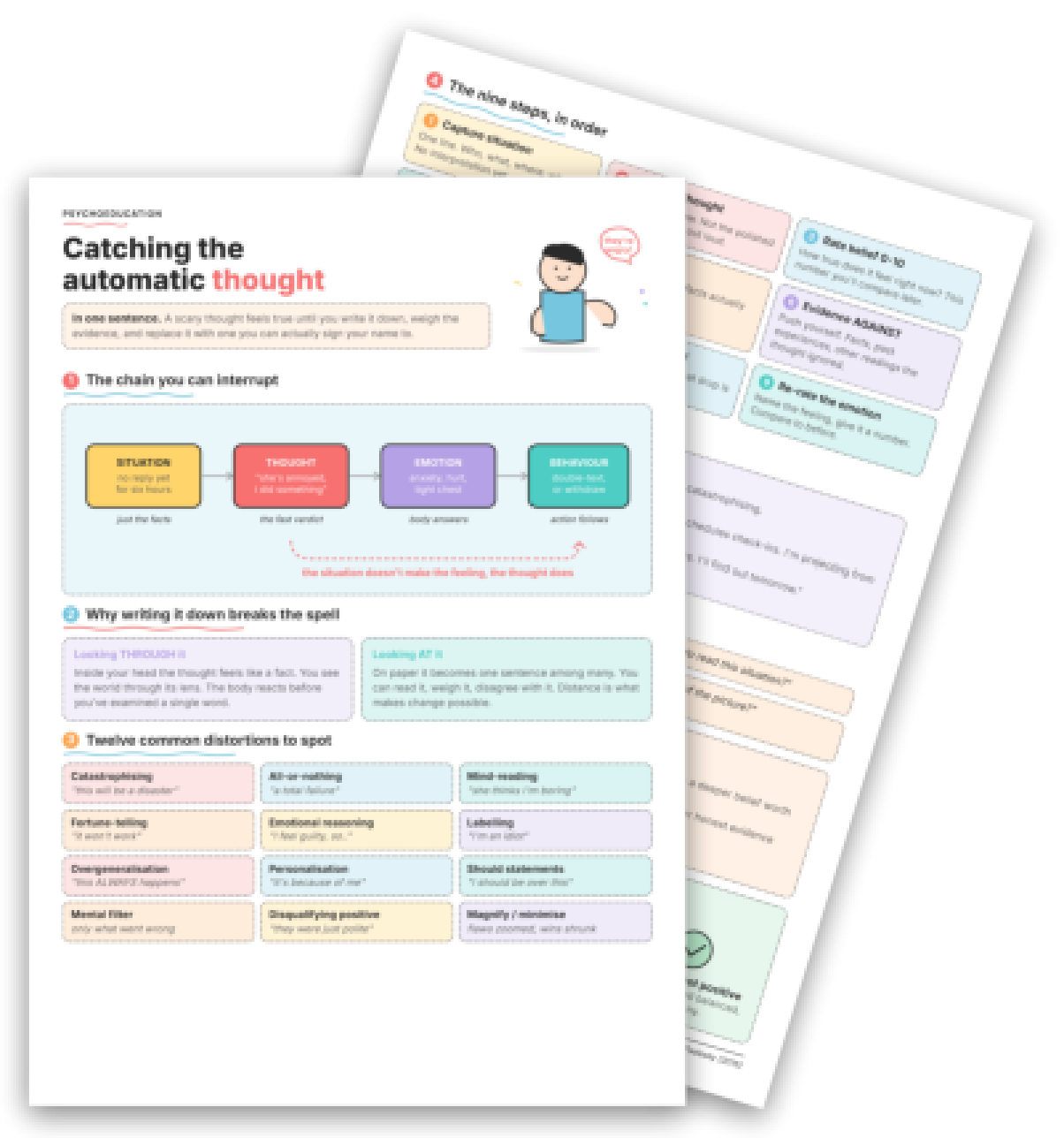
The fiche PDF is built around six panels that map the full restructuring process. The first introduces the situational chain (situation, thought, emotion, behaviour) with the explicit annotation that "the situation doesn't make the feeling, the thought does", which you can use as a precise anchor point when patients conflate triggers and interpretations.
The second panel addresses the central phenomenological problem directly, contrasting looking through a thought (inside the head, felt as fact) with looking at it (on paper, readable and disputable). This distinction, shown visually on the fiche, is often the moment something clicks in session.
The third panel reproduces twelve common cognitive distortions, each with a brief epitome phrase: catastrophising ("this will be a disaster"), overgeneralisation ("this ALWAYS happens"), emotional reasoning ("I feel guilty, so..."), personalisation, labelling, and six more. You can use this panel as a shared reference rather than asking patients to recall definitions from memory. For deeper work on individual distortions, the resources on all-or-nothing thinking, mind reading, and fortune-telling extend each one into a dedicated exercise.
The procedural core is a nine-step thought record: capture the situation, write the raw thought word for word, rate belief 0-10, name the distortion, list evidence for, list evidence against, build a balanced alternative, re-rate the original thought, re-rate the emotion. This sequence is fully printable and designed so patients can use it as a template between sessions, not just a concept they half-remember. For first-time introduction to the thought-catching step, Catching Your Thoughts and the Automatic Thoughts worksheet make natural companion tools.
A worked example (a patient facing an unexpected manager meeting, initial belief 9/10, dropped to 4/10 after honest evidence work) walks the nine steps end to end, making the process concrete before patients attempt it themselves. The fiche also includes six prompts for when counter-evidence stalls ("What would I tell a friend who thought this?", "What am I leaving out of the picture?"), which you can read aloud together when the evidence columns grind to a halt in session.
A dedicated To discuss in session box flags three clinical signals worth attending to: the same distortion recurring across multiple records (pointing toward a deeper schema), an alternative thought that stays shallow despite honest work, and thoughts too emotionally charged to sit with long enough to write down.
> Key point: The fiche is a visual support that facilitates the explanation of cognitive restructuring in session. It is not a form for patients to complete alone at home without guidance; it is a shared map the clinician uses to make the process visible, step by step, before the patient takes it away as a reference.
750+ clinical tools
A library built with and for clinicians, ready to use in session and extend between appointments.
Access all the toolsWhen and How to Introduce the Fiche in Session
This resource fits naturally from the second or third session onwards, once the cognitive model has been named and the therapeutic alliance is sufficient for collaborative work. It is particularly useful with patients who intellectualise readily but struggle to translate insight into between-session practice, and with those who show elevated interpretive biases across multiple presenting concerns (generalised anxiety, social anxiety, depressive rumination).
When introducing it, you might say: "I'd like to show you a map of the process we've been describing. Nothing to fill in right now; I just want us to walk through it together so you have something concrete to take away." This framing removes evaluative pressure and positions the fiche as a shared tool rather than homework the patient might fail.
Debrief it by asking which of the twelve distortions felt most recognisable, and whether the worked example matched anything from the patient's recent experience. When the same distortion keeps appearing across sessions, that pattern warrants a downward arrow to schema level: Tracing the Origin of a Negative Thought to Its Core Belief and the Clarifying a Core Belief exercise extend the work naturally. For patients where avoidance is entangled with the automatic thoughts (as it often is in anxiety presentations), pairing the fiche with the ABC Model (REBT) or the CBT Cognitive Model gives additional psychoeducational grounding.
One limit worth noting: patients in acute emotional flooding, or those with significant alexithymia, may need preliminary work on emotion identification and somatic awareness before the nine-step structure is accessible. In those cases, start with the Automatic Thoughts cognitive restructuring exercise as a gentler entry point.
The fiche does not replace the formulation or the therapeutic frame. It makes one difficult step of TCC visibly learnable, and leaves the patient with a procedure they can actually return to.
Use it with your patients
Share this tool in the mobile app and follow the work between sessions.
Sources
- Beck, A. T. (1976). Cognitive Therapy and the Emotional Disorders. Meridian / New American Library.
- Burns, D. D. (1980). Feeling Good: The New Mood Therapy. William Morrow.
- Beck, J. S. (2021). Cognitive Behavior Therapy: Basics and Beyond (3rd ed.). The Guilford Press.
- Greenberger, D., & Padesky, C. A. (2016). Mind Over Mood: Change How You Feel by Changing the Way You Think (2nd ed.). The Guilford Press.
- Beck, A. T., Rush, A. J., Shaw, B. F., & Emery, G. (1979). Cognitive Therapy of Depression. The Guilford Press.
Your session continues in your patients' pocket
Use with a patientYour resources, available everywhere
The handouts, exercises, programs and audios above: you choose which ones to make available to your patients, in the mobile app dedicated to them.
And far more than a library
The app goes well beyond resources, to support your patients every day:
Related categories
Explore other clinical resources by category.

Anxiety
Clinical hub for anxiety disorders: CBT and ACT worksheets, psychoeducation sheets, and exercises for assessment and treatment across the anxiety spectrum.

Mood
Evidence-based worksheets and clinical tools for mood disorders: CBT, ACT, and positive psychology resources for psychologists and therapists.

Emotions
Clinical resources on emotion regulation: worksheets, coping tools, CBT, REBT, and ACT exercises for therapists working across diagnoses and age groups.

Cognition
Printable cognitive therapy worksheets and clinical tools for therapists: CBT, ACT, schema work, defusion, distortions, and belief restructuring.

Build awareness
Clinical worksheets and tools to build awareness in therapy: cognitive distortions, schemas, emotions, ACT and CBT resources for practitioners.

Regulate
Clinical resources for emotion regulation: worksheets, ACT exercises, and psychoeducation tools for affect regulation across diagnoses. For clinicians.