
Clinical picture. M., a woman in her early thirties, presented with generalized anxiety and a longstanding pattern of rumination following perceived social slights. In session, she described significant distress after a close friend had not responded to her messages for two days, rating her subjective discomfort at around 70%. The clinician introduced the Perspective-Taking Worksheet, guiding M. to articulate her automatic interpretation and then systematically work through three alternative lenses: the friend lens, the fair-judge lens, and the future-self lens. M. noted, with some surprise, that she would never attribute hostile intent to a friend who went quiet, yet applied that standard routinely to herself. By the close of the exercise her distress rating had dropped to roughly 40%, and she agreed to use the worksheet independently before her next session.
Perspective-Taking: PDF Worksheet, Tools and Exercises for Clinical Practice
A visual PDF worksheet, concrete tools, and structured exercises to help patients challenge their first interpretation and try on alternative readings of distressing events.
Clinical vignettes
Reframing Social Silence in Anxiety
Challenging Self-Blame After Workplace Conflict
Clinical picture. T., a man in his mid-forties referred for depressive episodes, reported acute shame after a tense exchange with a colleague, concluding with certainty that he had damaged the relationship permanently. His initial narrative showed the hallmarks the worksheet is designed to address: speed mistaken for accuracy, and a verdict stated as fact rather than inference. The clinician used the worksheet's "same event, two stories" structure, asking T. to generate at least two alternative readings before evaluating either one. T. found the fair-judge prompt particularly useful, recognising that he was applying a stricter standard to his own conduct than he would to anyone else in an identical situation. He left the session with a printed copy of the worksheet and instructions to complete it the next time a similar automatic appraisal arose outside the consulting room.
Patients often grasp the idea of cognitive reframing in theory, then leave the session and apply their original interpretation anyway. This Perspective-Taking PDF worksheet gives you a visual scaffold to make the "try another lens" move concrete, memorable, and actually transferable outside the consulting room.
Use this resource with your patients
Handout, exercises and materials ready to use, right inside SessionFuel.
Why Perspective-Taking Resists Verbal Explanation
The core obstacle is speed. As the fiche frames it, the first automatic thought "arrives before you've even read the situation", and that felt speed reads as certainty. When you explain this orally, patients follow you conceptually but cannot feel the gap between the event and their interpretation because the two arrive fused. There is nothing on the table to point at.
Compounding this, patients frequently misread perspective-taking as an instruction to think positively, which triggers immediate resistance. The fiche is explicit that "forced positivity" is one of the most common traps: faking sunshine over a thunderstorm doesn't shift the underlying distress. Naming this upfront, with a printed page the patient can see, short-circuits that resistance before it takes hold.
A third difficulty is jumping to conclusions and mind-reading: patients treat inferences about others' intentions as facts. Purely verbal challenges to this tend to feel like an argument. A visual that separates "Story A" from "Story B" sidesteps the adversarial dynamic entirely.
What the Worksheet Contains: A Visual Support for In-Session Explanation
The fiche is structured across five panels, and it works because the clinician uses it as a shared visual reference, not as homework the patient reads alone.
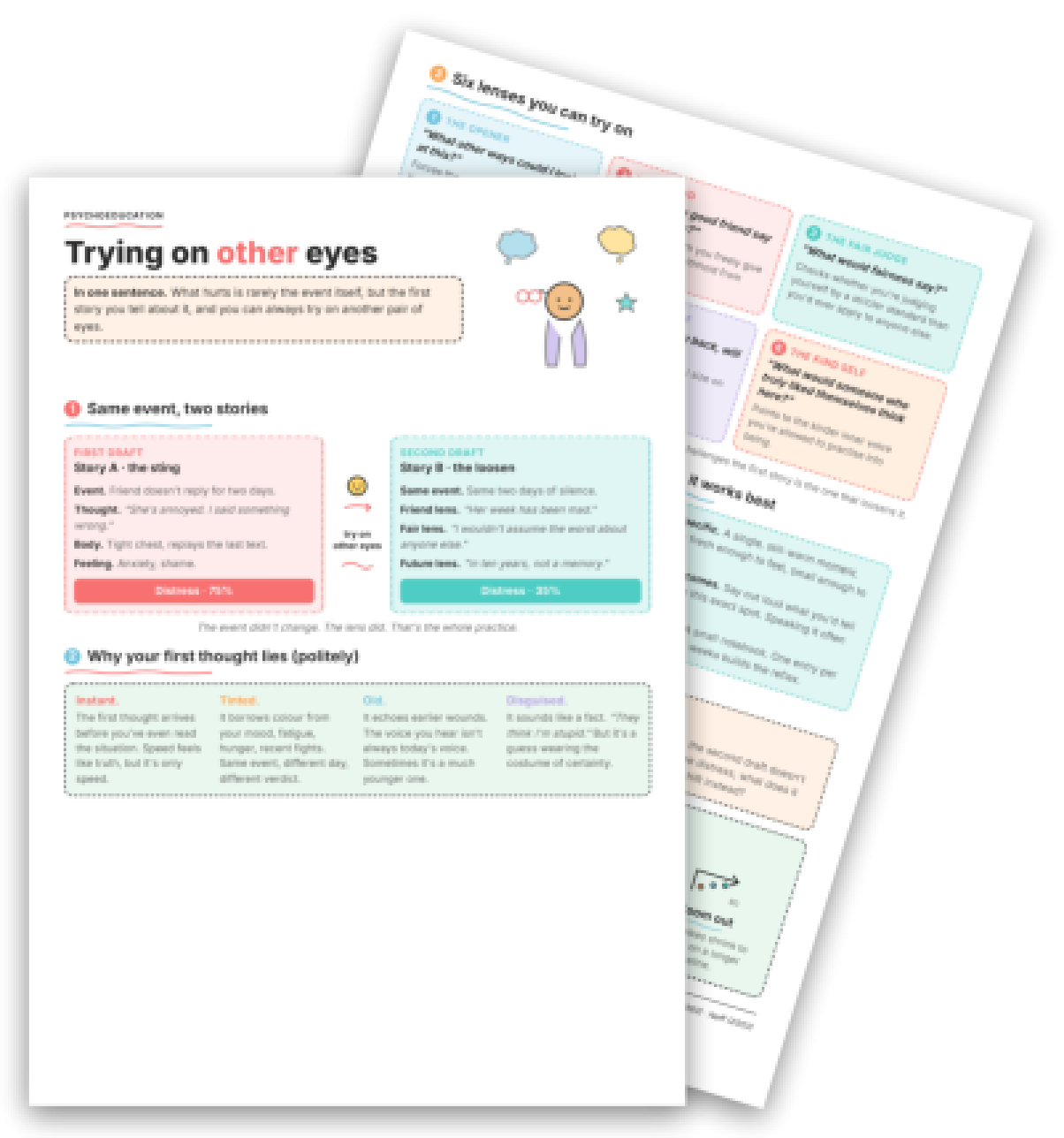
Panel 1, "Same event, two stories," does the heavy lifting. It places two readings of an identical event side by side: Story A carries a distress rating of 75%; Story B, after applying three lenses, drops to 35%. Showing this layout in session makes the core point viscerally clear: "The event didn't change. The lens did." No paraphrase achieves that as efficiently.
Panel 2, "Why your first thought lies (politely)," names four properties of automatic thoughts: instant, tinted, old, and disguised. This gives you precise vocabulary to use when a patient insists their interpretation is simply "the truth." The label "disguised", "it sounds like a fact... but it's a guess wearing the costume of certainty", tends to land without triggering defensiveness, and it dovetails cleanly with work on cognitive distortions and automatic thoughts.
Panel 3 offers six named lenses: The Opener, The Friend, The Fair Judge, The Three Gifts, The Future Self, and The Kind Self. Each carries a single prompt. This matters clinically: it prevents the patient from defaulting to the safest, least-challenging reframe. Panel 4 explicitly names the trap of "picking the safe prompt", the fiche instructs patients to choose the one that "gently challenges" the first story, not the one that costs nothing.
Panel 5 covers when the practice works best (recent, specific events; pairing with a habit log) and closes with a "To discuss in session" block that feeds directly into the following appointment. This makes debrief straightforward.
> Key takeaway: The worksheet is a visual support that facilitates the explanation in session; it is not a self-help exercise the patient fills out alone. The side-by-side story structure and the six named lenses give you something concrete to point at while you work.
750+ clinical tools
A library built with and for clinicians, ready to use in session and extend between appointments.
Access all the toolsWhen and How to Introduce It
The fiche fits naturally from the second or third session onward, once you have established a shared cognitive model and the patient has produced at least one recent example of a distressing automatic thought. It is particularly well-suited to patients who present with interpretive biases toward social situations, low self-esteem, or repetitive mind-reading patterns in relationships.
To introduce it without pathologizing, you might say: "I'd like to show you something that maps exactly what we've been discussing, it takes about two minutes to walk through together." Lay it on the desk and work through Panel 1 using the patient's own recent event, not the printed example. Let them identify which of the six lenses in Panel 3 pinches most for them, since the fiche explicitly flags that the effortless prompt is probably not the productive one.
For debrief, Panel 5's "To discuss in session" questions are ready-made: what recurring first thought keeps appearing across different situations, which lens felt off-limits, and whether a second draft shifted distress or something subtler. Pair the fiche with a thought record exercise or a distancing and decentering tool for patients who need more structured written practice between sessions.
The fiche does not replace the formulation or the relational work. It gives the explanation a form the patient can take home, return to, and build a reflex from.
Use it with your patients
Share this tool in the mobile app and follow the work between sessions.
Sources
- Beck, A. T. (1976). Cognitive Therapy and the Emotional Disorders. International Universities Press.
- Beck, J. S. (2011). Cognitive Behavior Therapy: Basics and Beyond. Guilford Press.
- Renner, F., Lobbestael, J., Peen, J., Arntz, A., Huibers, M. (2016). The Impact of Perspective Change as a Cognitive Reappraisal Strategy on Affect: A Systematic Review. Frontiers in Psychology, 7, 1715.
- Burns, D. D. (1999). The Feeling Good Handbook. Plume.
Your session continues in your patients' pocket
Use with a patientYour resources, available everywhere
The handouts, exercises, programs and audios above: you choose which ones to make available to your patients, in the mobile app dedicated to them.
And far more than a library
The app goes well beyond resources, to support your patients every day:
Related categories
Explore other clinical resources by category.

Anxiety
Clinical hub for anxiety disorders: CBT and ACT worksheets, psychoeducation sheets, and exercises for assessment and treatment across the anxiety spectrum.

Mood
Evidence-based worksheets and clinical tools for mood disorders: CBT, ACT, and positive psychology resources for psychologists and therapists.

Identity
Clinical resources for self-identity work in therapy: CBT, ACT, schema tools for clinicians addressing self-concept, core beliefs, and identity disruption.

Emotions
Clinical resources on emotion regulation: worksheets, coping tools, CBT, REBT, and ACT exercises for therapists working across diagnoses and age groups.

Cognition
Printable cognitive therapy worksheets and clinical tools for therapists: CBT, ACT, schema work, defusion, distortions, and belief restructuring.

Build awareness
Clinical worksheets and tools to build awareness in therapy: cognitive distortions, schemas, emotions, ACT and CBT resources for practitioners.