
Clinical picture. M., a woman in her late twenties presenting with social anxiety, reported intense distress after a colleague walked past her in the corridor without saying hello. In session, the clinician introduced the fact-or-interpretation distinction and asked her to state only what a camera would have captured: "She walked past and did not speak." M. had been treating "She blanked me on purpose because she dislikes me" as equally factual, and pausing on that difference visibly shifted her affect. She identified the colleague's silence as one data point that admitted several readings, including tiredness or distraction. By the following week she reported noticing the same interpretive slide in two other situations, which she described as "catching the story before it takes over."
Fact or Interpretation: CBT PDF Worksheet, Tools and Exercises
A visual psychoeducation worksheet helping clinicians teach patients to separate observable facts from personal interpretations, with sorting exercises and real-world examples.
Clinical vignettes
Untangling a Social Slight
A Grade Becomes a Verdict
Clinical picture. T., a male university student in his early twenties referred for low mood and academic avoidance, arrived to session after receiving a failing mark on a written assignment. His presenting belief was stated flatly: "I am not intelligent." The clinician asked him to write down, in the left column of a blank sheet, only what was observable: "I received a mark of 8 out of 20 on one assignment." T. noted, with some reluctance, that the number was a fact and the self-label was commentary he had added. The exercise did not resolve his distress, but it created enough distance for him to consider that a single grade and a fixed trait were not the same category of thing. Subsequent sessions built on this opening to address broader self-evaluation patterns.
The fact/interpretation distinction is foundational to CBT cognitive work, yet explaining it orally rarely produces the shift you need. Patients agree in the moment, then leave the session still treating "she hates me" as a piece of reality rather than a reading of a frown. This fiche PDF gives you a visual scaffold to make the distinction land, not just be heard.
Use this resource with your patients
Handout, exercises and materials ready to use, right inside SessionFuel.
Why This Distinction Resists Verbal Explanation
When you explain interpretive bias aloud, most patients map it onto a kind of deliberate exaggeration: "I know I sometimes catastrophize." What they miss is that the confusion is structural, not just emotional. The thought "he's angry at me" and the thought "he frowned" feel identical in phenomenological weight. Without a visual tool that separates them into two distinct columns, patients struggle to perform the sort in real time, under emotional load.
The problem compounds with automatic thoughts: the faster and more ego-syntonic the interpretation, the more it presents as fact. Mind-reading, arbitrary inference, and all-or-nothing thinking all rely on this collapse. A verbal psychoeducation session can name these patterns; a printed visual lets the patient see the collapse happening on paper and practice reversing it before the affect is live.
What the Fiche Contains: A Visual Support for Session
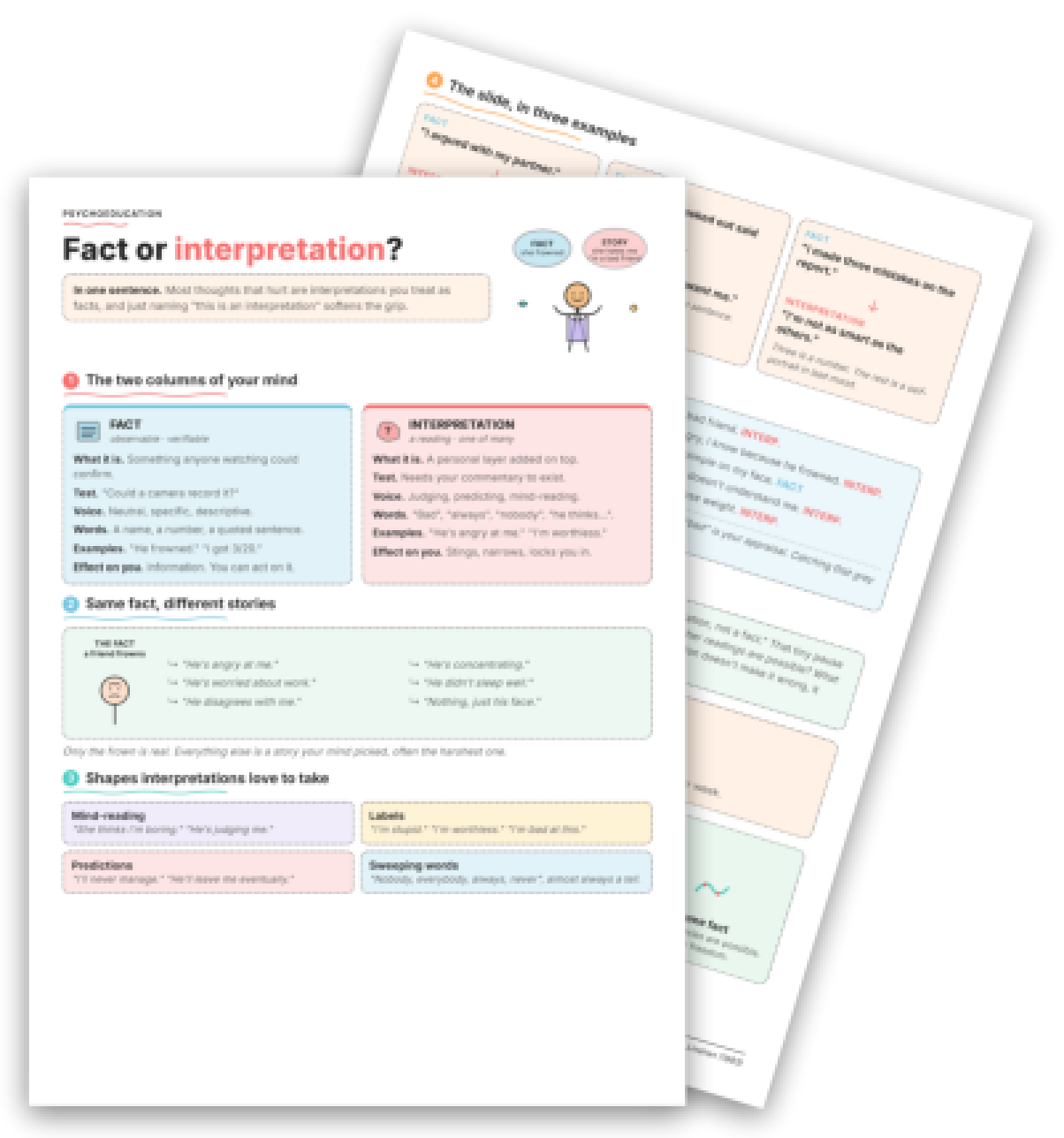
The fiche opens with a one-sentence clinical anchor the patient can memorize: "Most thoughts that hurt are interpretations you treat as facts, and just naming 'this is an interpretation' softens the grip." That line is worth reading aloud with the patient in front of it, because it reframes the entire exercise before a single column is discussed.
The two-column panel is the structural core. Each side defines its category precisely: FACT (observable, verifiable, what a camera could record) versus INTERPRETATION (a personal layer that "needs your commentary to exist"). Concrete markers include the type of words each generates: names and numbers for facts, terms like "bad," "always," "nobody, he thinks..." for interpretations. The effect on you row is clinically useful because it externalizes the emotional asymmetry: one column produces information you can act on, the other stings, narrows, locks you in.
The "same fact, different stories" panel shows six different interpretations of an identical observable event (a friend frowning), which works well when the patient's presenting interpretation feels self-evidently true. The fiche names the four shapes interpretations love to take: mind-reading, labels, predictions, and sweeping words ("nobody, always, never"), linking directly to the cognitive distortions framework patients may already know from the CBT cognitive model.
A 10-item sorting practice gives the patient immediate in-session exercise, with items spanning easy sorts and a built-in grey zone ("I got a bad grade": the number is a fact, "bad" is an appraisal). The grey zone is pedagogically essential: it teaches that the skill is catching the moment of appraisal, not sorting perfectly. The closing panel offers a brief three-step action sequence: "Name it. Breathe. Ask what other readings are possible." This maps cleanly onto defusion work in ACT-informed cognitive restructuring and onto challenging automatic thoughts in standard TCC.
> Key point: The fiche is a visual psychoeducation tool the clinician uses in session to explain the fact/interpretation distinction; it is not a self-report the patient completes alone. The two-column layout, sorting exercise, and camera test make a spoken explanation concrete and give the patient a reference to keep.
750+ clinical tools
A library built with and for clinicians, ready to use in session and extend between appointments.
Access all the toolsWhen and How to Introduce the Fiche
The fiche fits naturally after initial case formulation, once you have identified interpretive bias as a maintaining process. It is particularly indicated when the patient's distress pivots on interpersonal misreading (social anxiety, catastrophizing, relational conflict) or when emotional reasoning is prominent. It also works early in treatment as a psychoeducation primer before moving to more demanding cognitive restructuring exercises or the downward arrow technique.
Introduce it without labeling the patient: "I want to show you something that explains a pattern most of us fall into without noticing." Work through the two-column panel together, then run the 10-item sort with the patient directing. Debrief by asking which items felt uncertain, since hesitation on grey-zone items often surfaces the patient's key cognitive terrain.
One limit worth noting: with patients in acute dissociation or marked concreteness (certain psychotic presentations or intellectual disability), the abstract column logic may need significant scaffolding before the exercise is productive.
The fiche does not replace the full cognitive restructuring sequence or the cognitive triangle work that contextualizes why interpretations have emotional force. It installs the vocabulary and the habit of pausing, which is the prerequisite for everything that follows.
Use it with your patients
Share this tool in the mobile app and follow the work between sessions.
Sources
- Beck, A. T., Rush, A. J., Shaw, B. F., & Emery, G. (1979). Cognitive Therapy of Depression. The Guilford Press.
- Beck, J. S. (2021). Cognitive Behavior Therapy: Basics and Beyond (3rd ed.). Guilford Press / Routledge.
- Burns, D. D. (1980). Feeling Good: The New Mood Therapy. William Morrow.
Your session continues in your patients' pocket
Use with a patientYour resources, available everywhere
The handouts, exercises, programs and audios above: you choose which ones to make available to your patients, in the mobile app dedicated to them.
And far more than a library
The app goes well beyond resources, to support your patients every day:
Related categories
Explore other clinical resources by category.

Anxiety
Clinical hub for anxiety disorders: CBT and ACT worksheets, psychoeducation sheets, and exercises for assessment and treatment across the anxiety spectrum.

Mood
Evidence-based worksheets and clinical tools for mood disorders: CBT, ACT, and positive psychology resources for psychologists and therapists.

Identity
Clinical resources for self-identity work in therapy: CBT, ACT, schema tools for clinicians addressing self-concept, core beliefs, and identity disruption.

Cognition
Printable cognitive therapy worksheets and clinical tools for therapists: CBT, ACT, schema work, defusion, distortions, and belief restructuring.

Understand
Clinical hub for the therapeutic aim 'Understand': worksheets and tools to build patient insight across CBT, ACT, schema therapy and more.

Build awareness
Clinical worksheets and tools to build awareness in therapy: cognitive distortions, schemas, emotions, ACT and CBT resources for practitioners.