
Clinical picture. M., a 34-year-old with recurrent depressive episodes, reported a sharp drop in mood after her manager walked past her desk without speaking. In session, the clinician introduced the Thought Decoder worksheet and asked her to quote the thought exactly as it had arrived: "He's disappointed in me and probably regrets hiring me." Together they mapped it onto the eight traps and identified a blend of mind-reading and catastrophising, both meeting the unverifiability criterion on the sheet. M. noted, with some surprise, that she had treated the thought as settled fact before she had time to question it. She left with the daily-catch practice and returned the following week with three written examples, each labelled with reasonable confidence.
The Thought Decoder: PDF Worksheet, Tools and Exercises for Cognitive Distortions
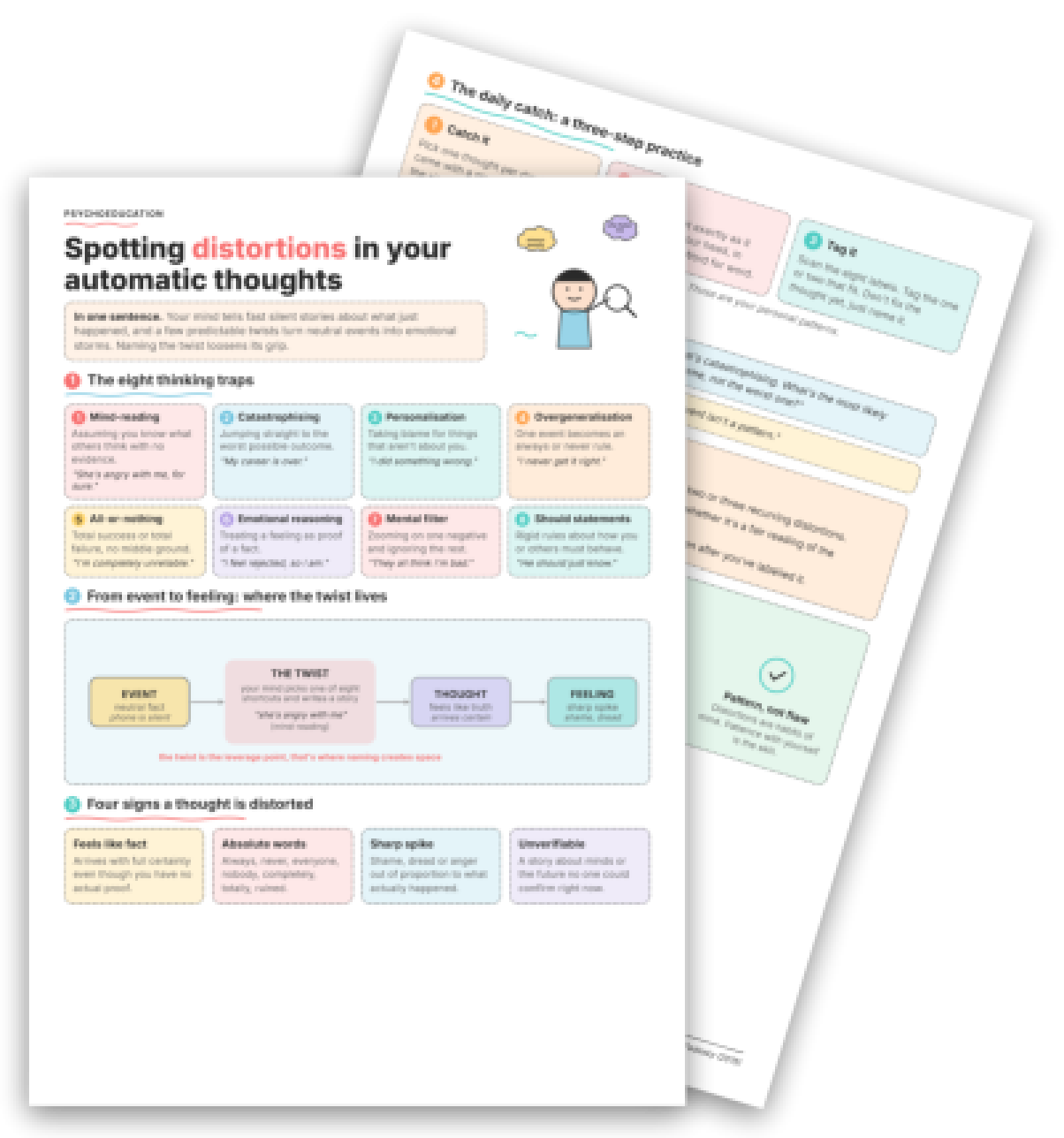
A visual psychoeducation fiche presenting eight cognitive distortions, a distortion-spotting framework, and a structured daily practice to use as a clinical support tool.
Clinical vignettes
Naming the Twist After a Work Silence
Should Statements and Chronic Irritability
Clinical picture. T., a 47-year-old referred for anger-related difficulties in close relationships, described a recurring cycle: a family member would forget a routine task, and T. would experience what he called a "wall of rage" that lasted hours. The clinician used the Thought Decoder sheet to slow the sequence down, asking T. to locate his thought on the event-to-feeling diagram. T. identified the automatic thought as "He should just know by now" and placed it without prompting under Should statements, remarking that the word "should" appeared three times in one sentence. The clinician noted that recognising the distortion did not dissolve the irritation, but T. reported the spike felt shorter when he could name what the mind was doing. Subsequent sessions used this foothold to explore the underlying rules driving the should statements.
Naming cognitive distortions in session is one thing. Getting the patient to recognize them in real time, in their own thinking, is another. Most patients nod along when you explain mind-reading or emotional reasoning verbally, then leave the session without a working vocabulary to apply independently. This fiche PDF bridges that gap: it is a structured visual support you use in session to make the concept concrete, shared, and immediately actionable.
Use this resource with your patients
Handout, exercises and materials ready to use, right inside SessionFuel.
Why Cognitive Distortions Resist Oral Explanation
The core clinical difficulty is not complexity, it's invisibility. Automatic thoughts arrive with the subjective weight of fact. Patients don't experience them as interpretations; they experience them as reality. Explaining this distinction at the board or in conversation leaves the patient with an abstract concept but no pattern-recognition template.
Two additional friction points come up regularly. First, patients often conflate the emotion with the thought, so the signal they need to catch keeps slipping past them unnoticed. Second, even patients who can recite the distortion labels in session fail to apply them between sessions because they have no portable reference. A five-column thought record becomes much easier to complete once a patient has a named taxonomy of the eight shapes their thinking tends to take.
The fiche PDF addresses all of this by turning an oral explanation into a visual map they can hold.
What the Fiche Contains: A Visual Framework for Distortion Recognition
The fiche organises its content across five sequenced panels, all grounded in the lineage of Beck (1976), Burns (1980), and Greenberger & Padesky (2015).
-
Panel 1: The eight thinking traps. Each of the eight distortions (mind-reading, catastrophising, personalisation, overgeneralisation, all-or-nothing thinking, emotional reasoning, mental filter, and should statements) is named, defined in one sentence, and illustrated with a verbatim example thought. Patients see immediately that "I never get it right" is labelled overgeneralisation, not a fair self-assessment. You can use this panel to walk through distortions selectively, rather than exhausting the full list in a single pass.
-
Panel 2: Event to feeling, where the twist lives. This is the layout's clinical backbone. A linear diagram moves from neutral fact (phone is silent) through the twist (the distortion the mind selects) to thought and then feeling. The visual makes visible what verbal description often loses: the twist is a leverage point, not an inevitable response to the event. This is the moment where the CBT cognitive model stops being abstract and starts being personal.
-
Panel 3: Four signs a thought is distorted. Absolute words, unverifiability, a sharp emotional spike, and the felt certainty of a thought without evidence. Patients who struggle to name a specific distortion can use these four signs as a first filter. The labeling cognitive distortion step becomes much quicker once they have these markers.
-
Panel 4: The daily catch, a three-step practice. Catch it, Quote it, Tag it. One thought per day, written verbatim, then scanned against the eight labels. No restructuring yet, just naming. This is a deliberately low-demand task, well-suited as a between-session assignment at early-to-mid treatment stages.
-
Panel 5: Inner phrases to borrow. Ready-made self-talk linked to specific distortions: "This sounds like mind-reading. What would I see if I had no idea what they were thinking?" These phrases act as a bridge toward challenging automatic thoughts without requiring the patient to invent their own cognitive reappraisal from scratch.
> To retain: The Thought Decoder is a visual support that facilitates in-session explanation. You use it with the patient, not instead of the clinical conversation; it stays with them as a portable reference between sessions.
750+ clinical tools
A library built with and for clinicians, ready to use in session and extend between appointments.
Access all the toolsWhen and How to Introduce the Fiche
The optimal window is sessions two to four, once the initial anamnesis is done and the patient has shared at least one emotionally loaded situation. You now have a live example to anchor each distortion concretely.
A useful framing: "I want to show you a map of the eight most common patterns minds use when they're under pressure. We'll look at them together and see which ones feel familiar to you." This avoids pathologising language while activating genuine self-recognition.
The fiche is particularly well-matched to patients presenting with all-or-nothing thinking, mind-reading distortions, or emotional reasoning, distortions that are highly prevalent across anxiety, low self-esteem, and interpersonal difficulties. It also complements the cognitive triangle if you are building psychoeducation incrementally.
Debrief the daily-catch task in the following session by asking the patient which one or two labels kept appearing. Those recurring patterns become a shared shorthand for the rest of the treatment: "Is that the mental filter showing up again?" After a few weeks, patients begin asking that question themselves.
One practical limit: patients in acute crisis or with significant dissociation may find the naming exercise destabilising before a solid grounding foundation is in place. Sequence accordingly.
The fiche does not replace the clinical formulation or Socratic questioning; it makes the vocabulary precise early enough that both become faster and more productive.
Use it with your patients
Share this tool in the mobile app and follow the work between sessions.
Sources
- Beck, A. T. (1976). Cognitive Therapy and the Emotional Disorders. International Universities Press.
- Burns, D. D. (1980). Feeling Good: The New Mood Therapy. William Morrow.
- Burns, D. D. (1989). The Feeling Good Handbook. Harper-Collins Publishers.
- Beck, J. S. (2021). Cognitive Behavior Therapy: Basics and Beyond (3rd ed.). The Guilford Press.
Your session continues in your patients' pocket
Use with a patientYour resources, available everywhere
The handouts, exercises, programs and audios above: you choose which ones to make available to your patients, in the mobile app dedicated to them.
And far more than a library
The app goes well beyond resources, to support your patients every day:
Related categories
Explore other clinical resources by category.

Anxiety
Clinical hub for anxiety disorders: CBT and ACT worksheets, psychoeducation sheets, and exercises for assessment and treatment across the anxiety spectrum.

Mood
Evidence-based worksheets and clinical tools for mood disorders: CBT, ACT, and positive psychology resources for psychologists and therapists.

Identity
Clinical resources for self-identity work in therapy: CBT, ACT, schema tools for clinicians addressing self-concept, core beliefs, and identity disruption.

Cognition
Printable cognitive therapy worksheets and clinical tools for therapists: CBT, ACT, schema work, defusion, distortions, and belief restructuring.

Understand
Clinical hub for the therapeutic aim 'Understand': worksheets and tools to build patient insight across CBT, ACT, schema therapy and more.

Build awareness
Clinical worksheets and tools to build awareness in therapy: cognitive distortions, schemas, emotions, ACT and CBT resources for practitioners.