
Clinical picture. M., a woman in her late twenties, presents with marked social anxiety and a longstanding pattern of avoiding professional networking events. She reports a near-automatic belief that colleagues find her incompetent, rated at 85% conviction before any structured work. The clinician introduced the five-column thought record after two sessions of psychoeducation, anchoring the first practice attempt to a specific meeting she had attended the previous week. She described the situation in camera-like terms, named her emotion as "shame" at 7/10, and identified the automatic thought "They noticed I said nothing useful" with 80% belief. Working through the evidence columns, she acknowledged that two colleagues had nodded in agreement during her one comment and that her manager had not given any critical feedback; the balanced thought she generated carried a belief rating of 55%, and her shame re-rated at 4/10. She left the session with a blank worksheet to complete independently before the next team meeting, with no instruction to feel better, only to notice.
Five-Column Thought Record: PDF Worksheet, Tools and Exercises
A printable PDF worksheet, clinical tools, and exercises for teaching cognitive restructuring in session through a structured five-column thought record.
Clinical vignettes
Thought Record in Social Anxiety
Restructuring After Critical Feedback
Clinical picture. T., a man in his early forties, was referred following a period of low mood linked to difficulties at work, including a formal written warning he perceived as evidence of total professional failure. In session four, the clinician proposed completing a five-column record together, using the moment he read the warning letter as the anchor situation. T. initially resisted, saying "writing it down won't change what happened," and the clinician acknowledged that point before suggesting the exercise as a way to examine what the event meant to him rather than to dispute the facts. His automatic thought was "I am useless and this proves I will never hold a job," belief 90%; emotions were shame at 8/10 and anger at 5/10. The balanced column was slow to build: T. identified that he had received a commendation six months prior and that the warning covered one specific conduct issue, not his overall performance. The original thought's belief dropped to 60% and shame to 5/10, a shift T. described as small but, in his words, "less stuck."
Most patients nod when you explain the cognitive model verbally, then return the following week without having caught a single automatic thought. Tracking thoughts in one's head asks a patient to observe the very instrument doing the observing. This fiche PDF breaks that impasse: a printable five-column thought record that anchors the cognitive restructuring sequence on paper, turning an abstract psychoeducation into a shared visual reference you can walk through together during the session.
Use this resource with your patients
Handout, exercises and materials ready to use, right inside SessionFuel.
Why the Thought Record Resists Verbal Explanation
The three-column version (Beck, 1979) is already familiar to many patients by reputation. The five-column format adds two steps that are clinically decisive: a rated balanced thought and a re-rated outcome. These are exactly the steps patients collapse or skip when working from memory alone.
Without a visual structure, the cognitive chain (situation → emotion → automatic thought → balanced response → outcome shift) exists as an undifferentiated narrative the patient rehearses rather than interrogates. The CBT cognitive model makes this chain explicit conceptually; the thought record makes it operational. Patients also routinely confuse feelings with thoughts ("I felt worthless" versus the exact sentence "I always ruin things"), and they substitute reassuring slogans for genuinely examined alternatives. Integrating this fiche with your existing cognitive distortions work becomes cleaner when patients have a column structure on which to hang each label, including catastrophizing, mind-reading, and all-or-nothing thinking, all named explicitly in the fiche.
What the Fiche Contains: A Visual Scaffold for In-Session Work
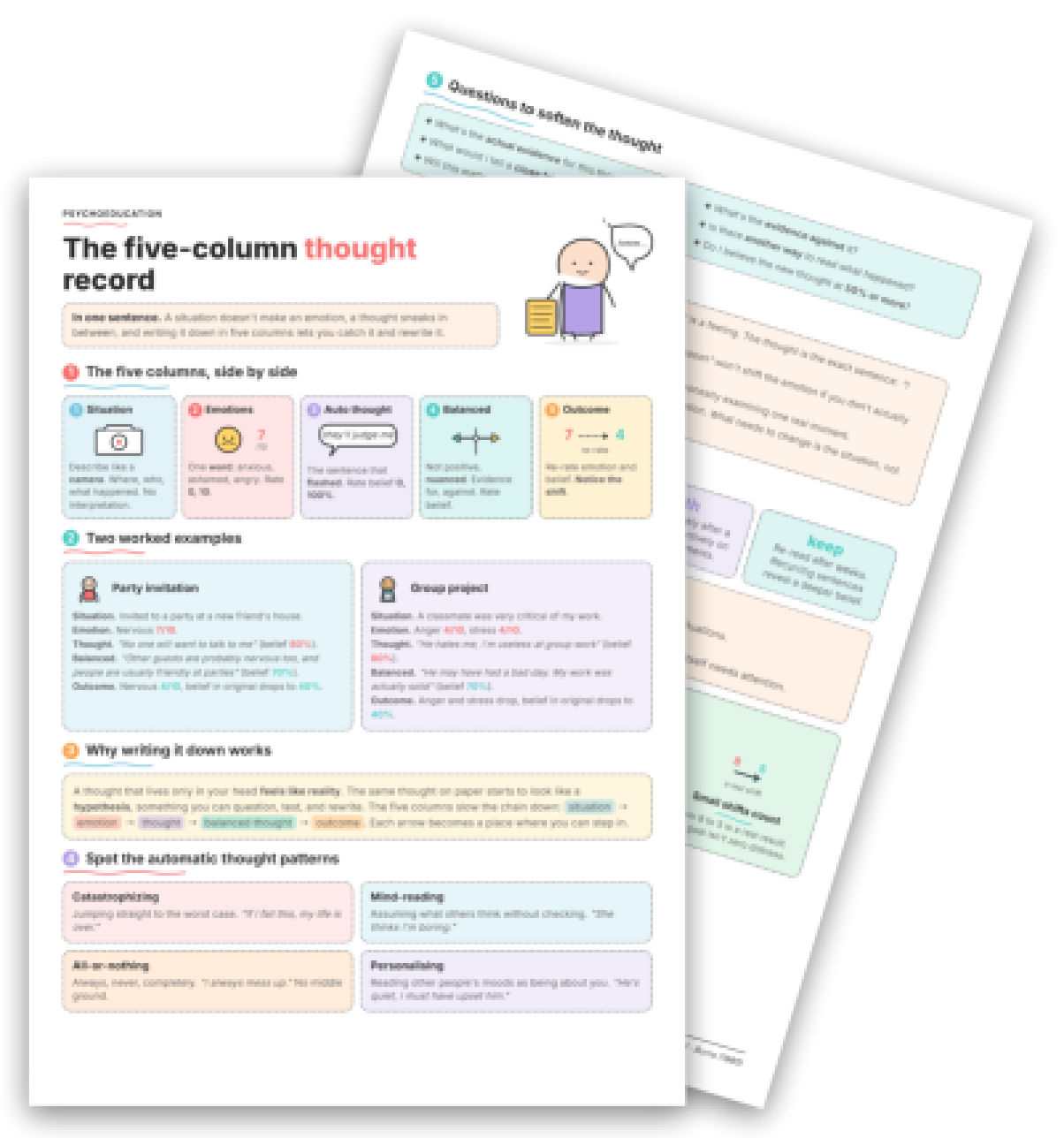
The fiche spans eight panels and functions as a support visuel that facilitates in-session explanation, not a form patients complete autonomously.
Panel 1 lays out the five columns side by side: Situation ("describe like a camera"), Emotions (one word plus a 0-10 rating), Automatic Thought (the exact sentence that flashed plus a 0-100% belief rating), Balanced Thought ("not positive, nuanced" plus belief re-rating), and Outcome (emotion and belief re-rated). Seeing all five columns simultaneously makes the sequential logic visible in a way a verbal walkthrough cannot replicate.
Panel 2 provides two fully worked examples: a social scenario (party invitation, "No one will want to talk to me", belief drops from 80% to 40%) and an interpersonal conflict (a critical colleague, "He hates me, I'm useless at group work", same arc). These examples let you model the task in session before assigning any homework. They pair naturally with automatic thought identification work and map onto the ABC model if you are working from an REBT frame.
Panel 5 lists six Socratic softening questions: evidence for and against the thought, the friend test, an alternative reading, time-projection, and a 50%-belief check. Clinicians using the downward arrow technique or moving toward core belief work will recognize these as the same moves that precede schema-level inquiry. Panels 6 and 7 address common pitfalls and practice cadence (1-3 honest entries per week, written while the thought is still fresh). A closing "To discuss in session" panel flags three situations worth raising explicitly: a recurring thought across very different contexts, an inability to reach a balanced alternative above 50% belief, and an emotion that does not shift despite a careful entry.
> Key takeaway: the fiche is a visual support that facilitates in-session explanation of the five-column thought record. You walk through it with the patient, name each step together, then send it home as a concrete reference, not an autonomous task to complete without guidance.
750+ clinical tools
A library built with and for clinicians, ready to use in session and extend between appointments.
Access all the toolsWhen and How to Introduce It in Session
The thought record fits naturally from session two onward, once the cognitive triangle has been introduced and a shared vocabulary exists. For presentations involving social anxiety or interpersonal stress, the worked examples in panel 2 provide immediate face validity.
A low-resistance introduction: "I'd like to show you a tool we'll use to slow down the moment between what happens and how you feel. It has five steps, and I'll walk through all of them with you now." Avoid framing it as homework before you have demonstrated it together.
When debriefing, prioritize the shift in numbers over whether the balanced thought feels fully convincing. The fiche states directly that "from 8 to 5 is a real result", a formulation worth quoting to patients who expect complete emotional relief. Patients with marked perfectionism will sometimes over-engineer every entry; coach them toward three honest entries rather than ten polished ones.
For patients whose distress traces to deep schema-level material rather than situational appraisals, the thought record is an entry point rather than a terminus. Recurring themes across the balanced-thought column open the conversation naturally toward restructuring a negative core belief. The fiche does not replace the formulation; it makes in-session explanation faster, leaves the patient with a precise visual reference, and generates a paper trail of cognitive shifts worth revisiting together.
Use it with your patients
Share this tool in the mobile app and follow the work between sessions.
Sources
- Beck, A. T., Rush, A. J., Shaw, B. F., & Emery, G. (1979). Cognitive Therapy of Depression. Guilford Press.
- Greenberger, D., & Padesky, C. A. (2016). Mind Over Mood: Change How You Feel by Changing the Way You Think (2nd ed.). Guilford Press.
- Padesky, C. A., with Greenberger, D. (2020). The Clinician's Guide to CBT Using Mind Over Mood (2nd ed.). Guilford Press.
- Beck, J. S. (2020). Cognitive Behavior Therapy: Basics and Beyond (3rd ed.). Guilford Press.
- VA VISN 5 MIRECC - CBT-D Program. 5-Column Thought Record (CBT-D Worksheet).
Your session continues in your patients' pocket
Use with a patientYour resources, available everywhere
The handouts, exercises, programs and audios above: you choose which ones to make available to your patients, in the mobile app dedicated to them.
And far more than a library
The app goes well beyond resources, to support your patients every day:
Related categories
Explore other clinical resources by category.
Anxiety
Clinical hub for anxiety disorders: CBT and ACT worksheets, psychoeducation sheets, and exercises for assessment and treatment across the anxiety spectrum.

Mood
Evidence-based worksheets and clinical tools for mood disorders: CBT, ACT, and positive psychology resources for psychologists and therapists.

Identity
Clinical resources for self-identity work in therapy: CBT, ACT, schema tools for clinicians addressing self-concept, core beliefs, and identity disruption.

Cognition
Printable cognitive therapy worksheets and clinical tools for therapists: CBT, ACT, schema work, defusion, distortions, and belief restructuring.

Build awareness
Clinical worksheets and tools to build awareness in therapy: cognitive distortions, schemas, emotions, ACT and CBT resources for practitioners.

Restructure
Clinical hub for cognitive restructuring worksheets: distortion identification, belief disputation, ABC model, and schema work for evidence-based practice.