
Clinical picture. T., a man in his late thirties referred for adjustment disorder following a redundancy, reported a persistent thought that he was "unemployable" and rated his belief in it at 90/100. During a session, the clinician introduced the six-question worksheet and asked him to write the thought word for word before working through the evidence columns. Under evidence against, T. listed three previous roles he had held successfully and recalled positive feedback from a former manager; at the silent-leaps step, he identified the assumption that one rejection equalled permanent failure. His belief rating dropped to 52/100 by the end of the exercise, and he described the shift as "seeing it from the outside for the first time." The worksheet was assigned as a between-session task for recurrent self-critical thoughts.
Challenging Negative Thoughts: PDF Worksheet, Tools and Exercises
A structured six-question PDF worksheet clinicians can use as a visual aid in session to help patients examine, challenge, and rewrite distorted automatic thoughts.
Clinical vignettes
Worksheet Reveals a Hidden Assumption
Zoom-Out Step Reduces Anticipatory Anxiety
Clinical picture. M., a woman in her mid-twenties presenting with generalised anxiety, brought to session a thought that a minor error in a work email would "ruin her reputation permanently," rated at 78/100 belief. The clinician walked her through the worksheet, pausing at step five, the zoom-out question, where M. acknowledged that in five years the error would almost certainly be forgotten. She struggled initially with the balanced-thought step, tending toward forced reassurance, so the clinician prompted her to aim for plausible rather than positive. The revised sentence, "A small mistake is noticeable to me but is unlikely to define how colleagues see my work," brought her belief rating down to 40/100. She noted that writing the thought on paper made it feel less urgent than when it stayed in her head.
Cognitive restructuring is one of the most robustly supported techniques in CBT, yet explaining it verbally in session rarely lands on its own. Patients nod, leave with a vague sense that they should "think differently," and return the following week having done nothing with it. This fiche PDF gives you a concrete visual scaffold to use alongside your explanation, so the mechanism becomes visible rather than just audible.
Use this resource with your patients
Handout, exercises and materials ready to use, right inside SessionFuel.
Why Cognitive Restructuring Resists a Purely Verbal Explanation
The core problem is that patients conflate thought challenging with forced positivity or arguing with themselves. Without a visible structure, they have no way to distinguish examining a thought from dismissing it. Patients with high automatic thought frequency, whether driven by depression, rumination, or social anxiety, often treat emotional certainty as evidential truth. The step from "it feels completely true" to "let me check the facts" is hard to bridge when the only reference point is something you said once in session.
The issue is compounded by common cognitive distortions like all-or-nothing thinking, arbitrary inference, or mind-reading, which keep patients locked inside the thought rather than stepping outside it. A printed, sequential tool gives both of you a shared map, a common vocabulary, and a visible process that the patient can reproduce without reconstructing it from memory.
What the Fiche Contains: a Visual Walk Through Six Questions
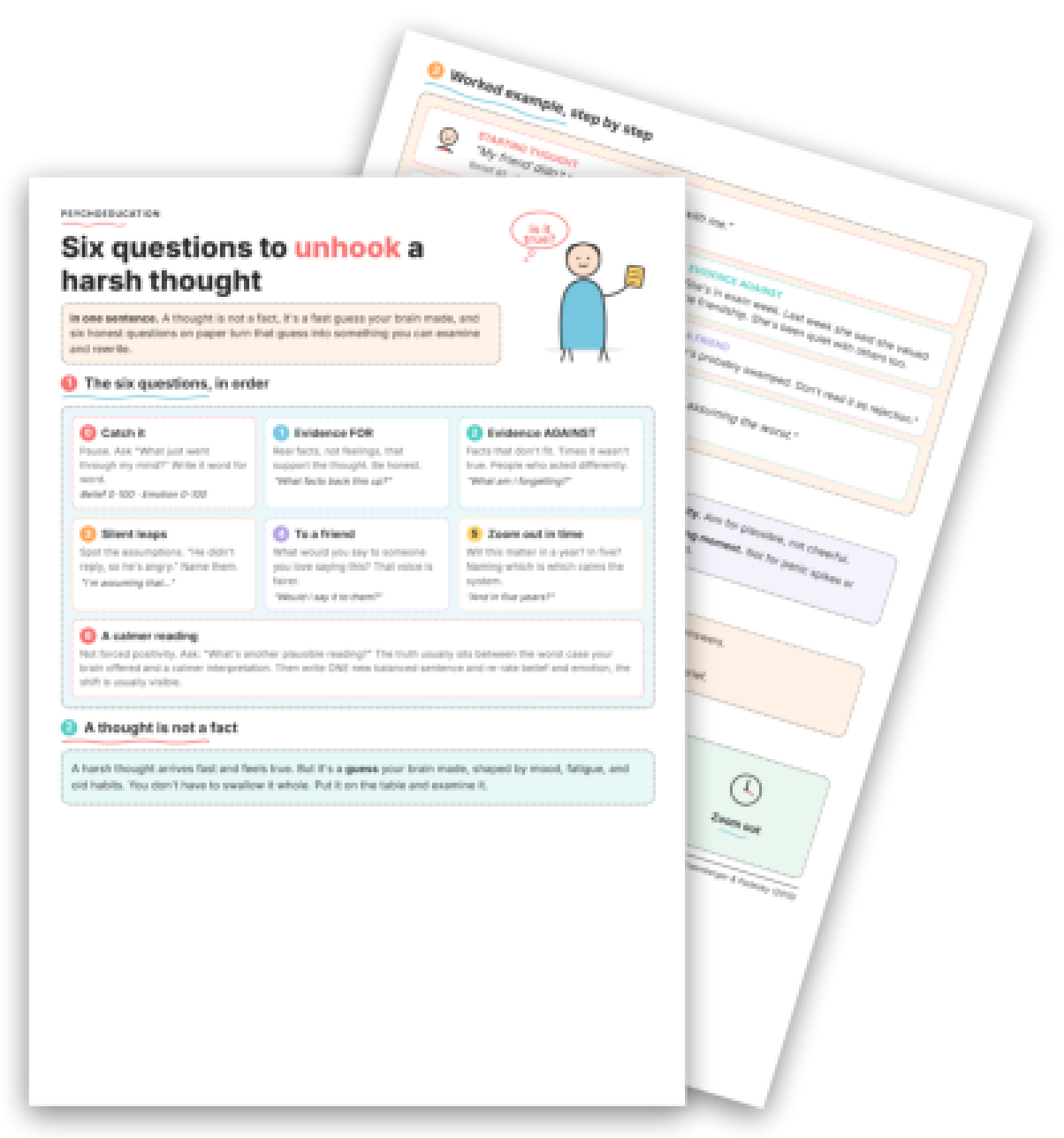
The fiche structures the whole process around six numbered questions, each occupying its own panel. Before any questioning begins, there is a "Catch it" step: the patient writes the harsh thought verbatim, then rates belief (0-100) and emotion (0-100). That baseline rating is what makes the shift measurable at the end, not merely claimed.
The six questions then progress in a deliberate order:
- Evidence FOR: "What facts back this up?", with an explicit prompt to use real facts, not feelings
- Evidence AGAINST: "What am I forgetting?", surfacing disconfirming data and past exceptions
- Silent leaps: naming embedded assumptions, framed as "I'm assuming that...", a direct route to catching distorted thinking patterns
- To a friend: accessing the fairer, less punishing voice the patient would use with someone they love
- Zoom out in time: "And in five years?", calibrating the actual temporal weight of the thought
- A calmer reading: generating one balanced sentence, then re-rating belief and emotion
That final step is framed carefully: "Not forced positivity. Ask: 'What's another plausible reading?'" Having that printed on the fiche saves you from repeating it every session, and it pre-empts the most common patient objection.
The fiche also includes a worked example, following the thought "My friend didn't text back. She's done with me" from belief 85 and emotion 80, down to belief 35 and emotion 40, step by step. A "Common traps" panel identifies the pitfalls patients hit most often: arguing instead of examining, running the process mentally rather than in writing, and misapplying the tool during panic or flashbacks. That last point is spelled out explicitly in the fiche's own language, "Wrong tool, wrong moment."
> Key point: The fiche is a visual support that facilitates the explanation in session. It is not a self-help form patients complete alone between appointments. Its value is in the shared examination it makes possible, letting patients follow the logic alongside you rather than reconstruct it from nothing.
750+ clinical tools
A library built with and for clinicians, ready to use in session and extend between appointments.
Access all the toolsWhen and How to Introduce This Tool
The fiche fits naturally from the second or third session, once you have introduced the CBT cognitive model and the patient has begun identifying their own thought patterns. It is particularly indicated for depressive rumination, generalized anxiety, perfectionism, and social avoidance, where thought-driven suffering is the primary maintenance process.
A practical framing to introduce it: "I'd like us to look at a tool together, not something to fill in alone, but a map we can walk through side by side." That positions the fiche as a shared exercise rather than homework, which matters for patients who already feel overwhelmed.
Work through the six questions on a real thought the patient brought to that session. Use the belief and emotion ratings before and after to make the shift observable. At the end, hand the fiche over as a reference, not an assignment. A simple debrief question, "Which of these six steps felt hardest?", often surfaces the specific distortion or core belief driving the thought, pointing directly to the next clinical focus.
The fiche explicitly flags its own contraindication: it is not the right tool for panic spikes or trauma flashbacks. In those presentations, somatic regulation or graded exposure work takes precedence. For patients ready to go deeper, the fiche pairs well with a downward-arrow exercise tracing the thought to its core belief, structured cognitive restructuring homework, or work on catastrophizing patterns. It does not stand alone; it anchors a broader arc.
Use it with your patients
Share this tool in the mobile app and follow the work between sessions.
Sources
- Beck, A. T., Rush, A. J., Shaw, B. F., Emery, G. (1979). Cognitive Therapy of Depression. Guilford Press.
- Greenberger, D., Padesky, C. A. (2016). Mind Over Mood: Change How You Feel by Changing the Way You Think (2nd ed.). Guilford Press.
- Padesky, C. A. (2020). The Clinician's Guide to CBT Using Mind Over Mood (2nd ed.). Guilford Press.
- Beck, J. S. (2021). Cognitive Behavior Therapy: Basics and Beyond (3rd ed.). Guilford Press.
Your session continues in your patients' pocket
Use with a patientYour resources, available everywhere
The handouts, exercises, programs and audios above: you choose which ones to make available to your patients, in the mobile app dedicated to them.
And far more than a library
The app goes well beyond resources, to support your patients every day:
Related categories
Explore other clinical resources by category.

Anxiety
Clinical hub for anxiety disorders: CBT and ACT worksheets, psychoeducation sheets, and exercises for assessment and treatment across the anxiety spectrum.

Mood
Evidence-based worksheets and clinical tools for mood disorders: CBT, ACT, and positive psychology resources for psychologists and therapists.

Identity
Clinical resources for self-identity work in therapy: CBT, ACT, schema tools for clinicians addressing self-concept, core beliefs, and identity disruption.

Cognition
Printable cognitive therapy worksheets and clinical tools for therapists: CBT, ACT, schema work, defusion, distortions, and belief restructuring.

Build awareness
Clinical worksheets and tools to build awareness in therapy: cognitive distortions, schemas, emotions, ACT and CBT resources for practitioners.

Restructure
Clinical hub for cognitive restructuring worksheets: distortion identification, belief disputation, ABC model, and schema work for evidence-based practice.