
T., a 38-year-old secondary school teacher, presented with persistent fatigue, low mood, and recurrent guilt after taking sick leave. During session four, the clinician introduced the informational sheet on "should" statements after T. described feeling "weak" for not managing the workload that colleagues seemed to handle without difficulty. T. identified the rigid rule: "I should be able to cope with this on my own." Using the sheet's chain model, the clinician helped T. locate the appended catastrophe: "and if I cannot, it means I am failing as a professional." T. acknowledged that the guilt was not evidence the rule was valid, but evidence it was rigid; by the following session he reported monitoring the rule's appearance across the week with noticeably less self-reproach.
"Should" Statements: PDF Worksheet, Tools and Exercises
A printable PDF fiche to help clinicians explain rigid inner rules in session, giving patients a visual framework to identify, challenge, and soften "should" thinking.
Clinical vignettes
Self-Directed Should in Burnout
Other-Directed Should in Relationship Conflict
M., a 45-year-old woman referred for recurrent conflict with her adult daughter, described a cycle of intense anger followed by shame whenever her daughter cancelled visits at short notice. The clinician used the sheet to map the three directions a should can point and asked M. to place her reaction on the grid; she quickly identified "she should know how much this hurts me" as the operative rule. Exploring the healthy-preference versus rigid-should distinction, M. noticed the emotion was disproportionate to the event itself, which suggested rigidity rather than legitimate grievance. The clinician did not frame this as invalidating her wish for closeness, but as a way to separate the preference from the rule's grip. M. agreed to track instances of the rule over two weeks before any direct conversation with her daughter was attempted.
"Should" statements sit at the intersection of Ellis's musturbation, Beck's prescriptive rules, and schema-level imperatives, yet in session, patients rarely recognise them as a cognitive distortion. They experience them as moral facts. Explaining this verbally often produces polite nodding without genuine insight. This PDF worksheet provides the visual scaffold that makes the mechanism legible in real time.
Use this resource with your patients
Handout, exercises and materials ready to use, right inside SessionFuel.
Why "Should" Statements Resist Explanation in Session
The clinical difficulty is not that patients deny having rules. It's that rigid rules feel like standards, not cognitions. When you name the distortion verbally, the patient's internal response is often "but it IS true that I should be productive", and the session stalls in a values debate rather than a cognitive one.
The second layer of resistance comes from the affect: guilt, anger, and shame arrive with such intensity that they seem to confirm the rule. As the fiche states plainly, "The emotion is not proof the rule is true, it is proof the rule is rigid." That reframe is easy to say and hard to land without a visual support to anchor it.
A further clinical complication: shoulds point in three distinct directions (self, other, world), each with its own emotional cost profile. Conflating them in a verbal explanation produces confusion. Patients following along therapy for low self-esteem, OCD, or burnout often have simultaneous rules across all three directions, and the emotional spillover from one contaminates the others.
What the Fiche Contains: a Visual Framework for Session Use
This is a psychoeducation support the clinician uses to walk the patient through the concept, not a self-report questionnaire to complete between sessions.
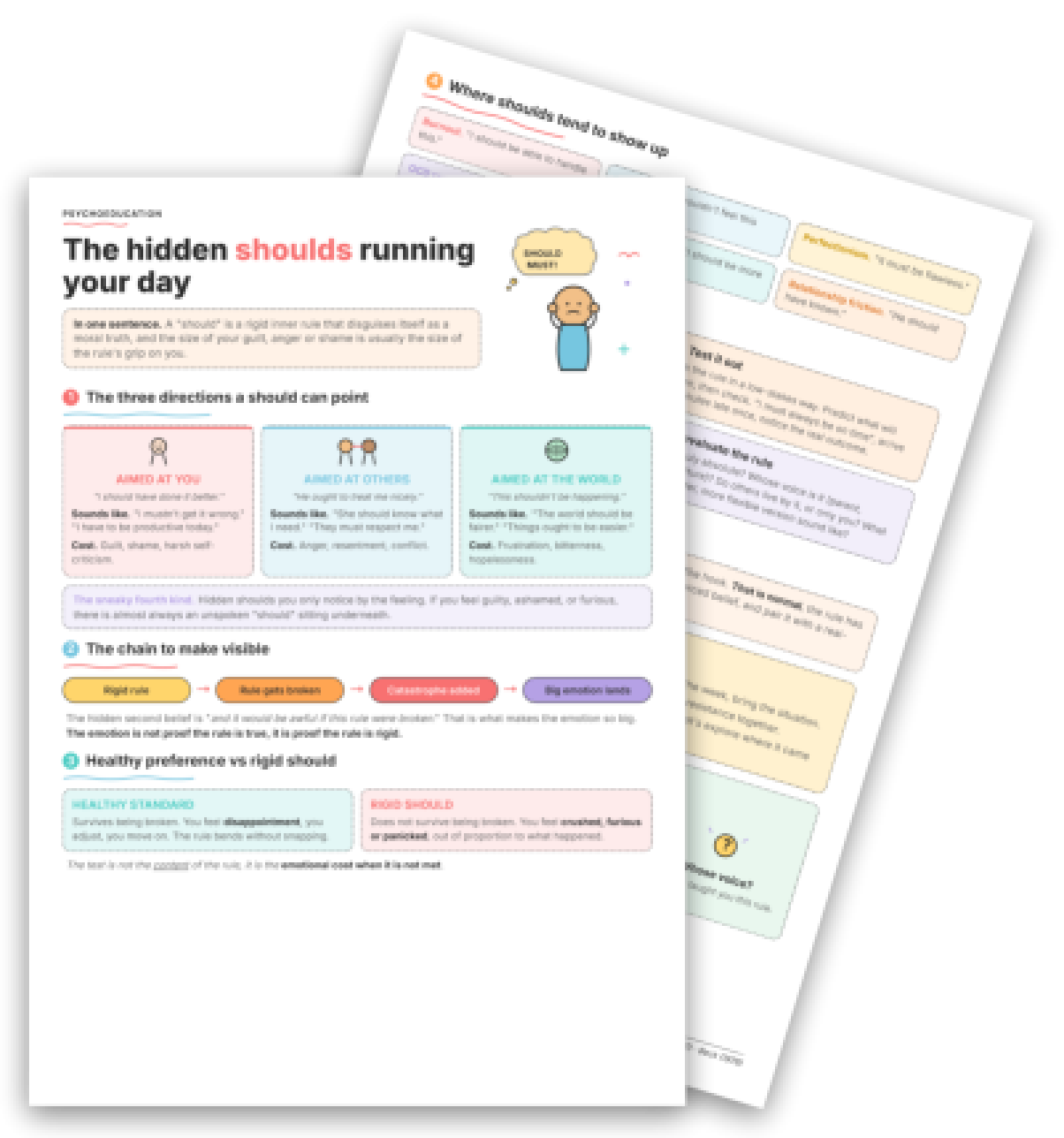
The fiche opens with a one-sentence definition that cuts straight to the mechanism: "A 'should' is a rigid inner rule that disguises itself as a moral truth, and the size of your guilt, anger or shame is usually the size of the rule's grip on you." That sentence alone tends to produce the first moment of recognition.
From there, the visual panels unfold in a clinically logical order:
- Three directions the "should" can point, each with concrete example phrases and its emotional cost (guilt/shame for self-directed rules; anger/resentment for other-directed ones; frustration and hopelessness for world-directed ones). Showing this as three separate columns prevents the patient from merging them.
- The activation chain: rigid rule → rule gets broken → catastrophe added → big emotion lands. The visual arrow sequence makes visible the hidden second belief: "and it would be awful if this rule were broken." This maps neatly onto the ABC model for practitioners working within REBT.
- Healthy preference vs rigid should, presented as a direct comparison. The clinical test offered on the fiche is behavioural, not semantic: it is not the content of the rule but the emotional cost when it is not met that reveals its rigidity. This distinction is decisive, and harder to communicate without the side-by-side visual.
- Where shoulds show up clinically, burnout, low mood, perfectionism, OCD-type responsibility, self-esteem, and relationship friction, giving you a quick formulation anchor across presentations.
- Four concrete moves: notice and label, test behaviourally, soften the language ("I must get it right" → "I'd prefer to get it right"), and re-evaluate the rule's origin. The fiche also addresses the predictable resistance head-on: "The new version often feels insincere at first...treat the rewrite as a language experiment, not a forced belief."
- A "To discuss in session" panel with three prompts that structure the debrief after patients take the fiche home.
> Key point: the fiche works as a visual psychoeducation tool that facilitates the explanation in session. The clinician guides the patient through it in real time; it is not assigned as homework to complete alone. The patient leaves with a concrete reference they can consult between sessions.
750+ clinical tools
A library built with and for clinicians, ready to use in session and extend between appointments.
Access all the toolsWhen and How to Introduce the Fiche
The optimal window is once a specific rule has surfaced in the material, after a shame spike, a conflict account, or an emotional reasoning episode, rather than as a general introduction to cognitive distortions. Premature introduction risks the patient engaging intellectually without connecting it to their own affect.
For practitioners working with cognitive distortions broadly, the fiche pairs cleanly with tools focused on all-or-nothing thinking and emotional reasoning, which often co-occur. In schema therapy contexts, the downward arrow technique typically surfaces the should before you present this fiche; it then gives the patient a name and a map for what was uncovered. For structured follow-up work on the rule itself, the Demandingness exercise and the Evaluating Demanding Standards worksheet extend the work autonomously.
A useful framing to introduce it: "I'd like to show you something that might explain why that feeling was so intense. Let's look at it together." Avoid labelling the patient's rule as irrational before you have explored its origin, the fiche includes a prompt to ask whose voice the rule belongs to, which opens that conversation naturally.
One contraindication worth noting: with patients in an active shame spiral, the self-directed "should" panel can temporarily amplify self-criticism if introduced too quickly. Stabilise affect first, then bring in the visual.
The fiche closes the psychoeducation work; it does not replace the relational exploration of where a given rule came from or why it persists. Used at the right moment, it shortens the conceptual groundwork considerably and leaves the patient with a shared vocabulary for every subsequent session in which a "should" surfaces.
Use it with your patients
Share this tool in the mobile app and follow the work between sessions.
Sources
- Horney, K. (1950). Neurosis and Human Growth: The Struggle Toward Self-Realization. W. W. Norton.
- Ellis, A., Harper, R. A. (1975). A New Guide to Rational Living. Prentice-Hall.
- Burns, D. D. (1980). Feeling Good: The New Mood Therapy. William Morrow.
- Ellis, A. (1994). Reason and Emotion in Psychotherapy, Revised and Updated. Birch Lane Press.
- Ellis, A.. Techniques for Disputing Irrational Beliefs (DIBS). Albert Ellis Institute.
Your session continues in your patients' pocket
Use with a patientYour resources, available everywhere
The handouts, exercises, programs and audios above: you choose which ones to make available to your patients, in the mobile app dedicated to them.
And far more than a library
The app goes well beyond resources, to support your patients every day:
Related categories
Explore other clinical resources by category.

Anxiety
Clinical hub for anxiety disorders: CBT and ACT worksheets, psychoeducation sheets, and exercises for assessment and treatment across the anxiety spectrum.

Mood
Evidence-based worksheets and clinical tools for mood disorders: CBT, ACT, and positive psychology resources for psychologists and therapists.

Identity
Clinical resources for self-identity work in therapy: CBT, ACT, schema tools for clinicians addressing self-concept, core beliefs, and identity disruption.

Emotions
Clinical resources on emotion regulation: worksheets, coping tools, CBT, REBT, and ACT exercises for therapists working across diagnoses and age groups.

Cognition
Printable cognitive therapy worksheets and clinical tools for therapists: CBT, ACT, schema work, defusion, distortions, and belief restructuring.

Understand
Clinical hub for the therapeutic aim 'Understand': worksheets and tools to build patient insight across CBT, ACT, schema therapy and more.