
Clinical picture. M., a 34-year-old doctoral candidate, presents with recurrent health anxiety triggered by physical sensations during periods of academic stress. In session, she describes a tight chest noticed the previous evening and the intrusive thought: "What if this is the start of something serious?" The clinician introduces the worksheet, inviting her to write the original "what if" and then generate three concrete alternatives: the tightness was residual tension from six hours at a desk, it was the second coffee of the afternoon, and it passed within twenty minutes and was forgotten. M. reported a noticeable shift in chest tension as she read back the alternatives aloud, and acknowledged that the third scenario matched her actual history almost every time. She agreed to use the three-step practice independently before seeking reassurance online.
What If...? Reframing Catastrophic Worry: PDF Worksheet, Tools and Exercises
A visual PDF worksheet clinicians can use in session to explain the 'what if?' attention trap and teach patients to generate concrete, balanced alternatives to catastrophic thinking.
Clinical vignettes
Reframing Pre-Exam Health Worry
Anticipatory Anxiety Before a Team Meeting
Clinical picture. R., a 41-year-old manager treated for generalised anxiety disorder, arrives describing three days of rumination ahead of a performance review he must deliver to a colleague. His looping question was: "What if she becomes hostile and the whole team turns against me?" Using the worksheet collaboratively, the clinician guided R. to write that question verbatim, then generate three equally plausible alternatives: the meeting goes awkwardly but ends without incident, his colleague asks one difficult question and accepts the response, and the conversation is shorter and more routine than anticipated. R. noted that the physical urgency attached to the original question did not diminish immediately, but that honest probability weighting based on his past twelve months of appraisals clearly favoured the neutral scenarios. He left with a printed copy of his completed worksheet to review the morning of the meeting.
Most patients already understand, intellectually, that their worst-case prediction probably won't happen. The problem is that explaining this verbally during the session rarely shifts anything. This fiche PDF on catastrophic "what if?" thinking gives you a concrete visual support to make the attention bias mechanism visible, create a shared vocabulary, and give the patient a replicable technique to take away.
Use this resource with your patients
Handout, exercises and materials ready to use, right inside SessionFuel.
Why "What If?" Loops Resist Verbal Explanation in Session
The core difficulty is one of felt probability. The fiche names it precisely: when the mind generates a "what if?", it presents the catastrophic outcome with a subjective certainty of around 90%, when actual probability sits closer to 2-10%. Patients are not being irrational by any subjective measure. The worry feels like evidence. Telling them it isn't tends to trigger either superficial agreement or pushback.
A second obstacle is structural. The "what if?" question has the form of information-gathering while functioning as a covert threat alarm. Patients rarely notice the asymmetry: their mind loops on one channel, always disaster, while quietly suppressing every neutral, boring, or positive alternative. Without a visual that shows this two-channel structure side by side, the concept stays abstract. Clinicians working in TCC (including third-wave approaches like ACT) know that identifying automatic thoughts is not enough on its own; the patient needs to see the architecture of the bias, not just be told it exists. This is where the fiche earns its place.
750+ clinical tools
A library built with and for clinicians, ready to use in session and extend between appointments.
Access all the toolsWhat the Fiche Contains: A Visual Layout That Does the Explaining
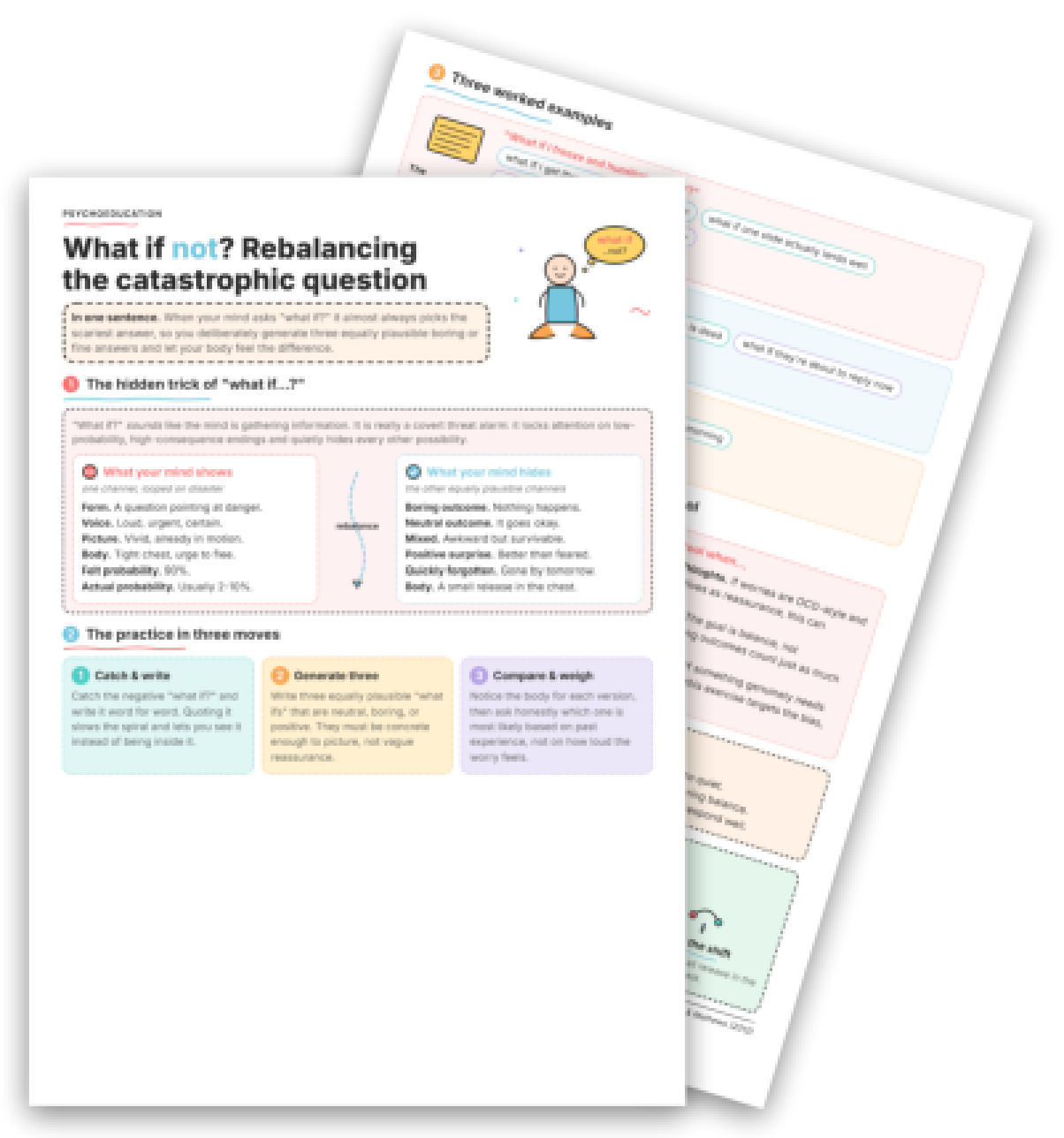
The fiche PDF is organized into four sections, each serving a distinct clinical function.
The first section, "The hidden trick of 'what if?'", presents a two-column contrast: what your mind shows (one channel looped on disaster, loud, urgent, vivid, body tight, felt probability 90%) against what your mind hides (the boring outcome, the neutral outcome, the mixed one, the positive surprise, each paired with "a small release in the chest"). Shown visually side by side, this contrast makes the attentional narrowing immediately legible. You can point to it rather than describe it.
The second section lays out the three-move practice: Catch and write the negative "what if?" word for word; generate three concrete, equally plausible neutral or boring alternatives; compare and weigh by noticing the somatic response to each version, then asking which is most likely based on actual past experience rather than loudness. This sequence maps naturally onto the restructuring anxious thoughts work already in progress.
Section three provides three worked examples (a presentation, an unanswered message, chest tightness), showing the method applied to common presentations including health anxiety and social anxiety. Patients who struggle to generate alternatives spontaneously can use these as models.
Section four is clinically essential: it lists unsticking prompts ("What would someone not anxious imagine?", "What actually happened the last ten times I worried about this?") alongside explicit contraindications. The fiche is direct: do not use this tool with OCD-type intrusive thoughts, where generating alternatives risks functioning as reassurance and reinforcing the compulsive loop. It also flags the difference between intolerance of uncertainty driving the spiral and a genuine actionable risk that deserves a different response.
> Key point: This fiche is a visual support that facilitates in-session explanation, not a self-administered questionnaire. Its two-column layout and worked examples do the heavy lifting of psychoeducation, freeing up session time for deeper formulation work.
Use it with your patients
Share this tool in the mobile app and follow the work between sessions.
When and How to Introduce This Tool
The fiche fits naturally from session two or three onward, once the initial case formulation has identified worry or catastrophizing as a maintaining process. It works well with GAD, health anxiety, and social anxiety presentations, and integrates readily into a CBT model of GAD alongside work on fortune-telling and jumping to conclusions.
A workable introduction: "I want to show you something about how 'what if?' questions actually work. This diagram makes it easier to see than to explain." Then walk through the two-column contrast together, ask the patient to identify a recent loop, and run through the three-move practice live in session. Debrief by asking what they noticed in the body as they generated each alternative, particularly whether there was any "small release in the chest" mentioned in the fiche.
Contraindication worth repeating at handover: if the patient is already using reassurance-seeking as a primary coping strategy (common in reassurance-seeking anxiety patterns), check that alternative generation doesn't become a new compulsive ritual. The worry-focused attentional exercise can be a useful parallel tool when that risk is present.
The fiche does not replace the therapeutic frame. It makes one specific mechanism visible quickly, creates a shared reference point, and gives the patient something concrete to use between sessions rather than abstract instruction.
Your session continues in your patients' pocket
Use with a patientYour resources, available everywhere
The handouts, exercises, programs and audios above: you choose which ones to make available to your patients, in the mobile app dedicated to them.
And far more than a library
The app goes well beyond resources, to support your patients every day:
Related categories
Explore other clinical resources by category.
Anxiety
Clinical hub for anxiety disorders: CBT and ACT worksheets, psychoeducation sheets, and exercises for assessment and treatment across the anxiety spectrum.

Cognition
Printable cognitive therapy worksheets and clinical tools for therapists: CBT, ACT, schema work, defusion, distortions, and belief restructuring.

Understand
Clinical hub for the therapeutic aim 'Understand': worksheets and tools to build patient insight across CBT, ACT, schema therapy and more.

Build awareness
Clinical worksheets and tools to build awareness in therapy: cognitive distortions, schemas, emotions, ACT and CBT resources for practitioners.

Restructure
Clinical hub for cognitive restructuring worksheets: distortion identification, belief disputation, ABC model, and schema work for evidence-based practice.

CBT
CBT worksheets, cognitive restructuring exercises & behavioral tools for clinicians. Evidence-based resources for every phase of cognitive behavioral therapy.