
Clinical picture. A is a 34-year-old presenting with generalised anxiety and a longstanding pattern of occupational avoidance; she had cancelled three job interviews in the preceding month, each time within hours of confirming attendance. When the clinician introduced the fortune-telling informational sheet, A identified her recurring thought, "I will freeze and they will see I am incompetent," and recognised it as a prediction treated as settled fact rather than as one possible outcome among many. Together, clinician and patient mapped the full sequence described in the sheet: the triggering email, the automatic forecast, the somatic tightening, and the cancellation that followed within the same afternoon. A agreed, with some reluctance, to a behavioural test: attending a low-stakes informational interview and recording the actual outcome against her written prediction beforehand. She returned the following week reporting that the interview had been unremarkable, which she described as "almost disappointing" given the certainty she had felt.
Fortune Telling: PDF Worksheet, Tools and Exercises for Clinical Practice
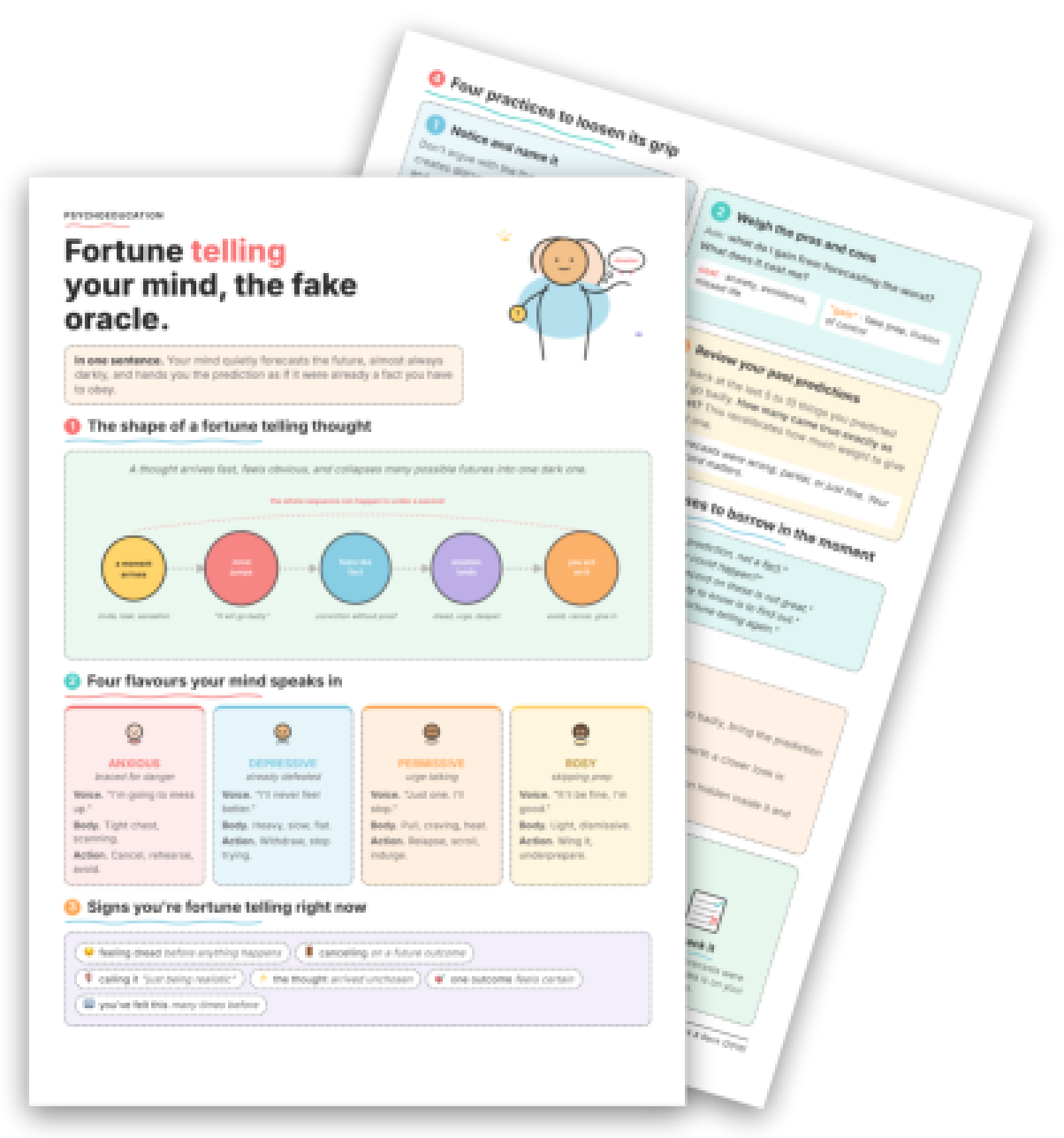
A printable PDF worksheet with structured visual tools and exercises to help clinicians explain the fortune-telling distortion clearly, establish shared vocabulary, and move patients toward behavioral testing.
Clinical vignettes
Cancellation Before the First Attempt
Depressive Forecasting and Withdrawal
Clinical picture. M is a 51-year-old with recurrent depressive disorder, currently in a partial remission that had stalled over several weeks; he had stopped attending a walking group he previously valued, stating he would feel worse for going. The clinician used the fortune-telling sheet to externalise the thought, "I'll feel flat the whole time and regret going," distinguishing it from a rational appraisal by noting that M had no recent behavioural evidence to support it. M was invited to list the costs of the forecast, which he articulated as continued isolation and the erosion of any remaining pleasurable activity. He agreed to attend one session of the group and to rate his mood before and after on a simple scale. His post-activity rating was modestly higher than the pre-activity baseline, a result he described as "smaller than I hoped but not what I expected," which the clinician used to open a discussion about the accuracy of depressive predictions more broadly.
A patient agrees, verbally, that their predictions are not facts. Then they cancel a job interview because it "won't go well." That gap, between intellectual assent and behavioral change, is precisely where this fortune-telling PDF worksheet justifies its place in session. Naming the distortion out loud rarely suffices. Showing it does.
Use this resource with your patients
Handout, exercises and materials ready to use, right inside SessionFuel.
Why Fortune Telling Resists Verbal Explanation
Fortune telling is one of those distortions patients struggle to catch in real time, not because they lack insight, but because the cognitive sequence is genuinely fast. The fiche makes this explicit: "the whole sequence can happen in under a second." By the time the patient is conscious of a prediction, the emotional and behavioral consequences (dread, cancellation, avoidance) are already underway. Describing this sequence verbally places the clinician in the position of asking the patient to imagine a process they have already completed without noticing.
A second friction point is the patient's subjective sense of realism. "I'm just being realistic" is one of the distortion's most effective shields, and it appears verbatim in the fiche's "To discuss in session" prompts. Oral psychoeducation often gets absorbed into that defensive frame. A visual support changes the dynamic: the patient sees a named structure on paper, which objectifies the mechanism without challenging the person.
This also connects to the broader landscape of cognitive distortions. Fortune telling frequently chains with catastrophizing and mind reading, and patients often present with several running simultaneously, which makes targeted naming especially useful early in treatment.
What the Worksheet Contains: Six Structured Panels
The PDF worksheet is organized across six clearly delimited sections, making it a genuinely usable visual support during session rather than a form the patient completes alone.
Panel 1 maps the five-step fortune-telling sequence (triggering moment, automatic prediction, felt certainty, emotional response, behavioral consequence) as a linear flow. This is the core psychoeducation asset: the clinician can walk through it with the patient while pointing to each step, which is far more anchoring than narrating the same content.
Panel 2 differentiates four flavours of fortune-telling thought: anxious ("I'm going to mess up"), depressive ("I'll never feel better"), permissive ("just one, I'll stop"), and rosy (overconfident under-preparation). This taxonomy matters clinically. Patients with generalized anxiety cluster in the anxious voice; those in a depressive episode often present with the defeated one. Pointing to the relevant box cuts the time needed to arrive at a shared formulation.
Panel 3 offers a checklist of six real-time signs, including the felt certainty about one outcome and the recurrence of the pattern across contexts. Useful for building self-monitoring capacity between sessions.
Panel 4 presents four concrete practices: labelling the thought without arguing with it, weighing the costs and pseudo-gains of worst-case forecasting, behavioral testing ("acting against the forecast is the only real evidence"), and retrospective tracking of past predictions. This last one has particular clinical weight: most patients, when they actually review five to ten prior predictions, discover their accuracy rate is poor. The fiche frames it plainly: "most forecasts were wrong, partial, or just fine."
Panels 5 and 6 address the fortune-telling versus catastrophizing distinction (predict the event, then catastrophize the consequence) and a set of ready-to-use phrases the patient can borrow in the moment. Both sections extend naturally into session dialogue.
> Key point: this fiche is a visual support that facilitates the explanation of fortune telling in session. The clinician uses it to walk through the mechanism panel by panel, not as a self-administered questionnaire. The patient takes it home as a concrete reference point.
750+ clinical tools
A library built with and for clinicians, ready to use in session and extend between appointments.
Access all the toolsWhen and How to Bring It Into Session
This worksheet fits naturally into the early-to-mid psychoeducation phase, once the therapeutic alliance is established and a preliminary cognitive formulation is in place. In TCC protocols targeting anxiety or depression, it works well in sessions two to four, after automatic thought identification has begun and before graduated exposure work starts.
You can introduce it without labeling the patient: "I want to show you something that might map onto what you described with the interview cancellation." Walking through Panel 1 together, while the patient locates their own example in the sequence, typically produces faster recognition than any purely verbal explanation.
For patients presenting with arbitrary inference patterns or emotional reasoning, the worksheet doubles as a differentiating tool, helping both clinician and patient tease apart overlapping distortion types.
Debrief at the following session by asking which panel felt most relevant and whether the patient caught any live predictions during the week. The companion Fortune-Telling Cognitive Distortion guided exercise extends this into structured between-session work, as does the Anticipatory Fear decatastrophizing exercise when the forecast is driving avoidance of a specific upcoming situation. For patients with all-or-nothing thinking complicating the picture, pair it with the relevant distortion worksheet to build a fuller cognitive map.
The fiche is less suited to early acute presentations where psychoeducation would feel cognitively overloading. In those cases, defer it until the patient has enough stabilization to engage reflectively with the mechanism. The worksheet does not replace the formulation process; it makes part of that process visible and portable.
Use it with your patients
Share this tool in the mobile app and follow the work between sessions.
Sources
- Beck, A. T., Rush, A. J., Shaw, B. F., & Emery, G. (1979). Cognitive Therapy of Depression. The Guilford Press.
- Burns, D. D. (1980). Feeling Good: The New Mood Therapy. William Morrow.
- Mizes, J. S., Landolf-Fritsche, B., & Grossman-McKee, D. (1987). Patterns of distorted cognitions in phobic disorders: An investigation of clinically severe simple phobics, social phobics, and agoraphobics.
- Leahy, R. L. (2017). Cognitive Therapy Techniques: A Practitioner's Guide (2nd ed.). Guilford Press.
Your session continues in your patients' pocket
Use with a patientYour resources, available everywhere
The handouts, exercises, programs and audios above: you choose which ones to make available to your patients, in the mobile app dedicated to them.
And far more than a library
The app goes well beyond resources, to support your patients every day:
Related categories
Explore other clinical resources by category.

Anxiety
Clinical hub for anxiety disorders: CBT and ACT worksheets, psychoeducation sheets, and exercises for assessment and treatment across the anxiety spectrum.

Mood
Evidence-based worksheets and clinical tools for mood disorders: CBT, ACT, and positive psychology resources for psychologists and therapists.

Cognition
Printable cognitive therapy worksheets and clinical tools for therapists: CBT, ACT, schema work, defusion, distortions, and belief restructuring.

Understand
Clinical hub for the therapeutic aim 'Understand': worksheets and tools to build patient insight across CBT, ACT, schema therapy and more.

Build awareness
Clinical worksheets and tools to build awareness in therapy: cognitive distortions, schemas, emotions, ACT and CBT resources for practitioners.

Restructure
Clinical hub for cognitive restructuring worksheets: distortion identification, belief disputation, ABC model, and schema work for evidence-based practice.