
Clinical picture. P., a 34-year-old teacher referred for mild to moderate depression, reports at the start of a session that she "achieved nothing" in the past week. When her clinician asks her to walk through each day briefly, she identifies three completed lesson plans, a well-received parent meeting, and one afternoon she describes as unproductive. The clinician names the process: one difficult afternoon has been filtering out four days of adequate functioning, a pattern consistent with the mental filter distortion described in the psychoeducation sheet shared the previous week. P. is invited to list, in writing, what she did complete during the week before drawing any global conclusion. She leaves with a small positives log as a between-session task, aiming for accuracy rather than forced optimism.
Mental Filter: PDF Worksheet, Tools and Exercises for CBT Practice
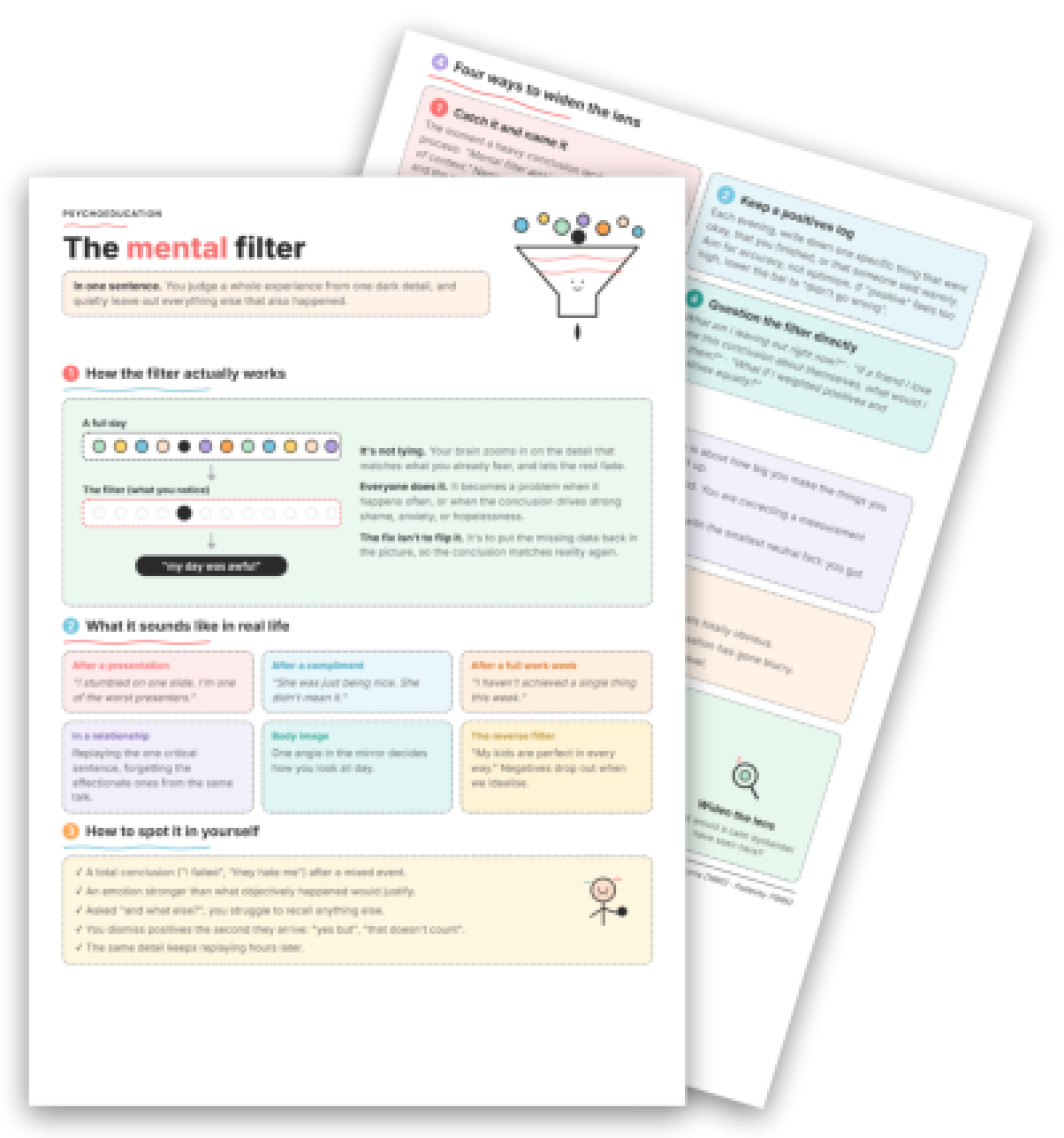
A printable psychoeducation sheet to help clinicians explain selective attention bias in session and give patients a concrete cognitive tool to take home.
Clinical vignettes
Filtering Out a Successful Week
One Critical Comment, One Conclusion
Clinical picture. M., a 29-year-old man seen for social anxiety, reports that a colleague's brief critical remark during a team meeting confirmed that his coworkers find him incompetent. Asked what else happened in the meeting, he pauses and recalls that two other colleagues thanked him for a document he prepared, a detail he had not thought about since. The clinician reflects that the single critical remark had been replaying for two days while the warmer exchanges had faded within minutes, and introduces the term mental filter to describe this selective attention process. Together they sketch a brief written account of the full meeting, restoring the omitted data. M. notes that the conclusion he had reached no longer fits the complete picture, though he remains uncertain how credible the positive feedback was.
Explaining selective abstraction verbally often lands flat: the patient nods, agrees that they "only focus on the bad," and then applies exactly the same skewed lens an hour later. The concept is intuitive enough to feel understood yet slippery enough to resist change. This fiche PDF on the mental filter gives you a concrete visual anchor to use directly in session, so the mechanism clicks rather than just registers.
Use this resource with your patients
Handout, exercises and materials ready to use, right inside SessionFuel.
Why the Mental Filter Is Hard to Explain Without a Visual
The core difficulty is not complexity; it is self-evidence. Patients experiencing a mental filter believe, with full conviction, that their negative conclusion is simply accurate. The skewed sampling is invisible from the inside. When you explain selective abstraction orally, you are asking someone to question a process they cannot currently perceive.
A second complication: the filter and its conclusions feel emotionally coherent. The patient who replays the one critical sentence from a conversation while the rest goes blurry is not being irrational by their own logic. Nothing in an oral explanation disrupts that coherence. A visual that makes the selection process visible, showing what gets in and what gets left out, does what words alone cannot.
This is exactly where a guide to cognitive distortions or a broader cognitive distortions overview becomes insufficient on its own: patients need to see their specific filtering mechanism mapped, not just named in a list.
What the Fiche Contains: A Visual Map of the Filter in Action
The fiche PDF opens with a one-sentence definition: "You judge a whole experience from one dark detail, and quietly leave out everything else that also happened." That sentence is worth reading aloud in session precisely because patients often pause at "quietly," recognizing the passive, automatic character of the bias.
The sheet then moves through five structured sections:
- How the filter actually works: a schematic showing a full day passing through a filter and collapsing into "my day was awful," with an explicit note that "your brain zooms in on the detail that matches what you already fear, and lets the rest fade." This diagram is the core psychoeducation tool: it externalises a process the patient has never seen from the outside.
- What it sounds like in real life: six concrete examples spanning professional performance, compliments, work weeks, relationships, body image, and the reverse filter (idealisation). Each one is short enough to read in session and prompt immediate recognition.
- How to spot it in yourself: five checkmarks, including "Asked 'and what else?', you struggle to recall anything else" and "You dismiss positives the second they arrive: 'yes but', 'that doesn't count'." These function as a brief self-monitoring checklist you can walk through together.
- Four intervention strategies: naming and labelling the filter, keeping a positives log (framed explicitly as "correcting a measurement error", not forcing optimism), perspective-widening questions ("If a calm bystander watched the whole thing, what would they have seen?"), and direct filter-questioning prompts.
- Common confusions to clear up: a clinically useful distinction between the mental filter and magnification/minimization, and a reframe of the positives log that pre-empts the "toxic positivity" objection before the patient raises it.
> Key takeaway: The fiche is a visual support that facilitates in-session explanation of the mental filter. It is not a self-administered questionnaire. You use it to make a cognitive mechanism visible, establish a shared vocabulary, and hand the patient something concrete to hold onto between appointments.
A fiche covering disqualifying the positive pairs naturally here, since the two distortions frequently co-occur: the filter selects what enters awareness, and disqualification dismisses what slips through.
750+ clinical tools
A library built with and for clinicians, ready to use in session and extend between appointments.
Access all the toolsWhen and How to Introduce It in Session
The fiche fits most naturally after the first full anamnèse, once you have enough material to identify the filter in the patient's own account. A low-pressure introduction might be: "I noticed that when you described your week, a few things came up briefly and then dropped away. I have a diagram that might help us look at that together."
For depressive presentations, the schematic in section 1 is often immediately activating: patients recognise the mechanism in their own narrative almost instantly, which itself becomes a defusion moment. For social anxiety, the real-life examples around compliments and presentations are the most productive entry point. You can use the Clark and Wells model of social anxiety alongside to contextualise the filter within the broader post-event processing loop.
The "To discuss in session" cues on the fiche (replaying one critical sentence, the positives log feeling impossible to start) double as debrief prompts at the following appointment, so you do not need to construct your own follow-up questions from scratch.
One limit worth naming: patients with pronounced all-or-nothing thinking may initially read the positives log as a demand for optimism. The fiche addresses this directly, but you may still need to slow down at the "correcting a measurement error" framing before handing it over. Similarly, for patients presenting with marked emotional reasoning, pair the fiche with explicit work on the automatic thought identification level before moving to filter-questioning.
The fiche does not replace the restructuring work. It makes the explanation land, installs a shared vocabulary ("mental filter again"), and gives the patient a reference to return to on difficult days.
Use it with your patients
Share this tool in the mobile app and follow the work between sessions.
Sources
- Beck, A. T., Rush, A. J., Shaw, B. F., Emery, G. (1979). Cognitive Therapy of Depression. Guilford Press.
- Burns, D. D. (1980). Feeling Good: The New Mood Therapy. William Morrow.
- Beck, J. S. (2020). Cognitive Behavior Therapy: Basics and Beyond (3rd ed.). Guilford Press.
Your session continues in your patients' pocket
Use with a patientYour resources, available everywhere
The handouts, exercises, programs and audios above: you choose which ones to make available to your patients, in the mobile app dedicated to them.
And far more than a library
The app goes well beyond resources, to support your patients every day:
Related categories
Explore other clinical resources by category.

Anxiety
Clinical hub for anxiety disorders: CBT and ACT worksheets, psychoeducation sheets, and exercises for assessment and treatment across the anxiety spectrum.

Mood
Evidence-based worksheets and clinical tools for mood disorders: CBT, ACT, and positive psychology resources for psychologists and therapists.

Cognition
Printable cognitive therapy worksheets and clinical tools for therapists: CBT, ACT, schema work, defusion, distortions, and belief restructuring.

Understand
Clinical hub for the therapeutic aim 'Understand': worksheets and tools to build patient insight across CBT, ACT, schema therapy and more.

Build awareness
Clinical worksheets and tools to build awareness in therapy: cognitive distortions, schemas, emotions, ACT and CBT resources for practitioners.

Restructure
Clinical hub for cognitive restructuring worksheets: distortion identification, belief disputation, ABC model, and schema work for evidence-based practice.