
Clinical picture. M., a woman in her mid-thirties, presents with persistent low mood and reduced work performance following a critical remark from a supervisor during a team meeting. She describes the incident as proof that she is "fundamentally incompetent," and when the clinician asks about recent successes she mentions, almost in passing, that she had led a well-received project the previous month. Using a brief psychoeducation sheet on magnification and minimization, the clinician invites her to place both events side by side and notice the difference in the weight she assigns each. M. identifies, with some surprise, that the compliments she received after the project had felt "just polite" and had not stayed with her past that afternoon. Over the following session she begins to track this asymmetry as a named pattern rather than as evidence about her ability.
Magnification and Minimization: PDF Worksheet, Tools and Exercises
A visual PDF worksheet with tools and exercises to help patients catch the two-way distortion that inflates negatives and erases positives, for use in CBT and schema-informed sessions.
Clinical vignettes
One Stumble, a Career Erased
Anxiety, a Speech, and Shrinking Competence
Clinical picture. T., a man in his early forties with a history of social anxiety, is referred ahead of a professional presentation he is convinced will "go badly from the first word." He reports little anxiety about content preparation, which has gone well, but describes a near-total focus on one likely awkward pause and on what colleagues might think at that moment. The clinician introduces the binoculars metaphor from the worksheet to name the process: the threat is held close, the preparation and past successful talks are held at arm's length. T. engages readily with the image and notes that his body cue, a tight chest the night before, appears precisely when he rehearses the anticipated stumble rather than the full talk. The psychoeducation does not eliminate his anxiety, but it gives him a shared vocabulary to interrupt the loop when it starts.
Magnification and minimization is one of the most underestimated distortions in the TCC taxonomy. Patients readily acknowledge their tendency to "catastrophize," but the simultaneous deflation of positive evidence is far harder to surface verbally, and without a visual anchor, it rarely sticks past the session door. This fiche PDF was designed to make the two-way mechanism explicit, scannable, and something the patient can take home.
Use this resource with your patients
Handout, exercises and materials ready to use, right inside SessionFuel.
Why magnification and minimization resists verbal explanation
The conceptual obstacle is asymmetry. When you name catastrophizing, patients recognize the inflated threat. What they systematically miss is the equal and opposite movement: the active dismissal of positive data. The Disqualifying the Positive worksheet treats the minimizing half in isolation; all-or-nothing thinking handles the polarity; but magnification and minimization is specifically a bidirectional distortion, both ends operating simultaneously.
Explaining this at the oral level produces agreement without comprehension. Patients nod, then immediately produce a new minimization ("But that success was just luck") without registering it as the same mechanism you just named. The problem is partly attentional, partly memorial: as the fiche states clearly, "dismissed positives can't be recalled later as proof." A schema of incompetence or worthlessness, familiar from Young's early maladaptive schema framework, actively filters what gets encoded. A good verbal explanation does not compete well with that.
The cognitive distortions overview can situate the pattern, but what makes magnification and minimization clinically tricky is that the patient will often perform it while you are describing it, minimizing the compliment you just gave their progress, or magnifying one bad session into evidence of treatment failure. A visual support stops that loop.
What the fiche contains: a visual tool for in-session explanation
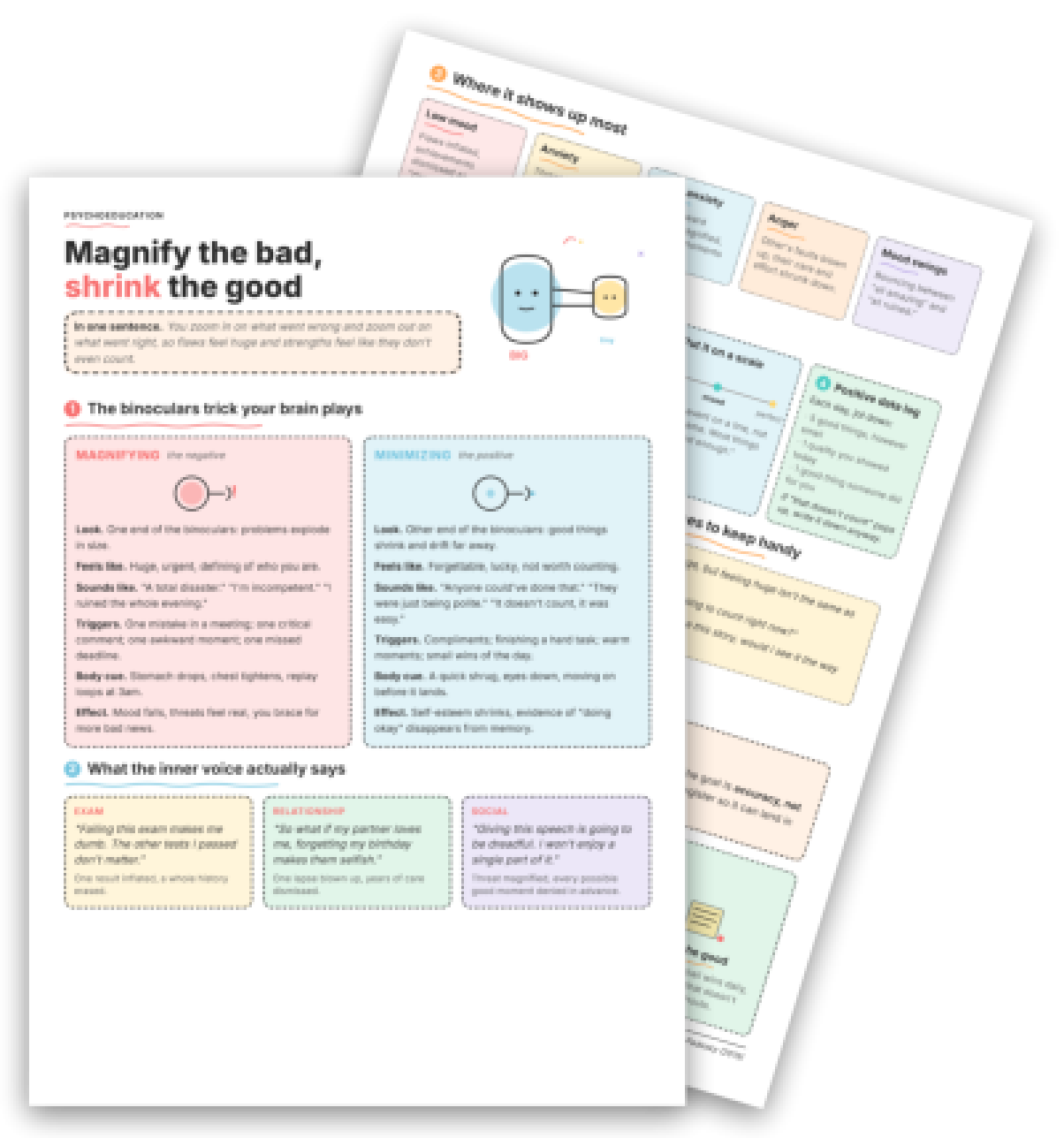
The fiche is structured across six panels, all grounded in a single, memorable image: binoculars held the wrong way.
The first panel, "The binoculars trick your brain plays," presents the two mechanisms side by side. Magnifying the negative is broken down into what it looks like, feels like, and sounds like, with concrete automatic thought examples ("A total disaster." "I ruined the whole evening."), identified somatic cues (stomach drops, replay loops at 3am), and downstream mood effects. The minimizing panel mirrors this exactly: the same categories, the opposite direction. Displaying both columns simultaneously, on paper, makes visible something the oral version cannot, that the patient is doing both, not just one.
Panel two offers three real-world scenarios (exam, relationship, social) that show the distortion in complete sentences, which you can use as starting points for Socratic questioning.
Panel three, "Where it shows up most," maps the pattern across low mood, anxiety, social anxiety, anger, and mood swings, useful for presenting it as cross-diagnostic rather than idiosyncratic.
Panel four is the clinical core: four concrete steps, moving from labeling ("I'm blowing this out of proportion again") through three structured reappraisal questions and a visual scale, to a positive data log, a daily practice of recording five small positives, one quality shown, and one kind act received. The instruction "If 'that doesn't count' pops up, write it down anyway" is particularly useful because it anticipates the minimization reflex inside the exercise itself.
Panel five distinguishes magnification and minimization from catastrophizing and mental filtering, clarifications that prevent conceptual confusion when you are also working with automatic thought records or cognitive restructuring exercises.
> To remember: this fiche is a visual support that makes the magnification and minimization mechanism explicit during the session; it is not a self-guided questionnaire. The clinician uses it to build a shared vocabulary, and the patient leaves with a concrete reference.
750+ clinical tools
A library built with and for clinicians, ready to use in session and extend between appointments.
Access all the toolsWhen and how to introduce it
The fiche fits naturally in early-to-mid formulation work, once the cognitive model has been introduced with something like the CBT cognitive model overview. It is particularly indicated for patients presenting with low self-esteem, perfectionism, or recurrent depressive episodes, where dismissal of positive evidence directly maintains the negative core belief.
You can frame it this way: "I'd like to show you a pattern I'm noticing, it has two sides, and I want us to look at them together." Handing the fiche over at this moment, rather than describing it abstractly, lets the patient's eyes do part of the work.
Debrief the positive data log in the following session before dismissal reflexes erase the week's evidence. Pair it with daily gratitude work or self-compassion exercises around mistakes when self-criticism is prominent. For patients who struggle to recognize any achievement, the Celebrating Personal Successes exercise makes a natural companion.
One limit worth naming: patients with active psychosis or severe dissociation may find the binoculars metaphor too abstract. For those presentations, ground the work somatically first before introducing this level of cognitive restructuring.
The fiche does not replace the formulation or the alliance. It makes one precise mechanism visible, gives the patient language for it, and provides a daily log that starts shifting the memory trap from the first week.
Use it with your patients
Share this tool in the mobile app and follow the work between sessions.
Sources
- Beck, A. T., Rush, A. J., Shaw, B. F., Emery, G. (1979). Cognitive Therapy of Depression. Guilford Press.
- Burns, D. D. (1980). Feeling Good: The New Mood Therapy. New American Library.
- Beck, J. S. (2020). Cognitive Behavior Therapy: Basics and Beyond (3rd ed.). Guilford Press.
Your session continues in your patients' pocket
Use with a patientYour resources, available everywhere
The handouts, exercises, programs and audios above: you choose which ones to make available to your patients, in the mobile app dedicated to them.
And far more than a library
The app goes well beyond resources, to support your patients every day:
Related categories
Explore other clinical resources by category.
Anxiety
Clinical hub for anxiety disorders: CBT and ACT worksheets, psychoeducation sheets, and exercises for assessment and treatment across the anxiety spectrum.

Mood
Evidence-based worksheets and clinical tools for mood disorders: CBT, ACT, and positive psychology resources for psychologists and therapists.

Cognition
Printable cognitive therapy worksheets and clinical tools for therapists: CBT, ACT, schema work, defusion, distortions, and belief restructuring.

Understand
Clinical hub for the therapeutic aim 'Understand': worksheets and tools to build patient insight across CBT, ACT, schema therapy and more.

Build awareness
Clinical worksheets and tools to build awareness in therapy: cognitive distortions, schemas, emotions, ACT and CBT resources for practitioners.

Restructure
Clinical hub for cognitive restructuring worksheets: distortion identification, belief disputation, ABC model, and schema work for evidence-based practice.