
Clinical picture. M., a woman in her early forties, presented to her general practitioner describing persistent tiredness and difficulty keeping up with household tasks over the preceding month; she attributed both to a demanding work schedule. The GP introduced the Am I Experiencing Depression? worksheet as a structured way to review her last two weeks, noting that it was not a diagnostic tool but a prompt for reflection. Working through the five questions together, M. recognised that her loss of interest in cooking, a long-standing hobby, and her early-morning waking were not simply stress responses. She scored several items in the often range and, for the first time, named the possibility that something beyond fatigue might be present. The GP used this shift in framing to open a referral conversation, which M. accepted without the resistance she had shown at earlier appointments.
Depression: PDF Worksheet, Tools and Exercises for Clinical Practice
A printable PDF worksheet, clinical tools, and structured exercises to open the depression conversation in session and help patients name what they are experiencing.
Clinical vignettes
Naming the Fog Before a Referral
Distinguishing Grief From Depression in Session
Clinical picture. T., a man in his late fifties, was seen six months after the death of his spouse; he reported that he felt he should be improving by now and expressed concern that he was simply lazy or weak. The psychologist offered the worksheet at the start of the second session as a shared reference point, emphasising the section clarifying that depression is not laziness and does not always present as visible sadness. As T. read through the real-life descriptions of anhedonia and fatigue, he noted quietly that the phrase a body made of concrete matched his experience more precisely than any label he had previously used. The clinician was then able to explore whether his presentation reflected complicated grief, a depressive episode, or both, without the session becoming a diagnostic debate. The worksheet gave T. a vocabulary that reduced his self-criticism enough to engage more fully in the clinical conversation.
Patients rarely arrive naming depression. They come in drained, flat, cancelling things, telling you they are "probably just tired" or "going through a lot." The diagnostic fog is real, and listing DSM-5 criteria verbally tends to land as either abstract or alarming. This PDF worksheet offers a concrete, gently framed entry point that you can use in session to make the pattern visible without the weight of a formal label.
Use this resource with your patients
Handout, exercises and materials ready to use, right inside SessionFuel.
Why Depression Is So Hard to Name in the Room
The semantic problem is persistent. Patients protect themselves from the word depression by attributing their symptoms to external circumstances: workload, poor sleep, a difficult relationship. Low motivation reads as laziness, anhedonia as ingratitude, psychomotor slowing as personality. The cognitive triad Beck described decades ago operates precisely because the patient's own interpretive framework treats these symptoms as evidence of personal failure rather than illness.
Explaining this at the whiteboard rarely breaks through. What shifts the conversation is showing the patient that what they are living matches a recognisable, named, and above all treatable pattern. That is the clinical function of a visual support: it externalises the pattern so the two of you can examine it together, from a shared vantage point, rather than the patient defending against an impression they feel you are forming about them.
The fiche also addresses a frequent differential difficulty: patients who confuse grief, burnout, or a rough patch with a depressive episode. The burnout worksheet covers overlapping territory on depletion; this worksheet focuses specifically on the DSM-aligned markers that distinguish a depressive episode from situational low mood.
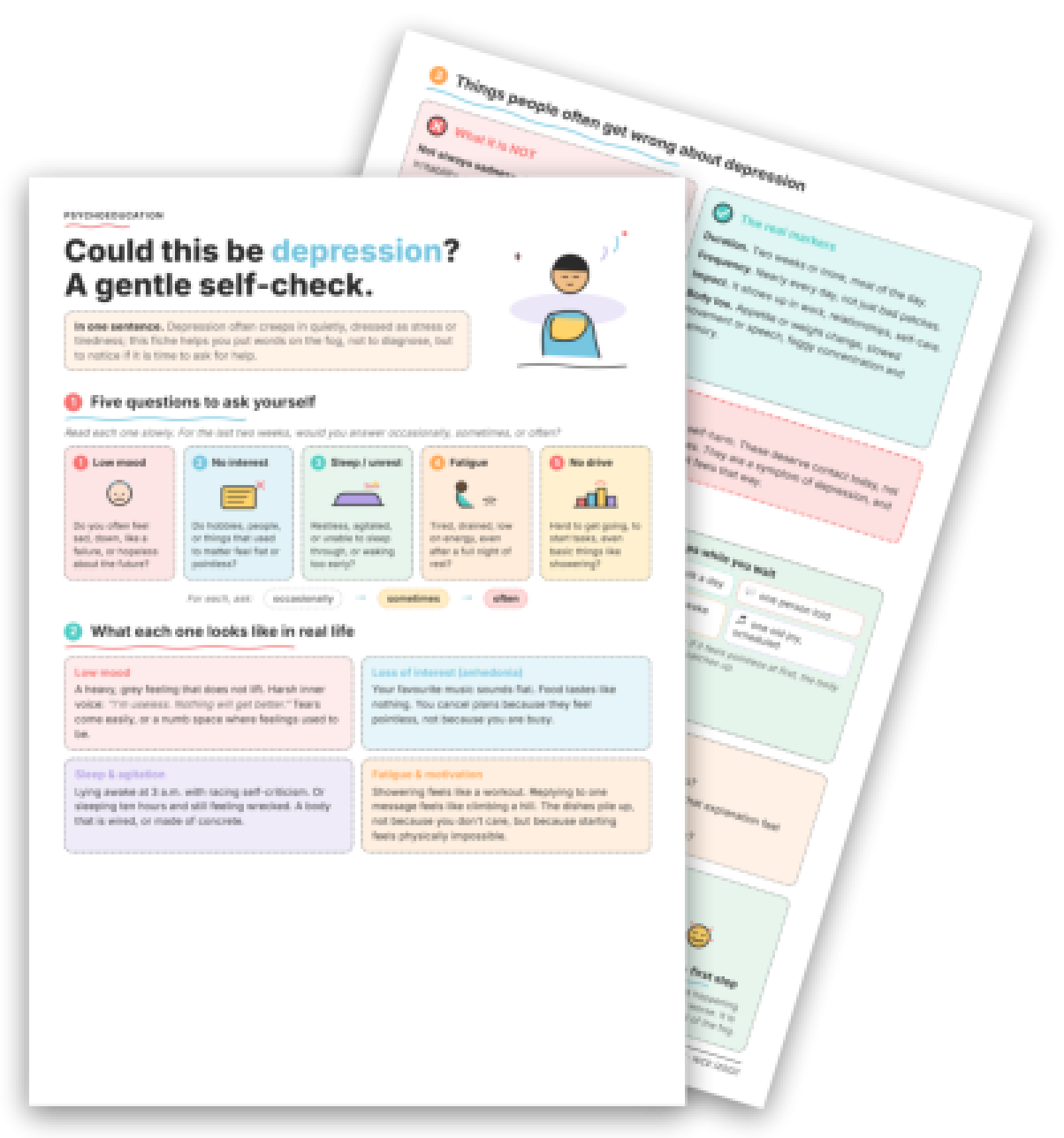
What the Worksheet Contains: Five Questions and a Visual Framework
The fiche opens with five structured questions covering low mood, anhedonia, sleep disruption and agitation, fatigue, and loss of drive, each rated on a simple graduated scale: occasionally / sometimes / often. The graduations matter clinically: they invite nuance rather than yes/no defensiveness, and they map onto a frequency dimension the patient can update across sessions.
Panel two grounds each question in concrete daily-life descriptions. On anhedonia: "your favourite music sounds flat. Food tastes like nothing. You cancel plans because they feel pointless, not because you are busy." On fatigue and motivation: showering as effort, replying to a message as climbing a hill. These anchors are more likely to produce recognition than a clinical sentence about markedly diminished interest in activities, and they do so without pathologising language.
Panel three tackles common misconceptions head-on, in two columns: what depression is not (sadness, laziness, grief, weakness) and the real diagnostic markers (duration of two weeks, daily frequency, functional impact across domains, somatic signs). A safety section addresses thoughts of death and self-harm directly and clearly, with guidance on same-day contact. Panel four closes with small actionable steps and a set of "To discuss in session" prompts, including two defusion-style questions designed to surface avoidance of the diagnosis itself.
> Key point: the fiche is a visual support that facilitates the explanation in session, not a self-administered questionnaire. The layout lets you walk through each panel with the patient, pause on the items that produce a reaction, and use the fiche's own phrasing, "a mirror, not a label," to lower the stakes of recognition.
750+ clinical tools
A library built with and for clinicians, ready to use in session and extend between appointments.
Access all the toolsWhen and How to Introduce It
This worksheet fits naturally in a first or second session, once the presenting complaint is established and before a formal formulation is offered. It is particularly useful when the patient's self-referral language has been vague ("I'm not myself," "I can't cope") and you want to test the depressive hypothesis collaboratively rather than declaring it.
A low-stakes introduction: "I have a short sheet that maps out some patterns people often don't immediately connect to depression. Would you be willing to read through it with me and tell me what fits and what doesn't?" The opt-in framing preserves alliance and positions the patient as the expert on their own experience.
After going through the five questions, pause on the "To discuss in session" prompts. The second one is particularly clinically rich: "If you find yourself defending it as 'just tiredness' or 'just a rough patch', what makes that explanation feel safer?" That question opens the motivational ambivalence work and the schema-level beliefs about weakness that often accompany depressive presentations.
For next steps, the Understanding Depression psychoeducation program deepens the psychoeducation arc across multiple sessions. Behavioral activation exercises for depression and the Weekly Activity Planning worksheet follow naturally once the patient has named the pattern. For cases where limiting beliefs are central to the maintenance cycle, the Depression and Limiting Beliefs program extends the formulation work. Patients with prominent rumination benefit from pairing this worksheet with the Rumination in Depression program, and those who have already engaged in some treatment will find the My Fight Against Depression exercise a strong consolidation tool.
A contraindication worth noting: for patients with severe suicidal ideation or acute risk, the worksheet's safety section is a useful prompt but does not substitute for a structured risk assessment. Use it to open the conversation, not to contain it.
The worksheet does not do the clinical work for you. What it does is give the patient a shared language, a concrete structure to carry home, and the beginning of a sentence they may not have been able to start on their own.
Use it with your patients
Share this tool in the mobile app and follow the work between sessions.
Sources
- Kroenke, K., Spitzer, R. L., Williams, J. B. W. (2001). The PHQ-9: Validity of a Brief Depression Severity Measure. Journal of General Internal Medicine.
- American Psychiatric Association (APA) (2022). Diagnostic and Statistical Manual of Mental Disorders, Fifth Edition, Text Revision (DSM-5-TR). American Psychiatric Association Publishing.
- Beck, A. T., Steer, R. A., Brown, G. K. (1996). BDI-II, Beck Depression Inventory: Manual. Psychological Corporation.
- National Institute for Health and Care Excellence (NICE) (2022). Depression in Adults: Treatment and Management (NG222). NICE.
Your session continues in your patients' pocket
Use with a patientYour resources, available everywhere
The handouts, exercises, programs and audios above: you choose which ones to make available to your patients, in the mobile app dedicated to them.
And far more than a library
The app goes well beyond resources, to support your patients every day:
Related categories
Explore other clinical resources by category.

Mood
Evidence-based worksheets and clinical tools for mood disorders: CBT, ACT, and positive psychology resources for psychologists and therapists.

Understand
Clinical hub for the therapeutic aim 'Understand': worksheets and tools to build patient insight across CBT, ACT, schema therapy and more.

CBT
CBT worksheets, cognitive restructuring exercises & behavioral tools for clinicians. Evidence-based resources for every phase of cognitive behavioral therapy.

Anxiety
Clinical hub for anxiety disorders: CBT and ACT worksheets, psychoeducation sheets, and exercises for assessment and treatment across the anxiety spectrum.

Trauma
Clinical hub on trauma and PTSD: assessment, differential diagnosis, treatment phases, and printable resources for practitioners. 155 chars.

Identity
Clinical resources for self-identity work in therapy: CBT, ACT, schema tools for clinicians addressing self-concept, core beliefs, and identity disruption.