
Clinical picture. M., a woman in her late twenties, presented for low mood and fatigue; she disclosed no eating concerns at intake and maintained a weight within the typical range. At the second session, her therapist offered the eleven-question self-check sheet as a low-pressure way to explore her relationship with food, framing it as a reflection tool rather than a diagnostic instrument. M. completed it quietly and returned it with seven items marked yes, including loss-of-control eating, self-induced vomiting, and laxative use, areas she had not volunteered spontaneously. This opening allowed the clinician to introduce psychoeducation about bulimia and to discuss a referral for a full eating-disorder assessment. The worksheet did not replace clinical judgment; it gave M. a structured, non-shaming prompt to name what she had been concealing.
Bulimia Nervosa: PDF Worksheet, Tools and Exercises for Clinical Practice
A printable PDF worksheet with eleven structured questions, tools, and exercises to help clinicians introduce bulimia nervosa in session and support early disclosure.
Clinical vignettes
Worksheet Opens a Hidden Presentation
Ambivalent Engagement, Partial Recognition
Clinical picture. T., a male university student in his early twenties, was seen in a campus counselling service following academic difficulties and reported that food was not a concern for him. His counsellor introduced the informational sheet midway through a session focused on perfectionism, noting that some of its questions touched on the rigid rule-following he had been describing in other areas of life. T. marked only four items yes but paused at question six, strict food rules, and at question eleven, preoccupation affecting daily functioning, saying aloud that he had not considered these patterns problematic before. The counsellor did not press for a conclusion; she invited T. to reflect between sessions on whether those two items felt worth exploring further. At the following appointment he raised them himself, which allowed a more detailed clinical history to be taken.
Patients who binge and purge rarely arrive describing those behaviors by name. They come with vague complaints about "eating badly," persistent anxiety around food, or low-grade body dissatisfaction, and the bulimic cycle stays hidden behind those presenting complaints, sometimes for years. This PDF worksheet gives you a concrete psychoeducational tool to open that conversation without triggering the defensive closure that direct oral questioning so often produces.
Use this resource with your patients
Handout, exercises and materials ready to use, right inside SessionFuel.
Why Bulimia Stays Hidden, and Why That Complicates Your Assessment
The core clinical difficulty is not diagnostic: it is the secrecy that structures the disorder. Unlike anorexia nervosa, bulimia nervosa typically presents at a typical body weight, which means there is no somatic signal prompting you or the patient to look further. Patients presenting with anxiety, depression, or relational difficulties may be carrying a full bulimic cycle in parallel, and neither party raises it.
The second obstacle is shame. Purging behaviors carry intense self-disgust, and when you open the topic verbally, the patient's affect can close the conversation before it begins. A printed set of neutral yes/no questions reorganizes the dynamic: the patient responds to the page, not to your face.
There is also a structural cognitive threshold error that keeps many patients from self-identifying. They have internalized false criteria: "I don't do it every day" or "I'm not underweight." Without correcting those thresholds first, psychoeducation about the diagnosis lands on blocked ground. This is exactly where a visual support earns its place.
What the Worksheet Contains: A Visual Tool for Session
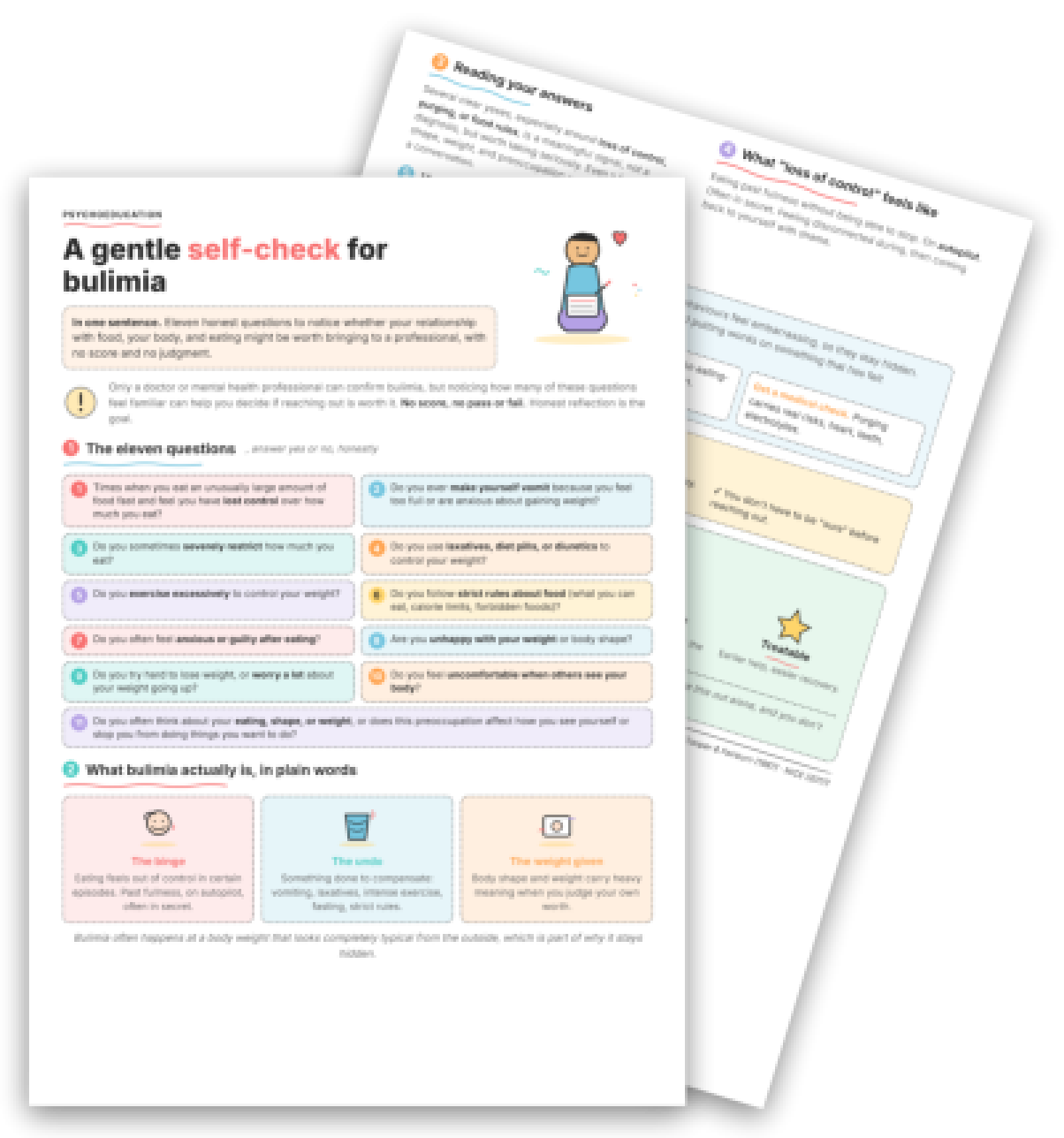
The fiche opens with eleven yes/no questions that cover the full behavioral and cognitive spectrum: loss-of-control eating episodes, compensatory behaviors (vomiting, laxatives, diuretics, excessive exercise), rigid food rules, guilt after eating, body dissatisfaction, weight preoccupation, and whether "this preoccupation affect[s] how you see yourself or stop[s] you from doing things you want to do." Each item is worded in plain, non-clinical language, which lowers the threshold for a candid answer.
A second panel names the three structural components of the disorder: The binge (out-of-control eating, often in secret), The undo (all compensatory behaviors grouped together), and The weight given (the outsized role of body shape and weight in self-evaluation). This maps directly onto the cognitive-behavioral maintenance model, and you can annotate it alongside the patient rather than sketching it from memory. For the full CBT maintenance cycle, the CBT model of bulimia nervosa worksheet extends this panel into a complete formulation tool.
A final section lists concrete next steps (naming one person, requesting an eating-disorder-specific assessment, obtaining a medical check for cardiac, dental, and electrolyte complications from purging) and closes with explicit threshold corrections: "You don't have to be underweight. You don't have to binge every day. You don't have to be sure before reaching out."
> Key point: This worksheet is a visual psychoeducational support that facilitates the explanation of bulimia nervosa in session. It is not a self-administered questionnaire to send home. It works when you go through it with the patient, pause at each item that resonates, and use their responses as live clinical material.
750+ clinical tools
A library built with and for clinicians, ready to use in session and extend between appointments.
Access all the toolsWhen and How to Introduce It
This fiche fits naturally into an early-phase assessment when you suspect an eating disorder but the patient has not volunteered behavioral details. It is also well-suited for patients referred for anxiety or self-image difficulties where a secondary eating disorder is plausible but undisclosed.
A low-pressure introduction might be: "I'd like us to look at a short list together. There's no score, no right answer. I'll just ask you to tell me which ones feel familiar." That framing removes the evaluative charge and positions the eleven questions as a shared inquiry rather than a clinical interrogation.
When debriefing, pay attention to items 1 and 2 (loss of control, purging) and item 11 (preoccupation with eating, shape, and weight) as primary signals. Items 8 and 9 often surface alongside core beliefs about self-worth and body image that will anchor later work. If shame is prominent in the patient's response, you may need to name it explicitly before moving toward formulation. For patients where all-or-nothing thinking is structuring their food rules, the fiche opens a natural segue into cognitive work. When a co-occurring anorexia presentation is possible, the anorexia screening worksheet provides a parallel tool for comparison.
The fiche does not replace a structured eating-disorder assessment or a medical evaluation, particularly where purging behaviors are confirmed. It is a first-step disclosure tool, and its clinical value lies precisely in what it makes speakable before the full therapeutic work begins.
Use it with your patients
Share this tool in the mobile app and follow the work between sessions.
Sources
- American Psychiatric Association (2013). Diagnostic and Statistical Manual of Mental Disorders, Fifth Edition (DSM-5). American Psychiatric Publishing.
- National Institute for Health and Care Excellence (NICE) (2017). Eating Disorders: Recognition and Treatment (NICE Guideline NG69).
- Fairburn, C. G. (2008). Cognitive Behavior Therapy and Eating Disorders. Guilford Press.
Your session continues in your patients' pocket
Use with a patientYour resources, available everywhere
The handouts, exercises, programs and audios above: you choose which ones to make available to your patients, in the mobile app dedicated to them.
And far more than a library
The app goes well beyond resources, to support your patients every day:
Related categories
Explore other clinical resources by category.

Behaviours
Clinical hub for behaviors in therapy: worksheets and tools for coping, eating disorders, CBT formulation, and maladaptive behavioral patterns.

Understand
Clinical hub for the therapeutic aim 'Understand': worksheets and tools to build patient insight across CBT, ACT, schema therapy and more.

CBT
CBT worksheets, cognitive restructuring exercises & behavioral tools for clinicians. Evidence-based resources for every phase of cognitive behavioral therapy.

Anxiety
Clinical hub for anxiety disorders: CBT and ACT worksheets, psychoeducation sheets, and exercises for assessment and treatment across the anxiety spectrum.

Trauma
Clinical hub on trauma and PTSD: assessment, differential diagnosis, treatment phases, and printable resources for practitioners. 155 chars.

Mood
Evidence-based worksheets and clinical tools for mood disorders: CBT, ACT, and positive psychology resources for psychologists and therapists.