
Clinical picture. Alex, 24, presented with a two-year history of binge-purge episodes occurring three to four times weekly, alongside rigid dietary rules that left most days heavily restricted. During the second session, the clinician introduced the CBT psychoeducational sheet on the maintaining cycle of bulimia nervosa, walking through each node of the loop together. Alex had previously framed binges as evidence of poor self-control; reviewing the diagram shifted that attribution, and Alex noted, unprompted, that the Thursday binge reliably followed two days of skipping lunch. The clinician used this observation to anchor the concept that restriction is a proximal driver of bingeing, not a solution to it. By the end of the session Alex agreed to the rationale for regular eating as a first behavioural target, which had felt counterintuitive before.
CBT Model of Bulimia Nervosa: PDF Worksheet, Tools and Exercises
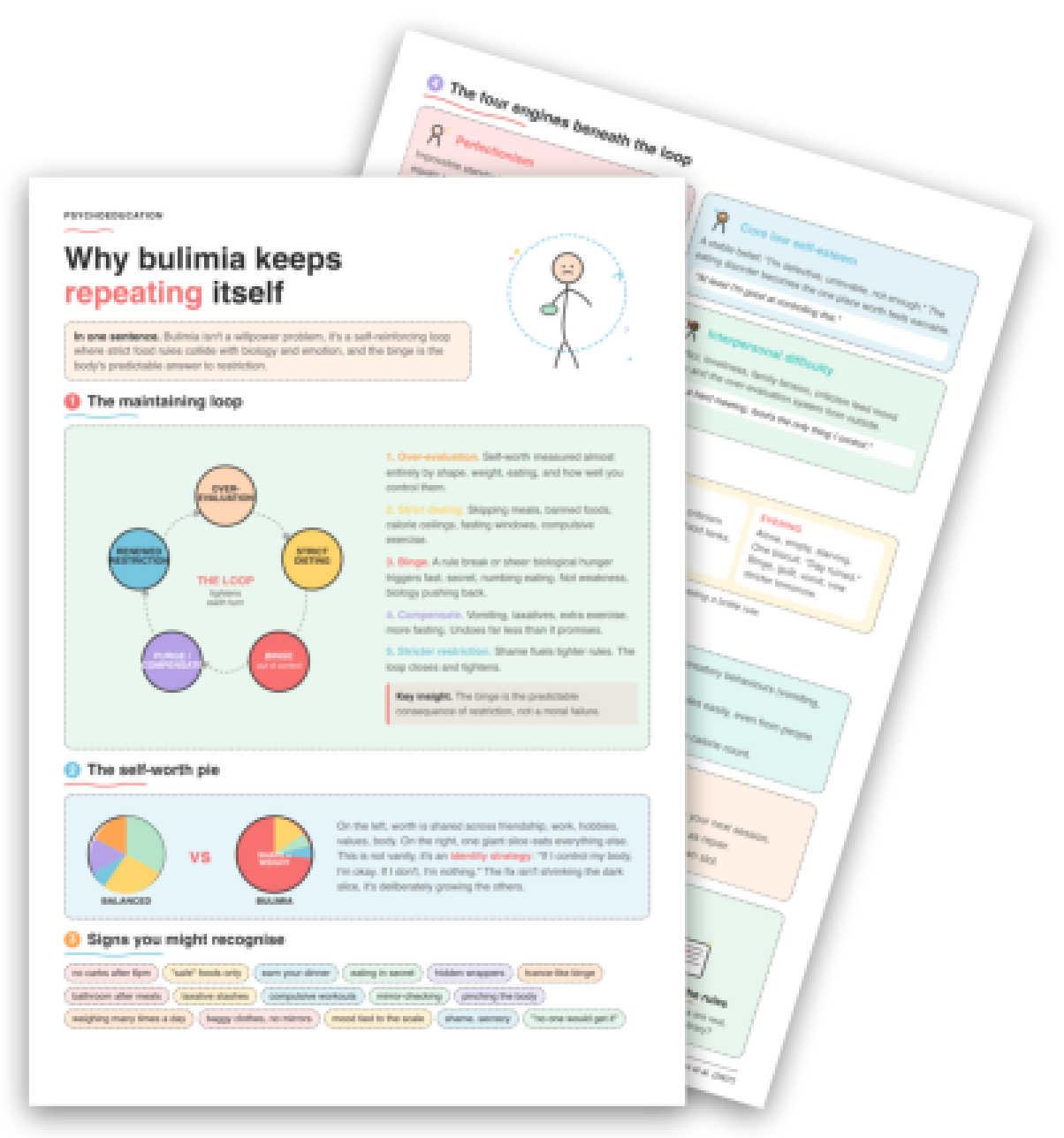
A visual PDF worksheet grounded in Fairburn's CBT model to help clinicians explain the binge-purge cycle, self-worth over-evaluation, and maintaining factors in session.
Clinical vignettes
Mapping the Loop With a Young Adult
Self-Worth Pie in a Mid-Career Patient
Clinical picture. Morgan, 38, sought treatment after a relapse following a period of occupational stress, reporting daily purging and several hours each evening spent weighing and mirror-checking. The clinician used the self-worth pie diagram from the informational sheet to explore the distribution of Morgan's self-evaluative criteria; Morgan identified that roughly 80 percent of perceived worth rested on weight and eating control, with professional identity and relationships filling only marginal space. This was not framed as vanity but as an identity regulation strategy that had been in place since adolescence. Morgan expressed relief at this reframe and began listing domains, such as mentoring junior colleagues and maintaining a close friendship, that could receive more deliberate investment. The exercise provided a clear rationale for the values-broadening work planned in later sessions without overstating expected gains.
Explaining why bulimia keeps repeating itself, to a patient who already knows intellectually that purging "doesn't work," is one of the most technically demanding psychoeducation moments in eating disorder work. The logic feels circular, the shame runs high, and a verbal walkthrough of Fairburn's CBT model rarely sticks on first hearing. This fiche PDF gives you a concrete visual scaffold to carry that explanation in session, together, rather than across a gap.
Use this resource with your patients
Handout, exercises and materials ready to use, right inside SessionFuel.
Why the Fairburn Loop Resists Verbal Explanation
The core clinical difficulty is not complexity; it is the self-reinforcing architecture of the disorder. Each component of the cycle (restriction, binge, compensatory behavior, renewed restriction) feels to the patient like a logical response to the previous one. When you describe this verbally, the patient follows each step and still cannot see the loop as a whole. They track the narrative; they miss the structure.
The second difficulty is over-evaluation of shape and weight, which Fairburn positions as the cognitive engine that drives everything else. Without a visual, this construct is easy for patients to hear as "you care too much about your body," which collapses into a shame experience rather than a formulation. Patients carrying core low self-esteem are particularly vulnerable to that misread, and the misread makes the model less useful rather than more.
A third obstacle is the four maintaining mechanisms (perfectionism, core low self-esteem, mood intolerance, interpersonal difficulty) that Fairburn and colleagues describe as fuelling the loop from beneath. These need to be named, differentiated, and connected to the central cycle in a way that feels personally accurate to the patient. That requires a shared visual reference point, not a monologue.
What the Fiche Contains: A Visual Tool for the Session
The fiche is structured across six panels, each doing specific clinical work.
Panel 1, "The maintaining loop," renders the five-step cycle (over-evaluation, strict dieting, binge, compensatory behaviour, renewed restriction) as a closed diagram with an annotation that "the loop tightens each turn." Showing this diagram while you talk shifts the patient from passive listener to someone pointing at a map of their own experience.
Panel 2, "The self-worth pie," contrasts a balanced worth distribution with the single-domain over-evaluation characteristic of bulimia. The caption, "this is not vanity, it's an identity strategy," is a reframe you can quote directly; it externalises the dynamic without minimising it.
Panel 3 lists sixteen specific signs organised by domain (food rules, secretive eating, body-checking, mood), useful for grounding the formulation in concrete, recognisable behaviours. You can pair this with the Bulimia Nervosa symptom checklist for a fuller behavioural picture.
Panel 4, "The four engines beneath the loop," names perfectionism (including the all-or-nothing thinking logic of "I ate one biscuit, the day's ruined"), core low self-esteem, mood intolerance, and interpersonal difficulty, each with a brief illustrative quote. This is where the fiche supports transdiagnostic work: the perfectionism strand links naturally to a perfectionism-focused session, the mood intolerance strand to emotion regulation psychoeducation.
Panel 5 walks through a single day inside the loop, from skipped breakfast through a tense meeting to an evening binge, closing with: "Notice: it was never about food. It was hunger plus a hard feeling meeting a brittle rule." This framing is valuable precisely because patients often arrive convinced their problem is about food.
Panel 6 draws the clinical distinction between bulimia and binge eating disorder, and flags the diagnostic camouflage that typical weight range provides. The closing "To discuss in session" prompts (rule-break thoughts, the meal skipped after a binge, interpersonal triggers) function as a structured debrief agenda.
> Key takeaway: this fiche is a visual support that facilitates explanation in session. It is not homework the patient completes alone; it is a shared reference the clinician and patient work through together, leaving a concrete map the patient can return to between appointments.
750+ clinical tools
A library built with and for clinicians, ready to use in session and extend between appointments.
Access all the toolsWhen and How to Introduce It
The fiche fits best after initial assessment but before beginning the behavioural regularisation work that sits at the core of Fairburn's protocol. At that point, a shared formulation model reduces the shame that otherwise makes early behavioural tasks feel like moral tests.
You can introduce it with a simple framing: "I'd like to show you a diagram that a lot of people find useful for understanding why the cycle is so hard to interrupt on willpower alone. Tell me what you recognise, and what doesn't fit." That instruction positions the patient as the authority on their own experience, which protects the therapeutic alliance and gives you diagnostic information in real time.
For patients with prominent shame responses after a binge, panel 5 is often the entry point: the concrete timeline externalises the episode without requiring the patient to narrate it themselves. For patients where maladaptive coping extends beyond eating (substance use, self-harm), the mood intolerance engine in panel 4 is worth pausing on explicitly.
A practical limit: the fiche does not include a longitudinal case formulation structure. If your intake points toward significant schema-level work (the self-image strand, early relational origins of the low self-esteem engine), the Fairburn map functions as a useful first layer, not the full picture. Use it to establish a shared language, then build the formulation outward from there.
Use it with your patients
Share this tool in the mobile app and follow the work between sessions.
Sources
- Fairburn, C. G. (2008). Cognitive Behavior Therapy and Eating Disorders. Guilford Press.
- Fairburn, C. G. (2013). Overcoming Binge Eating (2nd ed.). Guilford Press.
- Fairburn, C. G., Marcus, M. D., Wilson, G. T. (1993). Cognitive-behavioral therapy for binge eating and bulimia nervosa: a comprehensive treatment manual. In C. G. Fairburn & G. T. Wilson (Eds.), Binge Eating: Nature, Assessment and Treatment (pp. 361-404). Guilford Press.
- National Institute for Health and Care Excellence (NICE) (2017). Eating Disorders: Recognition and Treatment (NG69).
Your session continues in your patients' pocket
Use with a patientYour resources, available everywhere
The handouts, exercises, programs and audios above: you choose which ones to make available to your patients, in the mobile app dedicated to them.
And far more than a library
The app goes well beyond resources, to support your patients every day:
Related categories
Explore other clinical resources by category.

Identity
Clinical resources for self-identity work in therapy: CBT, ACT, schema tools for clinicians addressing self-concept, core beliefs, and identity disruption.

Behaviours
Clinical hub for behaviors in therapy: worksheets and tools for coping, eating disorders, CBT formulation, and maladaptive behavioral patterns.

Cognition
Printable cognitive therapy worksheets and clinical tools for therapists: CBT, ACT, schema work, defusion, distortions, and belief restructuring.

Understand
Clinical hub for the therapeutic aim 'Understand': worksheets and tools to build patient insight across CBT, ACT, schema therapy and more.

Build awareness
Clinical worksheets and tools to build awareness in therapy: cognitive distortions, schemas, emotions, ACT and CBT resources for practitioners.

CBT
CBT worksheets, cognitive restructuring exercises & behavioral tools for clinicians. Evidence-based resources for every phase of cognitive behavioral therapy.