
Clinical picture. A., a woman in her late thirties, presents with chronic low-grade anxiety and difficulty sleeping, reporting that her work performance is "never quite good enough" despite consistent positive appraisals from senior colleagues. The clinician introduces the cognitive-behavioral model of perfectionism using the informational sheet, walking through the self-worth loop and pointing out how each successful brief she produces simply raises the next threshold rather than providing relief. A. recognises herself immediately in the ratchet diagram, naming the 10-minute high followed by a new worry as something she had never before considered a symptom. As a first homework task, she agrees to write down one completed piece of work each day before allowing herself to reframe it as insufficient. At the next session she reports that the exercise felt "almost physically uncomfortable," which itself became useful clinical material for exploring the function her standards serve.
Cognitive Behavioral Model of Perfectionism: PDF Worksheet, Tools and Exercises
A visual PDF worksheet mapping the perfectionism loop, its maintenance cycles, and concrete CBT exercises to use in session with perfectionist patients.
Clinical vignettes
The Ratchet in a High-Achieving Lawyer
Procrastination Masked as High Standards
Clinical picture. T., a postgraduate student in his mid-twenties, is referred following a second incomplete academic year; he describes the problem as poor motivation, though assessment reveals a rigid all-or-nothing appraisal style and extensive avoidance of beginning written work. Using the informational sheet, the clinician maps T.'s pattern onto the third outcome branch of the loop, showing how procrastination and dropping projects feed back into the core belief that worth depends entirely on output. T. had not connected his avoidance to perfectionism, having assumed perfectionism meant finishing things obsessively rather than not starting them. The comparison between healthy striving and the trap, particularly the column contrasting flexible standards with rigid ones, opened a productive discussion about what "good enough" might look like for a draft chapter. Over the following fortnight T. submitted a partial draft, reporting significant anticipatory anxiety but also a reduction in the global sense of being "stuck."
Perfectionism is one of the harder presentations to psychoeducate around, not because the concept is complex, but because patients arrive with their standards framed as a competitive advantage. Getting them to see a self-maintenance loop rather than a personality asset takes more than a verbal explanation. This PDF worksheet gives you a visual architecture for that conversation, one you can work through together in session rather than hand over as reading material.
Use this resource with your patients
Handout, exercises and materials ready to use, right inside SessionFuel.
Why the Perfectionism Loop Is Hard to Explain at the Verbal Level
The core clinical challenge is that ego-syntonic framing. Most patients with clinical perfectionism do not present saying "my standards are hurting me." They say their standards are why they succeed, even as they describe exhaustion, procrastination, chronic dissatisfaction after wins, and a nagging sense of being a fraud. Exploring signs of perfectionism alongside them can surface the gap between that belief and the lived experience.
What patients miss, when the model is explained only in words, is the self-perpetuating logic of all three exits from the loop. They understand that falling short feels bad. They rarely grasp that meeting the standard also feeds the trap, because the bar immediately ratchets up and relief never lands. And they underestimate how avoidance behaviors, including dropping projects and procrastinating, circle back into the same self-worth equation. Showing that structure on paper changes the conversation.
What the Worksheet Contains: A Visual Map of the Trap
The fiche PDF is organised across four thematic panels, each doing work that a spoken explanation cannot do as efficiently.
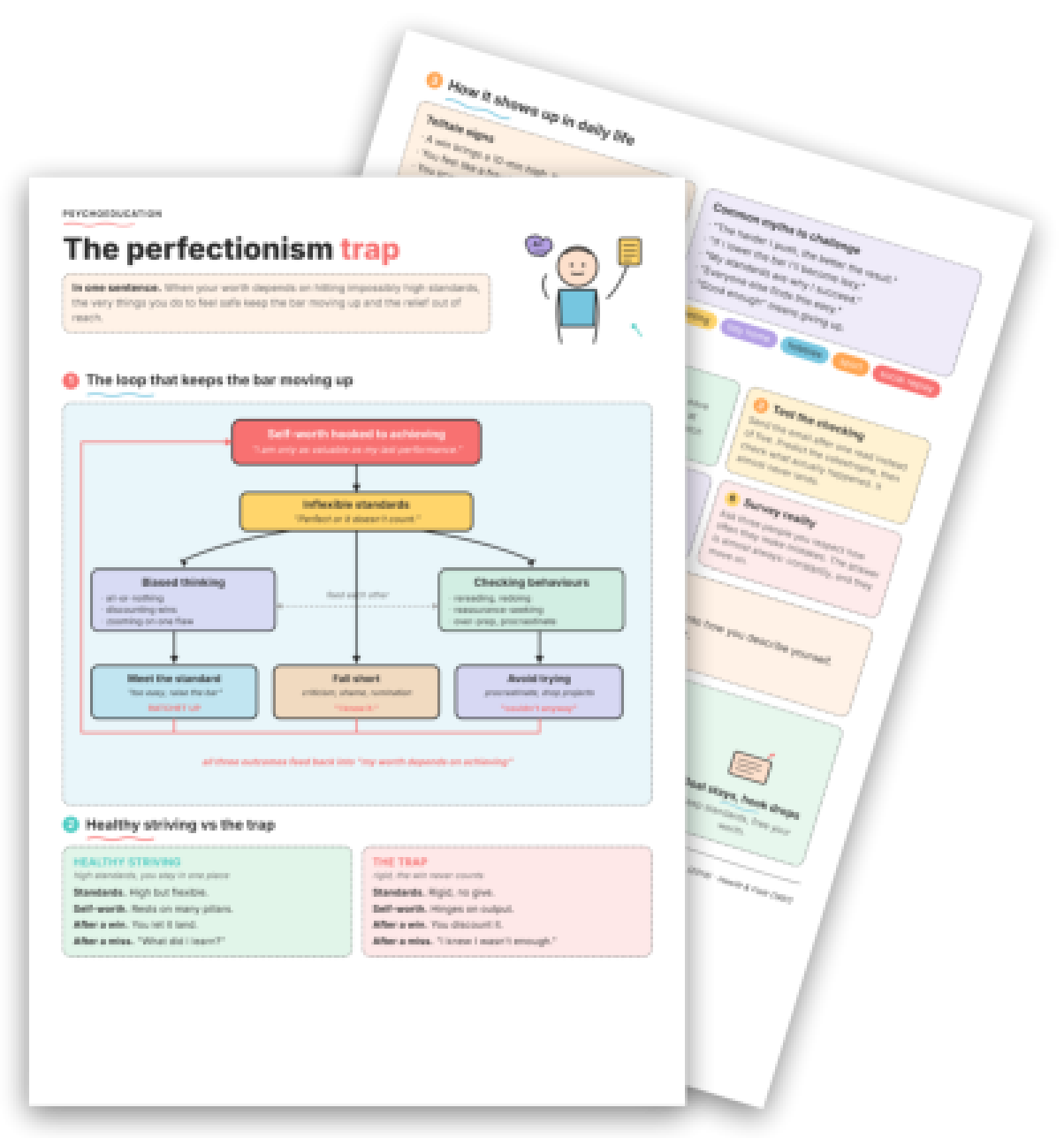
Panel 1 draws the full maintenance cycle: self-worth hooked to achieving, inflexible standards, three clusters of biased thinking (all-or-nothing, discounting wins, zooming on one flaw), and checking behaviours including reassurance-seeking and over-preparation. Crucially, the diagram shows all three outcomes converging back into the same starting point: "My worth depends on achieving." Meeting the standard triggers a ratchet upward. Falling short brings criticism and rumination. Avoiding confirms the patient's worst appraisal of themselves. Seeing this in a single diagram is harder to dismiss than hearing it described.
Panel 2 places healthy striving and the trap side by side, across four dimensions: standards, self-worth, the response to a win, and the response to a miss. The contrast between "What did I learn?" and "I knew I wasn't enough" is often a productive entry point to discuss all-or-nothing thinking and the interpretive biases that keep the loop running.
Panel 3 lists telltale signs ("a win brings a 10-min high, then a new worry"), common myths to challenge ("if I lower the bar I'll become lazy"), and the domains where perfectionism typically lives, from work output to social replay. Patients who have low self-esteem concentrated in one domain often recognise themselves more readily when the domain list is in front of them.
Panel 4 offers six concrete strategies: catching the ratchet, dropping a standard deliberately, testing checking behaviour empirically, broadening the self-worth base to five non-achievement pillars, reframing inner speech (for instance, "I have to" to "I'd like to"), and a brief reality survey. A "To discuss in session" block at the bottom prompts the patient to notice all-or-nothing language and the 10-minute win cycle before their next appointment.
> Key takeaway: The worksheet is a visual support that facilitates the explanation in session; it is not a questionnaire the patient completes alone, but a shared reference that externalises the loop and makes abstract maintenance processes visible to both of you simultaneously.
750+ clinical tools
A library built with and for clinicians, ready to use in session and extend between appointments.
Access all the toolsWhen and How to Introduce It
The worksheet fits naturally at the psychoeducation phase, once the formulation has made perfectionism a named target and the patient has shown some curiosity about the mechanism rather than pure resistance. That typically means session two or three, after the initial anamnesis and after the patient has articulated at least one moment when a win left them cold.
A low-threshold introduction: "I'd like to show you a diagram that maps how this kind of striving can end up feeding itself, whatever the outcome. Let's look at it together and you can tell me where you recognise yourself." That framing avoids labelling and positions the tool as collaborative. Work through Panel 1 first, then let the patient locate their own exit route. Many land on avoidance more than they expect.
For patients who present with impostor syndrome or who systematically discount their successes, Panel 2 is the most clinically productive panel to linger on. For those whose reassurance-seeking is prominent, the reassurance-seeking exercise pairs well as between-session homework after the worksheet is debriefed. To consolidate the broadened-base work in Panel 4, the accepting mistakes exercise and the growth mindset worksheet are natural follow-ons.
One limit to flag: patients with very high intellectual defences may engage analytically with the diagram without genuine experiential contact. In those cases, slow the debrief and anchor each panel in a specific recent episode before moving to the next section. The worksheet facilitates the explanation; the clinical work of connecting it to the patient's own history remains yours.
Use it with your patients
Share this tool in the mobile app and follow the work between sessions.
Sources
- Egan, S. J., Wade, T. D., Shafran, R., & Antony, M. M. (2014). Cognitive-Behavioral Treatment of Perfectionism. Guilford Press.
- Shafran, R., Egan, S. J., & Wade, T. D. (2018). Overcoming Perfectionism: A self-help guide using scientifically supported cognitive behavioural techniques (2nd ed.). Little, Brown Book Group.
- Frost, R. O., Marten, P., Lahart, C., & Rosenblate, R. (1990). The dimensions of perfectionism. Cognitive Therapy and Research.
Your session continues in your patients' pocket
Use with a patientYour resources, available everywhere
The handouts, exercises, programs and audios above: you choose which ones to make available to your patients, in the mobile app dedicated to them.
And far more than a library
The app goes well beyond resources, to support your patients every day:
Related categories
Explore other clinical resources by category.

Anxiety
Clinical hub for anxiety disorders: CBT and ACT worksheets, psychoeducation sheets, and exercises for assessment and treatment across the anxiety spectrum.

Identity
Clinical resources for self-identity work in therapy: CBT, ACT, schema tools for clinicians addressing self-concept, core beliefs, and identity disruption.

Behaviours
Clinical hub for behaviors in therapy: worksheets and tools for coping, eating disorders, CBT formulation, and maladaptive behavioral patterns.

Cognition
Printable cognitive therapy worksheets and clinical tools for therapists: CBT, ACT, schema work, defusion, distortions, and belief restructuring.

Understand
Clinical hub for the therapeutic aim 'Understand': worksheets and tools to build patient insight across CBT, ACT, schema therapy and more.

Build awareness
Clinical worksheets and tools to build awareness in therapy: cognitive distortions, schemas, emotions, ACT and CBT resources for practitioners.