
Clinical picture. M., a woman in her late thirties, presents with persistent health anxiety following a benign cardiac investigation eighteen months prior. She describes daily reassurance-seeking: checking her pulse, googling symptoms, and repeatedly asking her partner whether she looks pale. In the third session, the clinician introduced the five-part maintaining-processes worksheet and invited M. to map a specific episode from the previous week, a moment when she felt her heart flutter while climbing stairs. Working through the loop together, M. identified that her attentional spotlight had narrowed entirely onto her chest, filtering out the fact that she had climbed four flights without difficulty. Naming the safety behaviours explicitly, particularly the pulse-checking, as the mechanism keeping fear alive rather than resolving it, shifted M.'s stance enough that she agreed to a brief behavioural experiment the following week.
CBT Maintaining Processes: PDF Worksheet, Tools and Exercises
A visual PDF worksheet clinicians can use in session to map the five-part maintenance loop, distinguish safety behaviours from avoidance, and anchor psychoeducation in a concrete shared diagram.
Clinical vignettes
Loop Mapping in Health Anxiety
Avoidance Cycle in Social Anxiety
Clinical picture. T., a man in his mid-twenties referred for social anxiety, had progressively withdrawn from team meetings at work over six months, attending only when attendance was mandatory. The clinician used the informational sheet to map a concrete episode: an invitation to speak briefly at a morning briefing. T. quickly populated the thought box with an image of his face going red and colleagues exchanging glances, rated his fear at 80 out of 100, and located it as a heat spreading up his neck. When the behaviour box was completed, T. listed three actions he had taken: preparing a written script, arriving late to avoid small talk, and leaving immediately after speaking. He paused when the clinician reflected that each of those moves had prevented him from finding out whether the feared outcome would have occurred. The formulation did not resolve his anxiety in that session, but it gave both clinician and patient a shared, concrete map to target in subsequent exposure work.
Patients arrive with a detailed theory of origin and almost no theory of maintenance. They know why anxiety started; they cannot see what feeds it today. Explaining the self-reinforcing CBT maintenance cycle verbally rarely lands, because without a visual the loop stays abstract and patients keep locating themselves in the story of how things began, not in the mechanism keeping them stuck. This fiche PDF gives you a shared diagram to anchor that explanation directly in session.
Use this resource with your patients
Handout, exercises and materials ready to use, right inside SessionFuel.
Why the maintenance cycle is hard to convey without a visual
The distinction between precipitating and perpetuating factors, central to any solid longitudinal case formulation, is routine for practitioners. Patients, however, almost universally conflate the two, attributing ongoing distress to the original trigger rather than to what their behavioural and cognitive loop is doing right now. This is not a reasoning failure: it reflects the phenomenology of distress, where overwhelm makes the earliest event feel causally present.
The attentional arm of the cycle is especially self-concealing. Patients rarely notice their spotlight has narrowed until you show them a model where attention has its own labelled box. Safety behaviours present the same problem: Salkovskis's foundational work demonstrated that these behaviours function as maintenance factors, yet patients experience them as rational precautions. Trying to draw this distinction on a whiteboard mid-session, against a patient's lived conviction that checking helps, costs time and rarely produces the reframe that shifts therapeutic engagement.
The ABC Model and the broader CBT cognitive model give clinicians related frameworks, but neither isolates the attentional arm or names the paradox of safety behaviours as explicitly as this fiche does.
What the fiche contains, and what the visual shows that words cannot
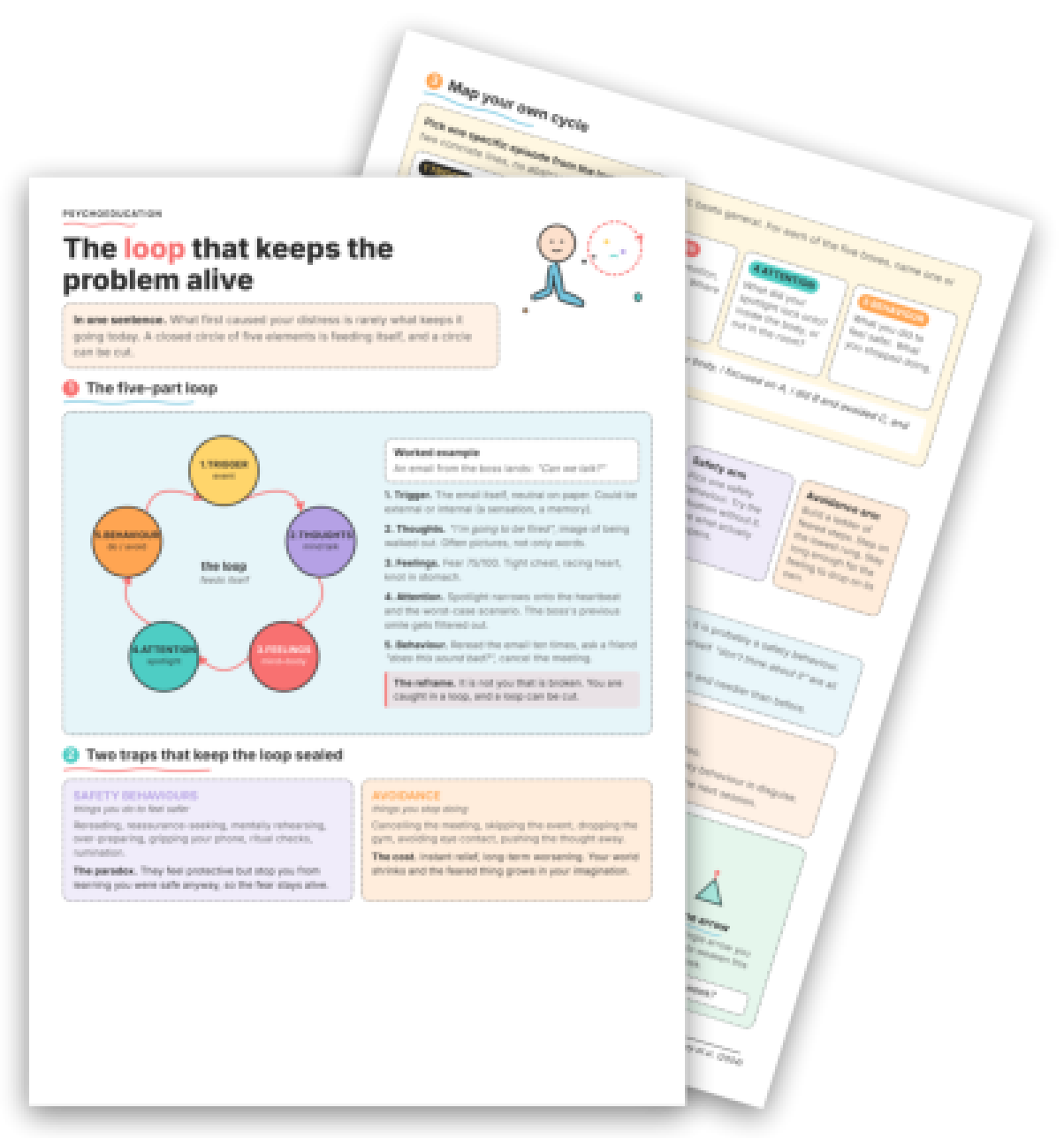
The fiche is built around a five-part loop diagram: Trigger, Thoughts, Feelings, Attention, Behaviour. Each node carries a functional label ("mind talk", "spotlight", "do / avoid") that gives the patient an immediately usable vocabulary. A fully worked example runs the loop through a single concrete episode (an email from a manager reading "Can we talk?"), tracking the cognitive appraisal ("I'm going to be fired"), the somatic fear rated at 75/100, the attentional narrowing onto heartbeat and worst-case scenario, and the resulting behaviours: rereading the email, seeking reassurance, cancelling the meeting.
Two dedicated panels separate safety behaviours and avoidance with their respective paradoxes. The fiche names it plainly: safety behaviours "stop you from learning you were safe anyway", while avoidance produces "instant relief, long-term worsening." This visual separation is precisely what a verbal explanation rarely achieves when patients present with mixed adaptive and maladaptive coping patterns.
A third panel prompts the patient to map their own cycle from a specific episode in the past seven days ("The exact words. The mental images. The prediction."). A fourth panel, "Where to cut the loop," lays out five intervention arms with one-sentence methods each: Thoughts, Attention, Body, Safety, Avoidance. The closing "Common misses" section flags three recurrent errors, safety hiding as common sense, mental avoidance counting as avoidance, and reassurance as a maintenance mechanism rather than connection, giving you ready-made language to pre-empt resistance.
> Key point: The fiche is a visual support that facilitates the explanation of maintaining processes in session. The patient does not complete it alone; the clinician uses it to make the loop visible, name each element precisely, and leave the patient with a concrete reference between appointments.
750+ clinical tools
A library built with and for clinicians, ready to use in session and extend between appointments.
Access all the toolsWhen and how to introduce it in your practice
The fiche fits the psychoeducation and formulation phase, once the anamnèse is complete and you are ready to share a maintenance hypothesis. It applies across presentations: social anxiety (Clark & Wells, 1995), OCD, health anxiety, GAD, and panic, wherever automatic thoughts and avoidance sustain the clinical picture. It is especially useful before you begin building an exposure hierarchy, because the avoidance arm of the loop establishes the rationale for graded work.
A straightforward introduction: "I'd like to show you a diagram of what tends to keep this kind of distress going, whatever started it. Tell me if it matches what you experience." This framing separates the maintenance model from the causal narrative, which usually comes as a relief.
Debrief using the fiche's own closing question: "Which single arrow would you most like to weaken first this week?" That question maps directly onto the next step, a cognitive restructuring exercise, a graded exposure list, or an anxiety self-reflection exercise, depending on which arm the patient selects. Patients who want to start with catching their thoughts naturally gravitate toward the Thoughts arm; those describing compulsive checking or avoidance point you toward the Safety or Avoidance arms.
One contraindication: patients with acute dissociation or florid psychotic symptoms may find the personal mapping panel destabilising. In those presentations, sections 1 and 2 work as illustration only; defer self-mapping until the clinical picture is more stable.
The fiche does not replace the formulation conversation. It makes that conversation faster, more precise, and leaves the patient with a map they can actually use.
Use it with your patients
Share this tool in the mobile app and follow the work between sessions.
Sources
- Greenberger, D., & Padesky, C. A. (2016). Mind Over Mood: Change How You Feel by Changing the Way You Think (2nd ed.). Guilford Press.
- Kennerley, H., Kirk, J., & Westbrook, D. (2017). An Introduction to Cognitive Behaviour Therapy: Skills and Applications (3rd ed.). Sage.
- Kuyken, W., Padesky, C. A., & Dudley, R. (2009). Collaborative Case Conceptualisation: Working Effectively with Clients in Cognitive-Behavioral Therapy. Guilford Press.
- Salkovskis, P. M. (1991). The Importance of Behaviour in the Maintenance of Anxiety and Panic: A Cognitive Account. Behavioural and Cognitive Psychotherapy, 19(1), 6-19.
- Moorey, S. (2010). The Six Cycles Maintenance Model: Growing a Vicious Flower for Depression. Behavioural and Cognitive Psychotherapy, 38(2), 173-184.
Your session continues in your patients' pocket
Use with a patientYour resources, available everywhere
The handouts, exercises, programs and audios above: you choose which ones to make available to your patients, in the mobile app dedicated to them.
And far more than a library
The app goes well beyond resources, to support your patients every day:
Related categories
Explore other clinical resources by category.

Anxiety
Clinical hub for anxiety disorders: CBT and ACT worksheets, psychoeducation sheets, and exercises for assessment and treatment across the anxiety spectrum.

Mood
Evidence-based worksheets and clinical tools for mood disorders: CBT, ACT, and positive psychology resources for psychologists and therapists.

Identity
Clinical resources for self-identity work in therapy: CBT, ACT, schema tools for clinicians addressing self-concept, core beliefs, and identity disruption.

Cognition
Printable cognitive therapy worksheets and clinical tools for therapists: CBT, ACT, schema work, defusion, distortions, and belief restructuring.

Understand
Clinical hub for the therapeutic aim 'Understand': worksheets and tools to build patient insight across CBT, ACT, schema therapy and more.

Build awareness
Clinical worksheets and tools to build awareness in therapy: cognitive distortions, schemas, emotions, ACT and CBT resources for practitioners.