
Clinical picture. M., a woman in her late thirties, presented with chronic relational fatigue and a recurring sense that close friends eventually stopped considering her needs. In a mid-therapy session, the clinician introduced the interpersonal beliefs and styles informational sheet and walked through the four-move loop with her. M. recognised herself immediately in the over-pleasing variant: she described always deferring to others' preferences and then feeling invisible, which she had read as confirming that her needs were inherently too much. The clinician used the sheet to distinguish her safety behaviour (habitual agreement) from the belief driving it, and M. began to notice that her silence was actively shaping the responses she then experienced as rejection. By the following session she had identified one recent interaction where she had filled in the other person's blank with her familiar caption rather than checking what had actually happened.
Interpersonal Beliefs and Styles: PDF Worksheet, Tools and Exercises
A visual PDF worksheet to explain the self-confirming interpersonal loop in session, with tools and exercises for schema-informed clinical work.
Clinical vignettes
Over-Pleasing Loop Recognised in Session
Pre-Emptive Hostility Mapped Collaboratively
Clinical picture. T., a man in his mid-forties referred after a workplace conflict, initially described colleagues as uniformly untrustworthy and his own conduct as merely self-protective. The clinician offered the informational sheet as a shared reference point rather than a reframe, framing it as a way to look at the mechanics rather than assign blame. Together they traced how T.'s early sharp tone in team meetings prompted colleagues to become guarded, which he then read as confirmation that openness would be punished. T. was sceptical but acknowledged the sheet's observation that the loop is not purely internal: his behaviour genuinely elicited the reactions he feared. This distinction, that the belief is understandable and the loop is real rather than imagined, reduced his defensiveness enough to warrant further functional analysis of specific interactions.
Most patients who present with chronic relational difficulties have already noticed the pattern: the same argument, the same exit, a different person. What they rarely see is their own role in keeping it running. Explaining interpersonal beliefs and styles verbally, without a visual anchor, rarely lands with enough precision to move the work forward. This fiche PDF gives you a concrete support to make the mechanism visible, right there in session.
Use this resource with your patients
Handout, exercises and materials ready to use, right inside SessionFuel.
Why Interpersonal Beliefs Resist Verbal Explanation
The core difficulty is not conceptual. It is perceptual. When a patient hears "your belief shapes how others respond to you," they often hear blame, or they agree abstractly without connecting the idea to any specific scene. The self-confirming loop described in Safran and Segal's interpersonal-cognitive framework (and echoed in Young, Klosko and Weishaar's schema coping model) operates below deliberate awareness. Safety behaviours feel like common sense, not strategy. Selective attention feels like accurate observation, not bias.
This is precisely why beliefs that organise relational life are so hard to shift through conversation alone: the patient is, in a meaningful sense, right. Their behaviour does pull a reaction. The loop is real. Without a visual that separates the four moves, the mechanism collapses into a single undifferentiated feeling of being stuck, and early maladaptive schemas continue to run the relational show unchallenged.
750+ clinical tools
A library built with and for clinicians, ready to use in session and extend between appointments.
Access all the toolsWhat the Fiche Contains: A Visual Map of the Loop
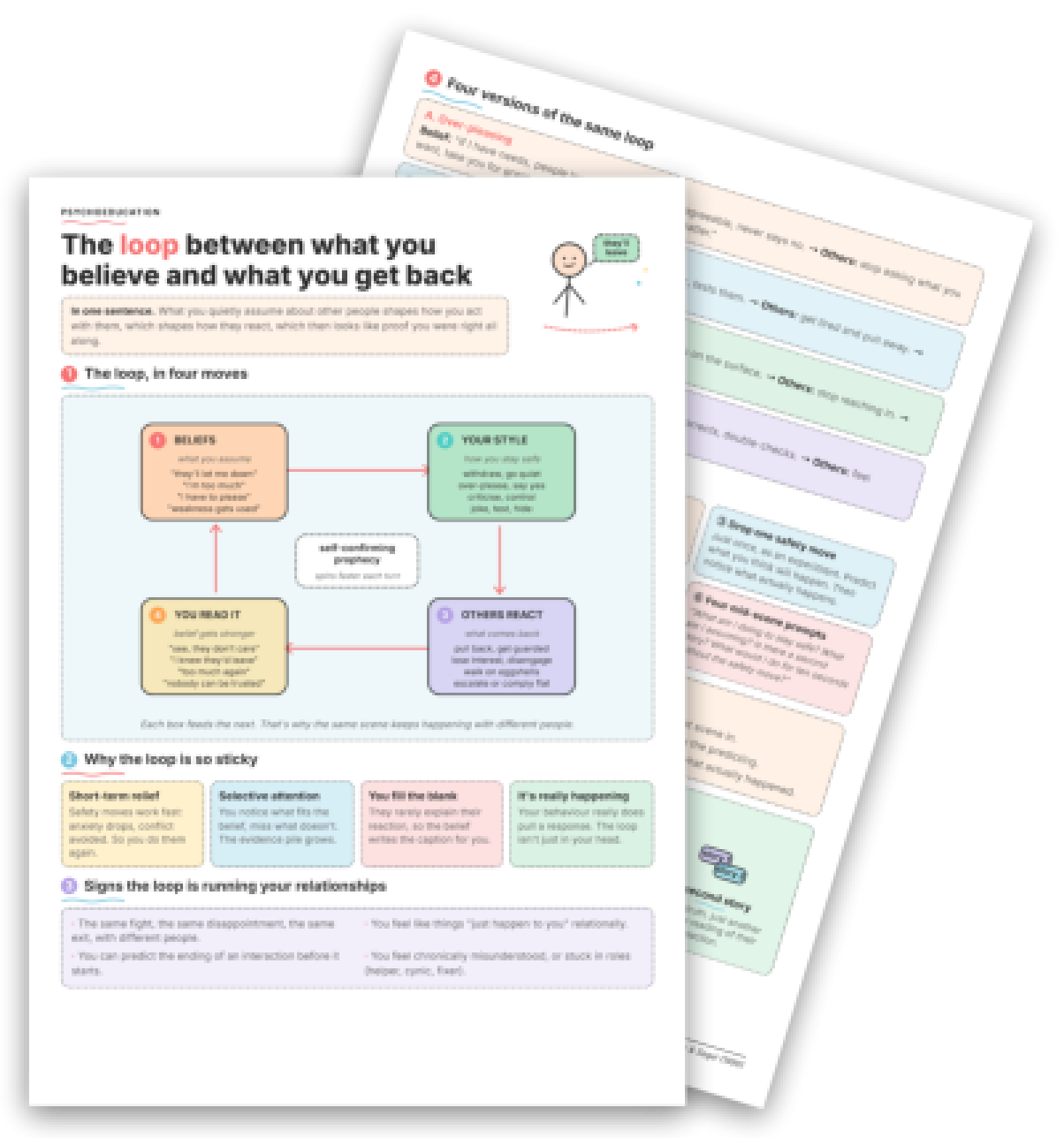
The fiche PDF is structured around five numbered panels, each building on the last.
Panel 1 names the loop in one sentence before mapping it across four labelled boxes: BELIEFS (the core interpersonal assumption), YOUR STYLE (the safety behaviour deployed), OTHERS REACT (the interpersonal consequence), and YOU READ IT (the confirmatory reading that closes the loop). The visual layout, with each box feeding directly into the next, shows in a glance what a verbal explanation can take twenty minutes to convey. Verbatim examples run inside each box: "I'm too much" → over-please, say yes → lose interest, disengage → "I knew they'd leave."
Panel 2 explains why the loop is sticky across four mechanisms: short-term relief, selective attention, filling the blank when others don't explain their reaction, and the crucial point that "your behaviour really does pull a response." This panel is particularly useful for dismantling the patient's resistance: the loop is not a cognitive error, it is a real dynamic with a real interpersonal cost.
Panel 3 lists four recognisable signs the loop is running (the same fight with different people, predicting the ending of an interaction before it starts, feeling chronically stuck in a role). These function as a quick self-recognition prompt you can use collaboratively in session.
Panel 4 maps four specific loop variants: over-pleasing, pre-emptive hostility, withdrawal, and controlling, each with its own belief-style-reaction-reading sequence. This is where patients often locate themselves for the first time, making the abstract suddenly specific. These variants map directly onto the four attachment styles in relationships and connect naturally to work on core beliefs about self, others, and the world.
Panels 5 and 6 offer six concrete steps for disrupting the loop, including "drop one safety move" as a behavioural experiment, and four mid-scene prompts patients can carry between sessions: "What am I assuming? Is there a second story?" A closing reminder block reinforces the three key moves: map one scene, drop one behaviour, generate a second reading.
> Key point: the fiche is a visual support that facilitates the explanation of interpersonal beliefs in session. It is not a self-report questionnaire to complete alone. The clinician uses it to anchor the psychoeducation, build shared vocabulary, and leave the patient with a concrete reference between appointments.
Use it with your patients
Share this tool in the mobile app and follow the work between sessions.
When and How to Introduce the Fiche
This fiche fits naturally from the second or third session, once the presenting relational difficulty has been named and a preliminary case formulation is in place. It is particularly indicated for patients presenting with abandonment fears, approval-seeking patterns, or social anxiety, as well as for anyone who describes relational life as "just happening to them."
A low-threshold introduction: "I'd like to show you something that might help us look at what's going on in those scenes you've described." Avoid framing it as a revelation about the patient's character; position it as a shared map of a mechanism, not a verdict. Use Panel 4 to ask which variant resonates most, then work backward to the belief in Panel 1.
For debrief: ask what the patient noticed when they tried dropping one safety behaviour, and whether any second story became available. Connect this to work on past experiences that shaped current relational patterns, and consider pairing it with a structured exercise on interpersonal conflict resolution for patients ready to experiment in an active conflict. The fiche does not replace the therapeutic frame; it makes the explanation clearer and leaves the patient with something to return to between sessions.
Your session continues in your patients' pocket
Use with a patientYour resources, available everywhere
The handouts, exercises, programs and audios above: you choose which ones to make available to your patients, in the mobile app dedicated to them.
And far more than a library
The app goes well beyond resources, to support your patients every day:
Related categories
Explore other clinical resources by category.

Identity
Clinical resources for self-identity work in therapy: CBT, ACT, schema tools for clinicians addressing self-concept, core beliefs, and identity disruption.

Relationships
Clinical worksheets and tools on relational functioning: attachment, schemas, assertiveness, and communication skills for therapists. Printable PDF resources.

Cognition
Printable cognitive therapy worksheets and clinical tools for therapists: CBT, ACT, schema work, defusion, distortions, and belief restructuring.

Build awareness
Clinical worksheets and tools to build awareness in therapy: cognitive distortions, schemas, emotions, ACT and CBT resources for practitioners.

Restructure
Clinical hub for cognitive restructuring worksheets: distortion identification, belief disputation, ABC model, and schema work for evidence-based practice.
CBT
CBT worksheets, cognitive restructuring exercises & behavioral tools for clinicians. Evidence-based resources for every phase of cognitive behavioral therapy.