
Clinical picture. M., a 34-year-old project manager, presented with work-related burnout and persistent low mood after several months of deteriorating performance reviews. She described a longstanding pattern of staying late to rework reports until she judged them flawless, at the cost of sleep and personal relationships. The clinician introduced the five-question self-reflection exercise as a between-session task, asking M. to write about a recent episode in which perfectionism had driven her behaviour. At the following session, M. returned with detailed answers: she had identified that her inner critical voice closely echoed her mother's approval-seeking scripts from childhood, and she noted that rewriting a single slide deck had taken four hours and left her exhausted. Working from her written responses, clinician and patient collaboratively developed a more nuanced self-statement acknowledging effort over flawlessness, which M. agreed to test during the coming week.
Perfectionism Self-Reflection: A Guided Clinical Exercise
A structured five-question homework exercise helping patients examine perfectionist patterns, trace their origins, and build genuine self-compassion.
Clinical vignettes
Perfectionism Exercise in Burnout Recovery
Tracing Perfectionist Standards in Chronic Anxiety
Clinical picture. T., a 28-year-old graduate student, sought treatment for generalised anxiety and recurrent procrastination, which he attributed to an inability to start tasks he feared he could not complete perfectly. In session four, the clinician assigned the structured exercise, encouraging T. to answer each question in writing before their next appointment. T.'s responses revealed that his standards had escalated since adolescence to secure approval from a demanding father, and that shame and self-contempt arose whenever work fell short of an imagined ideal. The written exercise gave the clinician concrete material for a Socratic dialogue around question five, helping T. articulate a more realistic benchmark and a tentative plan to submit one assignment without a final re-read. Progress was modest but observable: T. reported a slight reduction in pre-submission anxiety at the two-week follow-up.
Why perfectionism resists a purely verbal approach
Perfectionism sits at the intersection of cognition, affect, and personal history in a way that makes it genuinely difficult to dislodge through conversation alone. Most patients who present with perfectionist traits have long rehearsed a narrative that frames exacting standards as virtues. Naming the pattern out loud rarely disrupts it; the patient nods, agrees in the abstract, and returns the following week having applied the same standard with the same intensity.
The clinical challenge is threefold. First, the emotional and relational costs of perfectionism are often partially invisible to the person living inside it. Second, the self-critical inner voice is experienced as realistic appraisal rather than distortion. Third, the roots of the pattern, approval-seeking, early learning histories, key attachment figures, are rarely explored without a structured prompt to do so. Tools such as the Cognitive Behavioral Model of Perfectionism or the The Perfectionism Ratchet Effect can anchor psychoeducation, but they leave the patient as observer of a diagram. This exercise inverts that: the patient becomes the investigator of their own material.
Use this resource with your patients
Handout, exercises and materials ready to use, right inside SessionFuel.
What the exercise contains
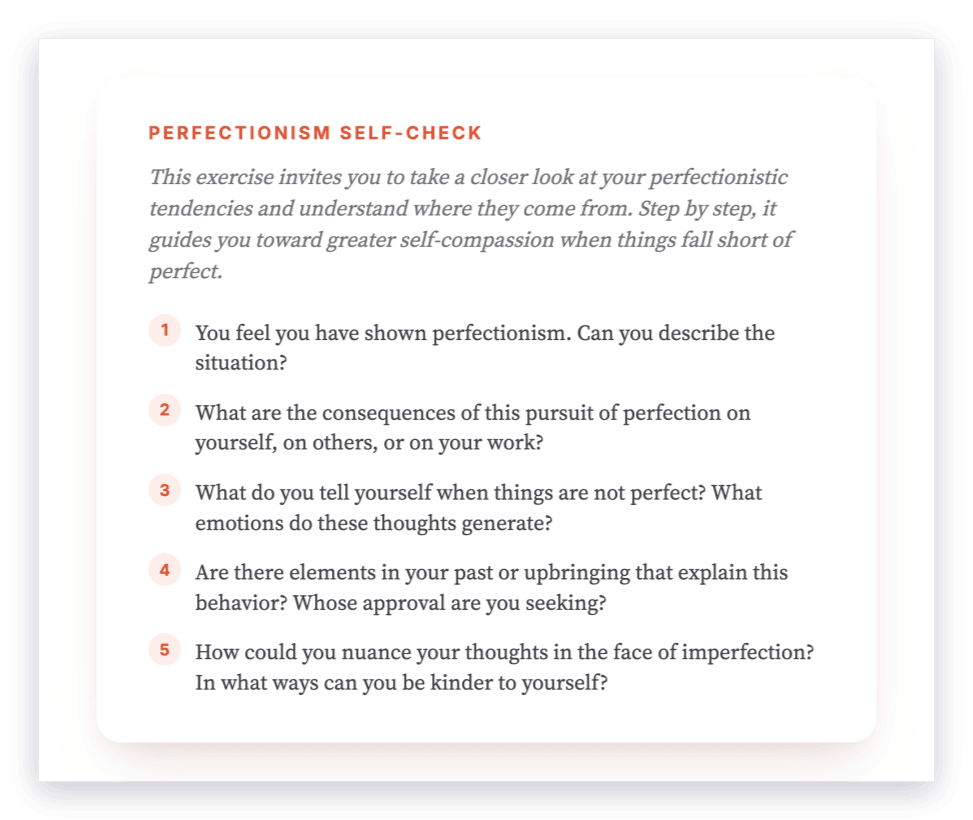
The exercise is built around five sequential questions that move from the concrete to the historical. The patient begins by describing a specific recent situation in which they recognise perfectionist behaviour. From there, they examine the actual consequences of that pursuit of perfection on themselves, on others, and on the work itself, a displacement of attention that often surfaces costs the patient had been minimising. The third question asks what they tell themselves when things are not perfect, and what emotions those thoughts generate, which opens the door to cognitive work connected to tools like Challenging Negative Thoughts, "Should" Statements, or All-or-Nothing Thinking. The fourth question turns to personal history and education, asking whether formative experiences or relationships explain the behaviour, and naming the question of whose approval the patient is actually seeking, a direct pathway into Approval & Admiration Seeking Schema work. The fifth question invites the patient to nuance their thinking about imperfection and identify how they might show themselves more compassion.
The image above lists the five questions in the order the patient encounters them. It is a static preview only: the full guided exercise, with patient-facing instructions, reflective prompts, and dedicated space for written answers, is experienced by the patient autonomously in the app, not in this image.
This exercise is available to patients through the SessionFuel patient app, the dedicated mobile interface for patients whose clinician uses SessionFuel: once you assign it, your patient completes it directly on their phone, on their own, between two sessions.
Key takeaway: The sequence from situation to history to self-compassion mirrors the clinical arc of perfectionism work itself, giving you a between-session map the patient has filled in with their own words.
750+ clinical tools
A library built with and for clinicians, ready to use in session and extend between appointments.
Access all the toolsUse it with your patients
Share this tool in the mobile app and follow the work between sessions.
Integrating the exercise as between-session homework
This exercise fits naturally into work with patients presenting rigid demanding standards, chronic overwork, procrastination driven by fear of imperfect output, or marked self-criticism after errors. It complements in-session tools such as Evaluating Demanding Standards, Demanding Standards, and Clinical Perfectionism, which you may have already used to build shared vocabulary.
A useful introduction is simply: "Between now and our next meeting, I'd like you to catch one moment where you notice your perfectionism at work, and use these questions to examine it on your own." Framing it as observation before change reduces the risk that the patient approaches the exercise perfectly, which is itself clinically informative when it happens.
When the patient returns, the written answers become the session's opening material. The third question in particular tends to generate automatic thoughts ready for restructuring, connecting directly to exercises like Accepting Mistakes, Feeling Not Good Enough, or Rigid Rules and Demandingness. The fourth question frequently surfaces historical material worth exploring further with tools such as Tracing the Origin of Core Beliefs. And the fifth question, where the patient attempts self-compassion in their own words, offers a baseline you can revisit throughout treatment alongside Practicing Self-Compassion.
The exercise is particularly well-suited to patients who are already engaged in the work and need a structured autonomous reflection task rather than another piece of reading. It produces usable clinical content without requiring the session itself to generate it.
Your session continues in your patients' pocket
Use with a patientYour resources, available everywhere
The handouts, exercises, programs and audios above: you choose which ones to make available to your patients, in the mobile app dedicated to them.
And far more than a library
The app goes well beyond resources, to support your patients every day:
Related categories
Explore other clinical resources by category.

Identity
Clinical resources for self-identity work in therapy: CBT, ACT, schema tools for clinicians addressing self-concept, core beliefs, and identity disruption.

Behaviours
Clinical hub for behaviors in therapy: worksheets and tools for coping, eating disorders, CBT formulation, and maladaptive behavioral patterns.

Cognition
Printable cognitive therapy worksheets and clinical tools for therapists: CBT, ACT, schema work, defusion, distortions, and belief restructuring.

Build awareness
Clinical worksheets and tools to build awareness in therapy: cognitive distortions, schemas, emotions, ACT and CBT resources for practitioners.

Restructure
Clinical hub for cognitive restructuring worksheets: distortion identification, belief disputation, ABC model, and schema work for evidence-based practice.

Repair & soothe
Clinical resources for the repair and soothe therapeutic aim: worksheets, exercises and tools to build self-compassion, reduce shame and restore emotional safety.