
Clinical picture. T., a woman in her mid-thirties, presents with chronic low mood and a pattern of ending relationships before they deepen. She describes herself as "boring" and maintains deliberately superficial conversations, fearing that sustained closeness will expose what she calls "the real, defective me." In session, the clinician introduces the defectiveness/shame schema framework and shares the informational sheet, drawing her attention to the avoidance coping column. T. recognises the pattern immediately, noting that scrolling and overworking serve the same function as keeping conversation light. Over the following two sessions she begins to name the schema when the urge to deflect arises, which does not resolve the belief but reduces its automaticity enough for her to stay present in one difficult exchange with a friend.
Defectiveness / Shame Schema: PDF Worksheet, Tools and Exercises
A visual PDF worksheet, clinical tools, and concrete exercises to explain the defectiveness/shame schema in session and support schema therapy work.
Clinical vignettes
Avoidance Masking a Shame Schema
Counter-Attack Coping in a High-Achiever
Clinical picture. M., a man in his late forties referred for burnout, arrives dismissive of the referral and quick to note his professional standing. He reports a relentless inner voice that registers each success as "not enough" and each peer's achievement as a direct indictment of his worth. The clinician offers the defectiveness/shame schema sheet as a shared language rather than a diagnosis, focusing on the counter-attack column: perfectionism and subtle contempt for colleagues as ways of pre-empting the exposure of a core sense of inadequacy. M. is initially resistant, then quietly identifies the childhood origin section as uncomfortably accurate, recalling a parent whose approval was always conditional on performance. He leaves the session with the sheet, and the following week reports noticing the "be flawless or vanish" voice twice at work, a first step toward distinguishing the schema's activity from factual self-assessment.
The defectiveness/shame schema is one of the hardest early maladaptive schemas to name directly in session: the moment you start describing it, the patient's shame system often activates, narrowing precisely the reflective capacity you need for psychoeducation to land. This PDF worksheet gives you a visual anchor that externalises the mechanism, keeping the patient's observing self engaged rather than flooded.
Use this resource with your patients
Handout, exercises and materials ready to use, right inside SessionFuel.
Why the Defectiveness/Shame Schema Resists Oral Explanation
The central clinical difficulty is structural. Shame, unlike guilt, is a global self-attack: as the fiche puts it plainly, "Guilt says 'I did something bad'. Shame says 'I AM bad'." That second sentence is where the schema lives, and it is also what makes verbal psychoeducation collapse. When the content of the schema is experienced as biographical fact rather than hypothesis, any reframe offered by the clinician gets processed through the same distorted lens.
Each of the three schema coping modes compounds this further. The surrendered patient agrees with everything, including your framing. The avoidant patient disengages the moment the conversation approaches the self. The counter-attacking patient challenges the model or performs indifference. Without a shared visual structure that sits outside the patient's internal monologue, the explanation risks being absorbed into the very loop you are trying to describe.
This dynamic surfaces frequently alongside the abandonment schema, approval-seeking patterns, and in patients whose low self-esteem presents primarily as self-concealment rather than overt self-criticism.
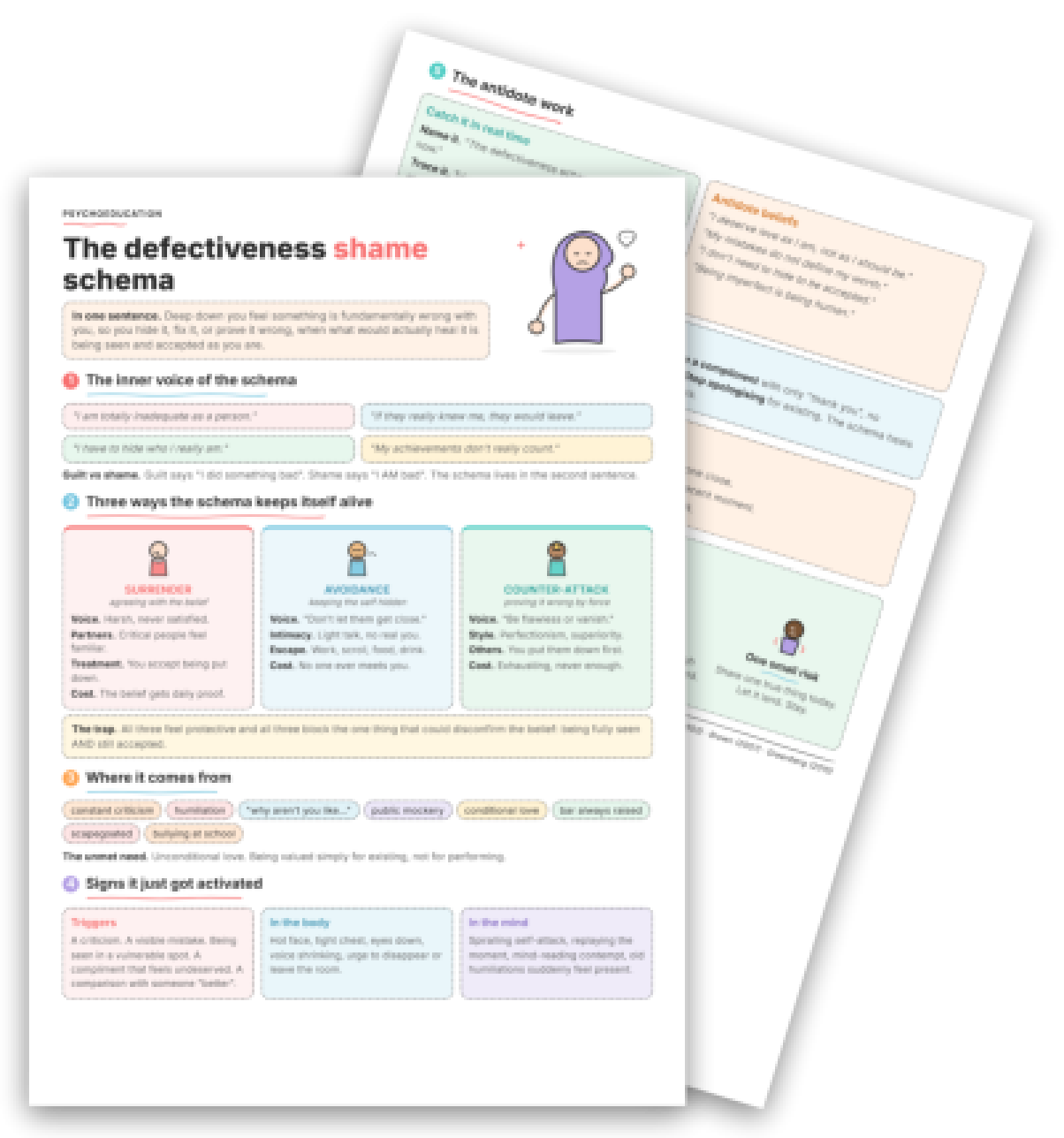
What the Fiche Contains: A Visual Map of the Schema
The fiche is structured across five panels, each readable in under a minute and usable as a shared reference point while you talk.
- Panel 1, The inner voice: four schema-typical self-statements (including "My achievements don't really count") alongside the guilt-vs-shame distinction, giving you a precise conceptual split without having to build it from scratch each session.
- Panel 2, Three maintenance modes: a side-by-side column layout of surrender, avoidance, and counter-attack, each with its internal voice, relational pattern, and cost. The layout makes immediately visible what normally takes several sessions to convey: "all three block the one thing that could disconfirm the belief: being fully seen AND still accepted." Showing this as a visual grid prevents patients from reading their perfectionism or superiority as health.
- Panel 3, Origins: a list of early experiences (chronic criticism, humiliation, conditional love, scapegoating, bullying) anchored to the unmet need: unconditional regard. This gives both of you shared language for the core belief formation work and connects naturally to tracing schema origins.
- Panel 4, Activation signs: somatic markers (hot face, tight chest, urge to disappear) alongside cognitive and interpersonal triggers. Useful for building the in-session somatic vocabulary needed before experiential schema work begins.
- Panel 5, Antidote work: four alternative beliefs and a set of behavioural disconfirmation experiments, including "Receive a compliment with only 'thank you', no deflection", the kind of graded step that pairs naturally with self-compassion exercises around mistakes as between-session homework.
A dedicated "To discuss in session" prompt block closes the fiche, cueing three specific disclosures for the debrief. It functions as a structured re-entry point at the next appointment without requiring the patient to remember the full psychoeducation.
> Key takeaway: the fiche is a visual support that facilitates the explanation of the defectiveness/shame schema during the session. It externalises the maintenance loop, builds a shared vocabulary, and leaves the patient with a concrete reference between appointments rather than a worksheet to complete alone.
750+ clinical tools
A library built with and for clinicians, ready to use in session and extend between appointments.
Access all the toolsWhen and How to Introduce the Fiche
This tool fits best in mid-treatment, once the therapeutic alliance is solid enough to name shame directly. It is well-timed when you have already established the schema map conceptually (for example, through the coping styles in schema therapy fiche) and are moving toward mode-level work. Patients where perfectionism or feeling not good enough dominates the presentation are frequent candidates.
Introduce it without labelling the patient: "There's a pattern I'd like to show you that connects some of what you've been describing. Have a look and tell me what feels familiar, if anything." Let the patient guide the reading. Silence at the inner-voice panel is clinically informative. For debrief, focus first on which coping mode resonates, then on the cost column. Avoid rushing to the antidote beliefs: with this schema, the pain of the maintenance cycle needs to land before alternative beliefs feel credible rather than hollow.
One clinical limit worth holding: in acute decompensation, or early in the relationship where shame is strongly defended, the origins panel can feel persecutory. Reserve it for when stabilisation permits it. Pair the fiche with the Shame in Therapy exercise and, when ready, the Shame Psychoeducation program for a sustained between-session curriculum. Consider the self-image program as a longer-arc complement once the schema has been named and partially accepted.
The fiche opens the door; it does not replace the experiential and relational work that ultimately disconfirms the belief.
Use it with your patients
Share this tool in the mobile app and follow the work between sessions.
Sources
- Young, J. E., Klosko, J. S., Weishaar, M. E. (2003). Schema Therapy: A Practitioner's Guide. Guilford Press.
- Young, J. E., Klosko, J. S. (1994). Reinventing Your Life: The Breakthrough Program to End Negative Behavior and Feel Great Again. Plume.
- Schmidt, N. B., Joiner, T. E., Young, J. E., Telch, M. J. (1995). The Schema Questionnaire: Investigation of Psychometric Properties and the Hierarchical Structure of a Measure of Maladaptive Schemas. Cognitive Therapy and Research.
- McKay, M., Greenberg, M. J., Fanning, P. (2020). The ACT Workbook for Depression and Shame: Overcome Thoughts of Defectiveness and Increase Well-Being Using Acceptance and Commitment Therapy. New Harbinger Publications.
Your session continues in your patients' pocket
Use with a patientYour resources, available everywhere
The handouts, exercises, programs and audios above: you choose which ones to make available to your patients, in the mobile app dedicated to them.
And far more than a library
The app goes well beyond resources, to support your patients every day:
Related categories
Explore other clinical resources by category.

Mood
Evidence-based worksheets and clinical tools for mood disorders: CBT, ACT, and positive psychology resources for psychologists and therapists.

Identity
Clinical resources for self-identity work in therapy: CBT, ACT, schema tools for clinicians addressing self-concept, core beliefs, and identity disruption.

Understand
Clinical hub for the therapeutic aim 'Understand': worksheets and tools to build patient insight across CBT, ACT, schema therapy and more.

Build awareness
Clinical worksheets and tools to build awareness in therapy: cognitive distortions, schemas, emotions, ACT and CBT resources for practitioners.

Repair & soothe
Clinical resources for the repair and soothe therapeutic aim: worksheets, exercises and tools to build self-compassion, reduce shame and restore emotional safety.
CBT
CBT worksheets, cognitive restructuring exercises & behavioral tools for clinicians. Evidence-based resources for every phase of cognitive behavioral therapy.