
Clinical picture. A., a man in his late thirties, presented with recurrent major depression and an alcohol use disorder in partial remission. He disclosed that six months prior he had driven his adolescent son to a sporting event while over the legal alcohol limit; no accident occurred, but his son had since been cool and distant. In session, A. described rehearsing the incident nightly and characterised himself as "irredeemable," a framing consistent with the condemnation pole described in the psychoeducation sheet. The clinician introduced the three-response framework, naming the difference between holding the act as serious and fusing it with global self-worth; A. was asked to read the sheet between sessions and note which internal voice arrived first each morning. By the third week he had initiated a direct conversation with his son and reported a modest but stable reduction in ruminative self-attack, without minimising the original harm.
Self-Forgiveness: PDF Worksheet, Tools and Exercises for Clinicians
A structured PDF worksheet, clinical tools, and practical exercises to help patients move from self-condemnation to genuine moral repair in therapy.
Clinical vignettes
Condemnation Loop After a Relapse
Excusing Pattern Blocking Repair
Clinical picture. M., a woman in her mid-forties referred for generalised anxiety, revealed during a mid-treatment session that she had disclosed a colleague's confidential health information to a shared manager, rationalising it as concern for workplace safety. She had since reframed the event as a misunderstanding, yet reported persistent low-grade guilt and social avoidance at work. The clinician named the excusing pattern using the sheet's language, noting that rapid relief through minimisation had left the relational harm unaddressed. M. was invited to sit with the discomfort of full accountability before moving to repair, a sequence the sheet frames as the necessary order of real self-forgiveness. Over the following two sessions she drafted a private acknowledgement letter, which she chose not to send but described as helping her "stop arguing with what happened."
Self-forgiveness sounds intuitive until you try to explain it to a patient who has been rehearsing the same moral verdict about themselves for years. The gap between "I know I should move on" and actually doing the work is wide, and oral explanation alone rarely closes it. This PDF worksheet gives you a structured visual support to anchor the concept during the session, establish a shared vocabulary, and hand the patient a concrete reference to hold onto between appointments.
Use this resource with your patients
Handout, exercises and materials ready to use, right inside SessionFuel.
Why Self-Forgiveness Resists Oral Explanation
Most patients arrive with one of two positions already consolidated. They are either locked in self-condemnation (the guilt spiral that feels like penance) or engaged in minimisation and excusing (the cognitive manoeuvre that drops shame at the cost of accountability). Neither position looks like avoidance to the patient living inside it. Explaining the distinction verbally tends to produce nodding without real discrimination.
Patients also consistently conflate self-forgiveness with self-compassion, or assume it means forgetting, or treat it as a shortcut past genuine repair. The forgiveness literature (Worthington, 2013; Cornish, 2014) is clear that genuine self-forgiveness is an episodic, accountability-laden process, distinct from the ongoing attitudinal stance that characterises self-compassion work. That distinction collapses easily under oral explanation. The Forgiveness in Therapy worksheet addresses forgiving others; this fiche handles the specific challenge of moral repair directed inward.
The punitiveness trap adds another layer. Patients who use self-punishment as a proxy for taking things seriously are not simply self-critical; they are caught in a logic where condemnation substitutes for change. The Punitiveness Schema handout maps the long-term cost of that stance; the self-forgiveness fiche gives you the functional alternative to place beside it.
What the Fiche Contains: A Visual Support for Moral Repair
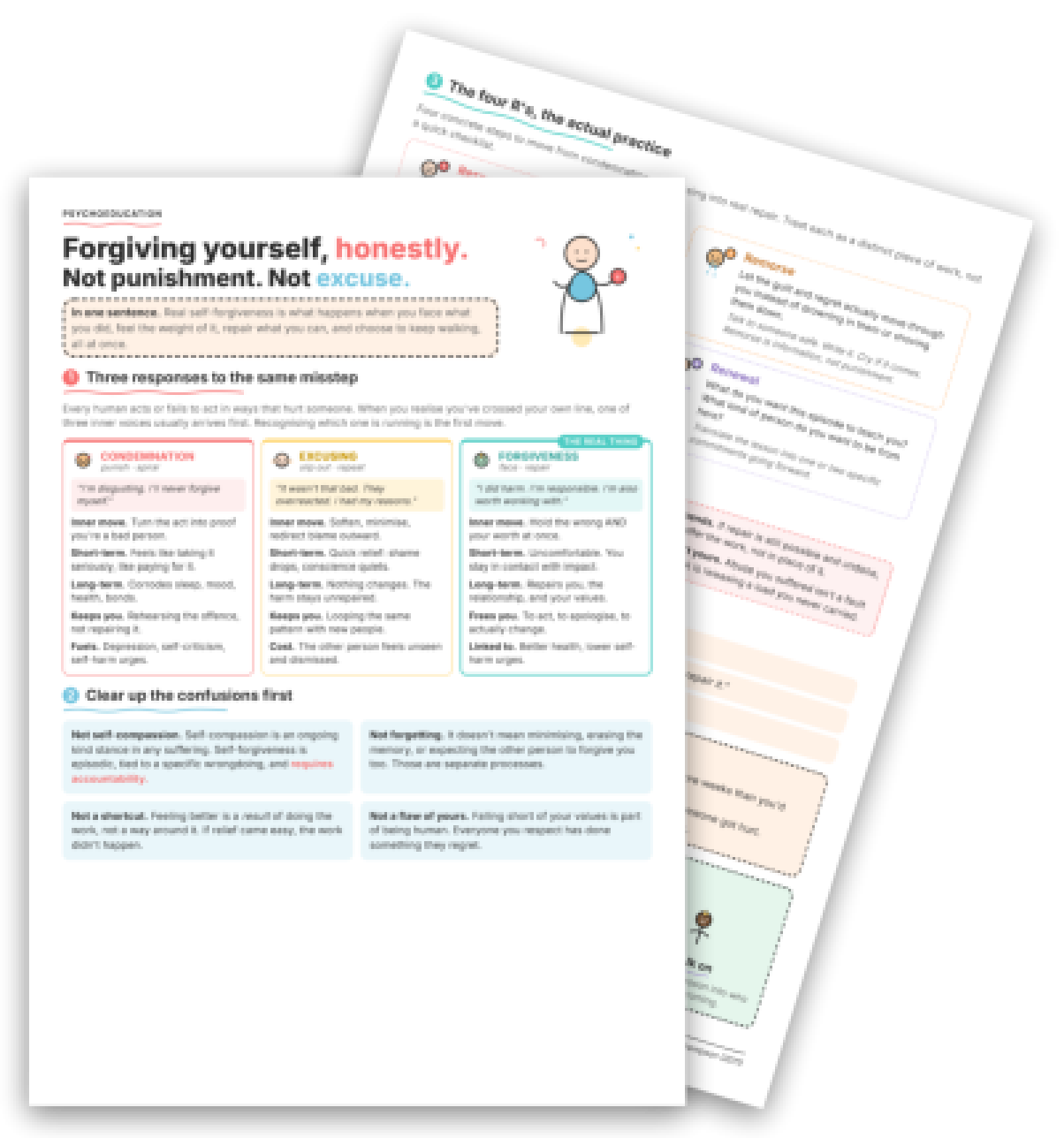
The fiche opens with a definitional anchor that doubles as a session touchstone: "Real self-forgiveness is what happens when you face what you did, feel the weight of it, repair what you can, and choose to keep walking, all at once." Having that sentence on paper prevents the patient from drifting into either adjacent distortion mid-session.
The structural centrepiece is a three-column panel contrasting Condemnation, Excusing, and Forgiveness in parallel rows: the inner move involved, the short-term effect, the long-term cost, and the behavioural consequence for each. Shown visually, the parallel layout makes the distinctions land in a way that description alone does not. Patients can see, on the same page, that condemnation "keeps you rehearsing the offence, not repairing it" while excusing "loops the same pattern with new people." The Defectiveness/Shame Schema worksheet and the Self-Blame handout map adjacent territory; this fiche positions self-forgiveness as the functional third option between them.
A second section clears four clinical confusions: self-forgiveness versus self-compassion, versus forgetting, versus shortcut, versus personal flaw. Patients who have done work with the Practicing Self-Compassion handout often need this disambiguation explicitly.
The operational core is the Four R's: Responsibility, Remorse, Restoration, Renewal. Each step includes concrete behavioural guidance. "Remorse is information, not punishment" is precisely the reframe patients can use when the guilt loop activates at 2 a.m. The Guilt and Responsibility exercise pairs naturally with the Remorse step as between-session homework.
A fourth section, framed with a clear warning header, lists when self-forgiveness is not the move: before responsibility has been faced, in place of amends, during ongoing harm, and for abuse the patient never actually caused. This section is clinically essential for patients who have a history of bypassing guilt as a signal; the Guilt Psychoeducation program offers the fuller curriculum if that pattern runs deep.
> Key takeaway: The fiche is a visual support that facilitates the explanation of self-forgiveness in session. It is not a questionnaire to complete alone; it is a structured reference the clinician uses with the patient to show the three-position distinction and the Four R's in one shared view, then leaves as a concrete anchor for between-session use.
750+ clinical tools
A library built with and for clinicians, ready to use in session and extend between appointments.
Access all the toolsWhen and How to Introduce the Fiche
The natural entry point is after an initial anamnèse has surfaced chronic self-critical rumination, unresolved moral shame, or a specific transgression driving avoidance. It fits well in TCC, schema therapy (particularly alongside work on the shame-defectiveness schema), ACT (where values clarification sharpens the Renewal step), and any integrative approach where guilt or interpersonal rupture is a driver.
A low-threshold introduction: "I want to show you something that maps the different ways people typically respond when they've crossed their own line. Let's look at it together." This avoids labelling the patient as someone who needs to forgive themselves, which can activate shame defences before the alliance is solid enough to hold them.
Debrief by asking which column they recognise themselves in first. That self-identification generates more clinical material than any directed question. The How to Apologize handout and the How to Forgive worksheet offer concrete next-step supports once the patient has located themselves on the map. For patients with deep ruminative loops, pairing the fiche with the Constructive vs Harmful Rumination worksheet helps distinguish productive guilt from the corrosive rehearsal cycle.
One contraindication worth naming explicitly: patients whose self-blame is a post-traumatic survival adaptation may need stabilisation work before this material is safe. The fiche itself signals this: "Abuse you suffered isn't a fault to forgive." The Accepting Mistakes self-compassion exercise offers a gentler on-ramp for those profiles.
The fiche does not replace the formulation or the therapeutic relationship. It shortens the time needed to establish a shared language for moral repair, and gives the patient something to return to when the rehearsal loop starts again.
Use it with your patients
Share this tool in the mobile app and follow the work between sessions.
Sources
- Hall, J. H., & Fincham, F. D. (2008). The Temporal Course of Self-Forgiveness. Journal of Social and Clinical Psychology.
- Worthington, E. L. (2013). Moving Forward: Six Steps to Forgiving Yourself and Breaking Free from the Past. WaterBrook Press.
Your session continues in your patients' pocket
Use with a patientYour resources, available everywhere
The handouts, exercises, programs and audios above: you choose which ones to make available to your patients, in the mobile app dedicated to them.
And far more than a library
The app goes well beyond resources, to support your patients every day:
Related categories
Explore other clinical resources by category.

Trauma
Clinical hub on trauma and PTSD: assessment, differential diagnosis, treatment phases, and printable resources for practitioners. 155 chars.

Mood
Evidence-based worksheets and clinical tools for mood disorders: CBT, ACT, and positive psychology resources for psychologists and therapists.

Identity
Clinical resources for self-identity work in therapy: CBT, ACT, schema tools for clinicians addressing self-concept, core beliefs, and identity disruption.

Understand
Clinical hub for the therapeutic aim 'Understand': worksheets and tools to build patient insight across CBT, ACT, schema therapy and more.

Repair & soothe
Clinical resources for the repair and soothe therapeutic aim: worksheets, exercises and tools to build self-compassion, reduce shame and restore emotional safety.

ACT
Clinical hub for Acceptance and Commitment Therapy (ACT): worksheets, exercises, programs and audio resources for practitioners using the ACT model.