
Clinical picture. A and his partner presented for couples therapy following a conflict in which A had raised his voice and later attempted to apologize by saying, "I'm sorry, but I was exhausted and you kept pushing." The therapist introduced the three-step framework as a shared psychoeducational reference, drawing attention to how the conjunction shifted the focus from A's behavior onto his partner's role. In the following session, A reported having reflected on what his tone had communicated before speaking, named the specific behavior without qualification, and proposed a concrete behavioral plan: leaving the room for ten minutes when he noticed his voice beginning to rise. His partner acknowledged the apology felt different, though she was not yet ready to move past the incident. The therapist noted the outcome as clinically meaningful without framing it as a repair.
How to Apologize: PDF Worksheet, Tools and Exercises for Clinical Practice
A structured PDF worksheet, clinical tools, and exercises to help patients grasp what genuine apology requires, and stop confusing it with the non-apology patterns that quietly damage relationships.
Clinical vignettes
Removing the 'But' in Couples Work
Apology Anxiety in Individual Therapy
Clinical picture. M, a woman in her early forties seen for generalized anxiety, described a pattern of chronic over-apologizing alongside a recent inability to apologize to a close friend after a genuine rupture. The therapist used the informational sheet to help her distinguish between appeasement behavior and a functional apology, noting that the worksheet explicitly flags over-apologizing as a separate clinical pattern. M used the reflection step to identify that she had disclosed private information the friend had shared in confidence, and she was able to name this plainly in a written draft she brought to the next session. She acknowledged uncertainty about whether her friend would respond, and the therapist reinforced that receiving forgiveness was outside her control and not the measure of whether the apology was adequate.
Patients often arrive reporting that they apologized and the conflict only deepened. The difficulty is rarely motivation: it is structure. Most people have never been taught what a genuine apology actually requires, and without a clear framework the intention collapses into the very patterns it was meant to repair. This fiche PDF gives you a visual support to walk through the skill in session, transforming a vague moral prescription into a concrete, learnable three-step sequence.
Use this resource with your patients
Handout, exercises and materials ready to use, right inside SessionFuel.
Why Apology Is Harder to Teach Than It Looks
Explaining the difference between a real apology and a non-apology verbally is deceptively difficult. Patients nod, agree that "I'm sorry you feel that way" is not an apology, and then produce exactly that phrase in the next relational rupture. The oral explanation registers as a rule; it does not dismantle the automaticity.
Two mechanisms sustain this. First, shame and defensive activation interrupt the reflective stance required at the very first step. The patient under-estimates how fast a single "but" reasserts self-protection and dismantles accountability. Second, myth-based beliefs about apology operate below conscious awareness. Research in the social psychology of accountability (Schumann, 2018; Lewicki et al., 2016) consistently shows that people conflate apologizing with weakness, believe the verbal act is self-sufficient, or assume forgiveness is a logical consequence. Without a shared visual reference, these myths are invisible in session and hard to name without triggering defensiveness. A support like this fiche externalizes the framework, which makes it easier to examine without it feeling like a personal accusation.
This matters especially in couple conflict work, where asymmetric apology patterns often maintain the rupture cycle the Gottman model calls the Four Horsemen. The fair fighting rules conversation frequently stalls precisely because neither party knows what repair actually looks like at the level of language and behavior.
What the Fiche Contains, and Why the Visual Format Does the Work
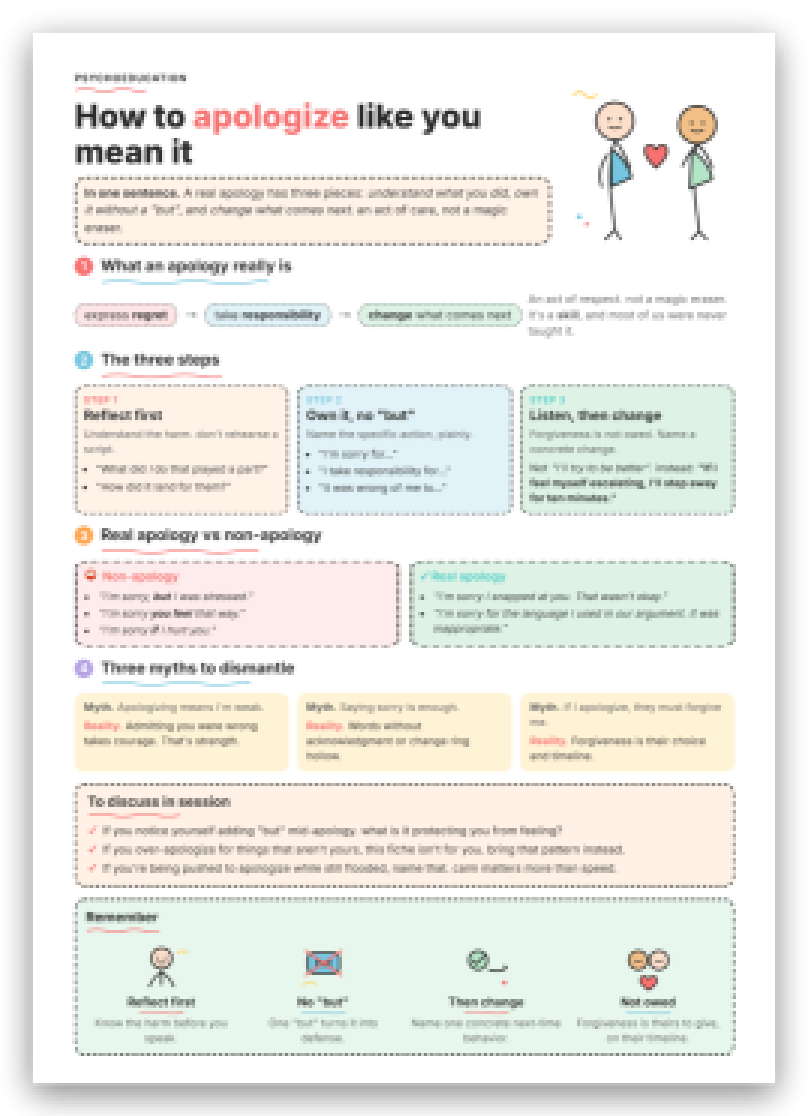
The support is organized around four numbered sections that build sequentially.
Section 1 opens with a plain conceptual anchor: "An act of respect. Not a magic eraser." This framing immediately counters the transactional belief that an apology obligates forgiveness, a point the fiche revisits explicitly in Section 4.
Section 2 is the clinical core: the three-step sequence, each step carrying its own focused prompts.
- Step 1: Reflect first. Two questions guide the patient before they speak: "What did I do that played a part?" and "How did it land for them?" This separates reflection from script-rehearsal, which is the distinction patients most often skip.
- Step 2: Own it, no "but". The fiche provides three concrete sentence starters ("I'm sorry for...", "I take responsibility for...", "It was wrong of me to...") and makes the injunction against hedging explicit. The visual placement of "no 'but'" as a structural label makes the mechanism impossible to miss.
- Step 3: Listen, then change. Forgiveness is positioned as the other person's right and timeline. The fiche contrasts the hollow vow ("I'll try to be better") with a behaviorally specific alternative: "If I feel myself escalating, I'll step away for ten minutes." This maps directly onto the committed action work many patients are already doing elsewhere in treatment.
Section 3 presents a side-by-side comparison of non-apologies and real apologies, grounded in specific examples. Seeing "I'm sorry if I hurt you" next to "I'm sorry I snapped at you. That wasn't okay" on a single page clarifies the distinction far more efficiently than a spoken explanation. This is where the visual format does work that discourse cannot: the contrast is scannable, revisitable, and undeniable.
Section 4 names the three myths directly, paired with one-sentence clinical reframes. This part travels well as a between-session reference.
The fiche closes with a "To discuss in session" block that flags three specific clinical signals: the patient who automatically inserts "but", the patient who over-apologizes for things that are not theirs, and the patient being pushed to apologize while still physiologically flooded. These prompts align naturally with anger regulation work and with the active listening skills often needed before Step 3 becomes possible.
> À retenir: this fiche is a visual support that facilitates the explanation of genuine apology directly in session; it gives the patient a concrete, revisable reference rather than a rule to remember, and it externalizes the framework so myths and defensive patterns become easier to examine together.
750+ clinical tools
A library built with and for clinicians, ready to use in session and extend between appointments.
Access all the toolsWhen and How to Introduce It
The fiche fits best in the middle phase of work, once the therapeutic alliance is solid enough to examine relational behavior without triggering a shame spiral. It is particularly useful when:
- A patient repeatedly reports post-conflict "I already apologized" while the relational rupture persists
- Couple or co-parenting sessions are stalled on the repair step
- The formulation includes beliefs that damage relationships, particularly around vulnerability and admitting fault
To introduce it without labeling, you might say: "I'd like to show you a framework I use with a lot of people. It's not about whether you're a good or bad partner, it's about a skill most of us were never explicitly taught." This sidesteps moralization and opens the psychoeducation.
Debrief by going through the three-step sequence together, inviting the patient to apply it to one recent rupture. The interpersonal conflict resolution exercise and the I-messages worksheet pair well as between-session follow-up once the structure is clear.
One contraindication worth naming: if the patient is still somatically flooded about the incident in question, the reflection required at Step 1 is not yet available. The fiche itself flags this. In those cases, a grounding or emotion regulation tool belongs in session first.
The fiche does not replace the relational repair work; it makes the structure of that repair legible, which is the precondition for everything else.
Use it with your patients
Share this tool in the mobile app and follow the work between sessions.
Sources
- Lazare, A. (2004). On Apology. Oxford University Press.
Your session continues in your patients' pocket
Use with a patientYour resources, available everywhere
The handouts, exercises, programs and audios above: you choose which ones to make available to your patients, in the mobile app dedicated to them.
And far more than a library
The app goes well beyond resources, to support your patients every day:
Related categories
Explore other clinical resources by category.

Identity
Clinical resources for self-identity work in therapy: CBT, ACT, schema tools for clinicians addressing self-concept, core beliefs, and identity disruption.

Relationships
Clinical worksheets and tools on relational functioning: attachment, schemas, assertiveness, and communication skills for therapists. Printable PDF resources.

Understand
Clinical hub for the therapeutic aim 'Understand': worksheets and tools to build patient insight across CBT, ACT, schema therapy and more.

Build skills
Skill-building resources for clinicians: printable worksheets and exercises for coping, assertiveness, and communication skills training in therapy.

Repair & soothe
Clinical resources for the repair and soothe therapeutic aim: worksheets, exercises and tools to build self-compassion, reduce shame and restore emotional safety.
CBT
CBT worksheets, cognitive restructuring exercises & behavioral tools for clinicians. Evidence-based resources for every phase of cognitive behavioral therapy.