
Clinical picture. A., a woman in her mid-thirties, presented with persistent low mood and escalating arguments with her long-term partner, which she described as "always about small things." Her therapist introduced the psychoeducation program on conflict in romantic relationships, starting with Lesson 1 on the origins of conflict. Working through the unit on unexpressed expectations between sessions, A. completed the guided reflection prompt and identified several assumptions she had never articulated to her partner, including around shared finances and household roles. At the next session she reported that naming these expectations, even privately on paper, had reduced her sense of grievance enough to initiate one calm conversation with her partner. No marked relational change was observed at this stage, though A. expressed willingness to continue to Lesson 2.
Conflict in Romantic Relationships: A Psychoeducation Program
A structured 4-lesson program helping patients map conflict origins, escalation phases, cognitive biases, and concrete de-escalation strategies in their relationship.
Clinical vignettes
Unstated Expectations Driving Recurrent Arguments
Early Upbringing Linked to Conflict Avoidance
Clinical picture. M., a man in his late forties, sought therapy following a separation and described a lifelong pattern of withdrawing from disagreement, which his former partner had experienced as emotional unavailability. The therapist assigned the opening lesson of the conflicts psychoeducation program, which addresses the role of upbringing and prior relationships in shaping conflict behaviour. M. completed the reflection prompt on which early relationships had been most influential and brought his written responses to the following session, noting for the first time an explicit link between his parents' volatile arguments and his own habitual silence. The lesson did not resolve the pattern, but it provided a shared conceptual language that the therapist and M. used to structure subsequent work on communication and de-escalation in Lesson 2.

Use this resource with your patients
Handout, exercises and materials ready to use, right inside SessionFuel.
Why conflict is clinically harder to address than it looks
Every couple argues. Yet conflict in romantic relationships remains one of the most demanding topics to work with clinically, not because patients lack motivation, but because the mechanisms are genuinely counterintuitive. Patients rarely see their own role in escalation. They experience the other person as the problem, and their own reactions as justified responses. Explaining the actor-observer bias or the difference between assertiveness and aggression verbally, in a single appointment, rarely sticks.
There is also the timing problem. By the time a patient sits with you, the fight is over. The emotional charge has cooled, the sequence is blurry, and the lesson cannot land on lived experience. What clinicians need is a way to send structured reflection into the gap, into the days between sessions, when patterns are actually playing out. That is exactly what this program is built for.
The Interpersonal Conflict Resolution: A Guided Clinical Exercise can complement individual conflict work, and the Relationship Conflict Resolution: PDF Worksheet, Tools and Exercises gives you a visual anchor for in-office psychoeducation. This program operates at a different level: it builds understanding progressively, lesson by lesson.

What the program contains
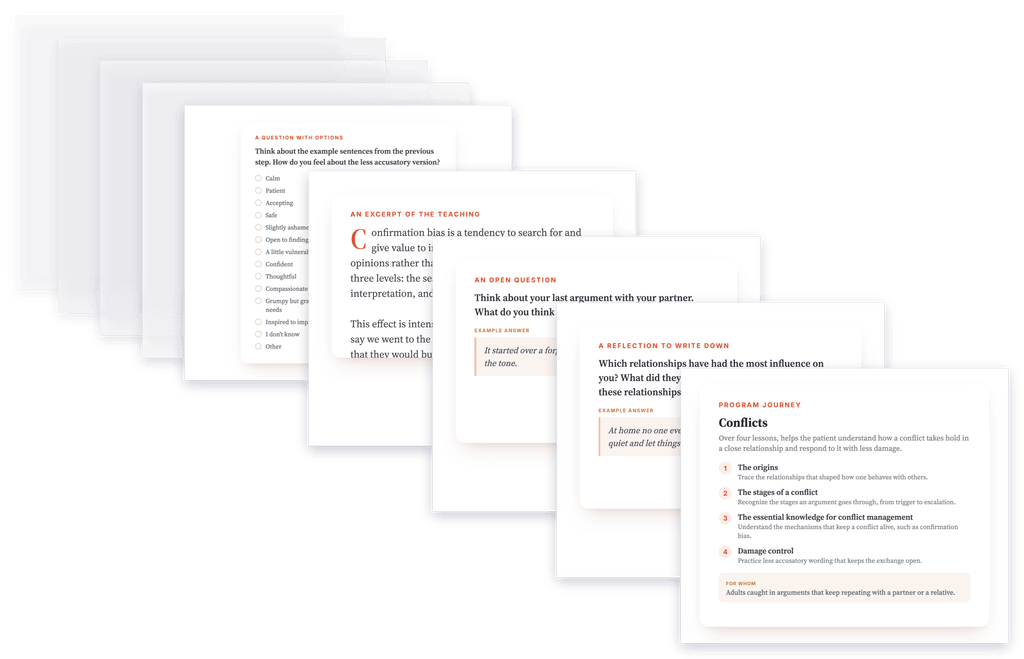
This four-lesson program walks patients through the full arc of relational conflict, from its roots to practical repair strategies. Each lesson combines psychoeducation text with guided written prompts and multiple-choice reflection questions, making abstract concepts personally anchored.
Lesson 1, Origins examines the upstream causes: family history and earlier relationships, unexpressed expectations, and communication breakdowns. Patients are asked to reflect on which relationships shaped them most, what relational expectations they have never articulated to their partner, and what they did during the biggest misunderstanding in their current relationship.
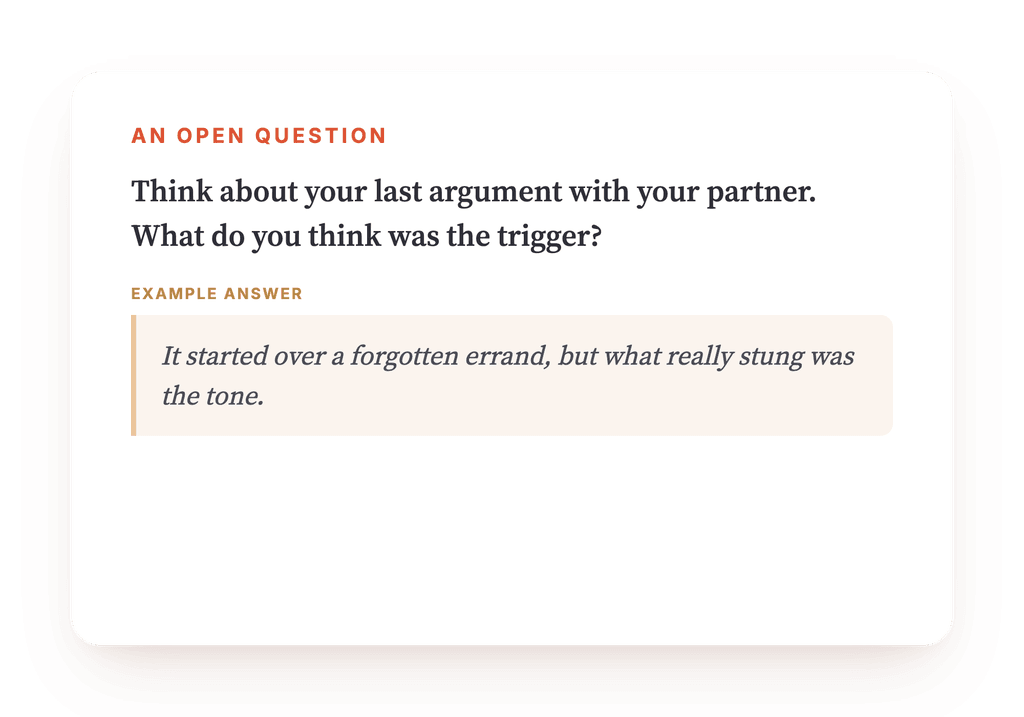
Lesson 2, Phases of conflict maps the typical arc: the trigger, escalation dynamics, emotional blackmail, and reconciliation. A key prompt invites patients to identify what started their last argument and to examine whether they use guilt to gain the upper hand. The lesson closes by naming the crucial insight that every escalation has a moment where a different choice is possible.
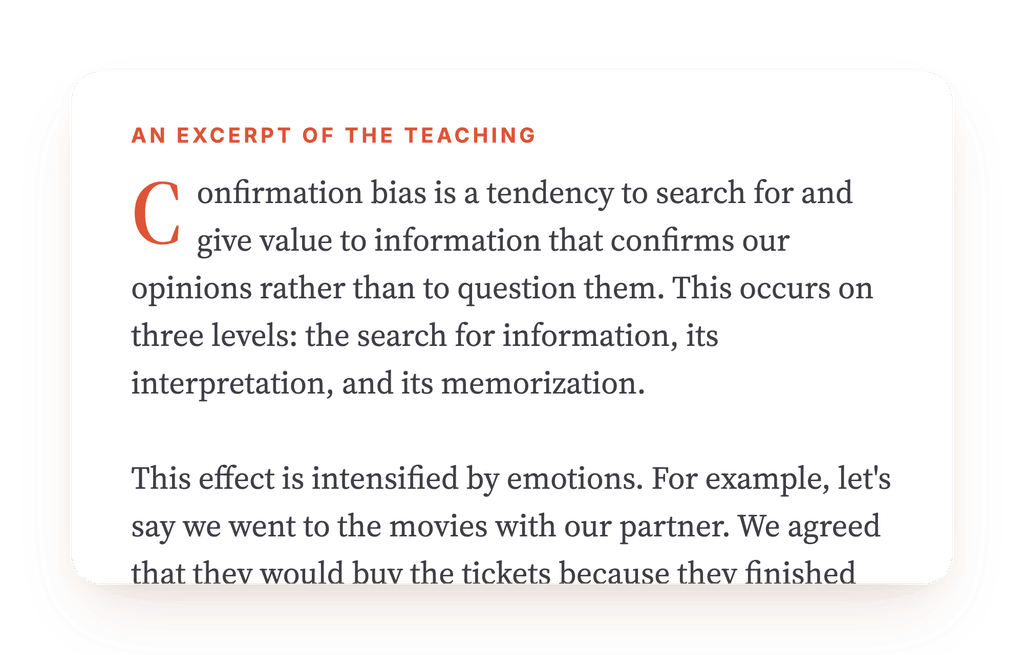
Lesson 3, Essential knowledge is the most cognitively dense. It covers confirmation bias, the actor-observer attribution asymmetry, the necessity of accepting ambivalence in love, and the clinical distinction between assertive and aggressive communication. Prompts push patients to notice when they and their partner hold two irreconcilable versions of the same event. This pairs naturally with the The Four Horsemen & Their Antidotes: PDF Worksheet, Tools and Exercises and with the Assertive Communication: PDF Worksheet, Tools and Exercises for deepening the assertiveness thread.
Lesson 4, Damage limitation teaches four practical strategies: reframing accusatory language ("you always" → "I feel"), tackling one issue at a time rather than opening every unresolved wound, giving non-accusatory feedback, and recognising the illusion of universal moral or emotional measurement. A multiple-choice question after the reframing step asks patients to name the feeling the less accusatory version produces in them, a small but clinically rich data point.
This program is available to your patients through the mobile application that is the dedicated patient-side interface of SessionFuel: you assign the program directly from your SessionFuel account, and your patient works through each lesson on their own phone, between your appointments.
The preview images embedded here, an overview map and a few sample cards, show only a small fraction of the program. The complete curriculum is far richer, with many more lessons, steps, guided prompts, and multiple-choice questions than what these aperçus reveal.
750+ clinical tools
A library built with and for clinicians, ready to use in session and extend between appointments.
Access all the toolsIntegrating this program into your practice
Which patients benefit most. This program suits individuals or partners who are motivated but cognitively stuck, those who intellectually want to fight differently but keep reproducing the same patterns. It is particularly useful for patients with strong confirmation bias (who consistently present as the injured party), those prone to escalation they cannot explain, and anyone working on moving from passive-aggressive or aggressive communication toward genuine assertiveness. See Communication Styles: PDF Worksheet, Tools and Exercises for Clinical Practice and Passive-Aggressive Communication: PDF Worksheet, Tools and Exercises as companion psychoeducation supports.
How to introduce it. A simple framing works best: "Between now and our next appointment, I'd like you to work through a program on conflict, not to analyse your partner, but to understand your own part in what happens." Assigning it after a session where a recent conflict has been discussed gives patients immediate material to map onto the lessons. The Fair Fighting Rules: PDF Worksheet, Tools and Exercises for Clinical Practice and the Ten Principles for Healthy Conflict: PDF Worksheet, Tools and Exercises can serve as visual anchors you discuss at the same appointment, before the patient begins the independent work.
What to do with what the patient brings back. The program generates rich clinical material. The written responses to prompts, especially the expectations exercise in Lesson 1 and the emotional blackmail reflection in Lesson 2, often surface attachment patterns and schema-level beliefs that are worth pursuing. Ask the patient to share their answers to the one-topic-at-a-time prompt (what issues they want to address with their partner): it becomes a live agenda for relational work. The multiple-choice response about reframing is a quick entry point into emotional reactivity. For patients where the bias lessons land deeply, you can follow up with the Behavior, Emotion, Underlying Need: PDF Worksheet, Tools and Exercises or Nonviolent Communication (NVC): PDF Fiche, Tools and Exercises to extend the work toward need identification and clean expression.
Use it with your patients
Share this tool in the mobile app and follow the work between sessions.
Articulating this program with your broader relational toolkit
This program fits naturally within a relational psychoeducation sequence. It pairs well upstream with the Healthy Relationships: A 4-Lesson Psychoeducation Program and downstream with the Communication Skills in Couples: A Psychoeducation Program or the Compromise in Relationships: A Psychoeducation Program. For patients whose conflict is entangled with attachment insecurity, the Secure Attachment: PDF Worksheet, Tools and Exercises for Clinical Practice and the EFT Infinity Loop: PDF Worksheet, Tools and Exercises for Couples Therapy extend the clinical conversation meaningfully. The How to Apologize: PDF Worksheet, Tools and Exercises for Clinical Practice addresses the reconciliation phase that Lesson 2 introduces but does not fully develop.
To remember: The program's clinical value is not that it teaches conflict theory, it is that it turns the patient into an observer of their own role, between sessions, with structured prompts that make that observation impossible to avoid.
Your session continues in your patients' pocket
Use with a patientYour resources, available everywhere
The handouts, exercises, programs and audios above: you choose which ones to make available to your patients, in the mobile app dedicated to them.
And far more than a library
The app goes well beyond resources, to support your patients every day:
Related categories
Explore other clinical resources by category.

Identity
Clinical resources for self-identity work in therapy: CBT, ACT, schema tools for clinicians addressing self-concept, core beliefs, and identity disruption.

Relationships
Clinical worksheets and tools on relational functioning: attachment, schemas, assertiveness, and communication skills for therapists. Printable PDF resources.

Understand
Clinical hub for the therapeutic aim 'Understand': worksheets and tools to build patient insight across CBT, ACT, schema therapy and more.

Build skills
Skill-building resources for clinicians: printable worksheets and exercises for coping, assertiveness, and communication skills training in therapy.
CBT
CBT worksheets, cognitive restructuring exercises & behavioral tools for clinicians. Evidence-based resources for every phase of cognitive behavioral therapy.

Systemic & narrative
Systemic family narrative therapy resources for clinicians: worksheets, psychoeducation programs, and exercises for couples, families, and groups.